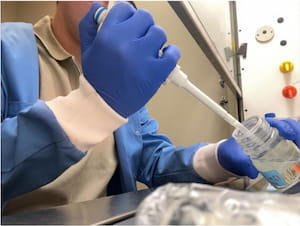
The past few weeks at the University of Colorado Anschutz VA Hospital have been full of ups and downs. Most of my time has been spent getting comfortable in the lab. I have run the same tests over and over, and since I have never worked in this field before, I have failed more than I have succeeded. In research, you are told to expect your hypothesis to be wrong so you do not force meaning into bad data. But the practice assays I have been doing are supposed to be near bulletproof because of Dr. Nate’s previous work. So after repeating the same test so many times, it was frustrating to still end up with failed runs.
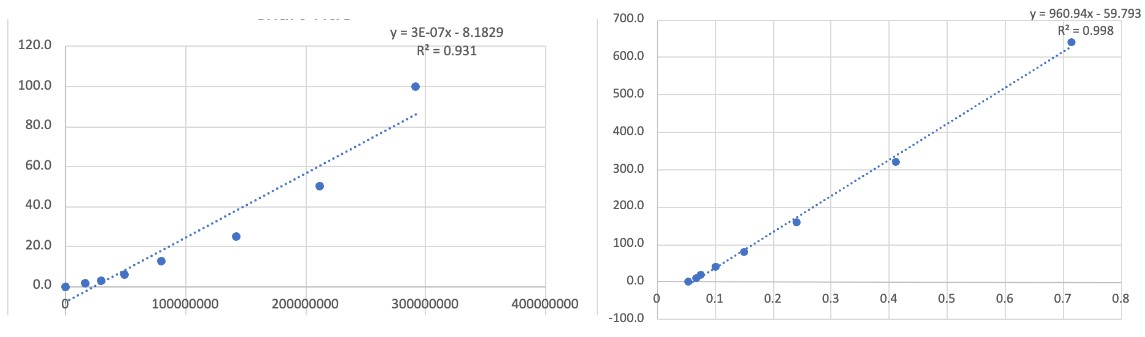
A good example is the standard curve I made early on. The first attempts (graph on left) were nowhere near the clean curve I needed (graph on right). After a string of failures, my motivation plateaued. It felt pointless to keep trying if the result was going to be the same. Eventually I realized something important: if I want to get better, failure is part of the process. I am in research because I want to help future drug therapy, and that can only happen if I push through the parts that do not work. Once I accepted that, the assay finally worked and I got the results I had been chasing.
My summer project is also in full swing now. I started it with a presentation to Nate, Amy, and the lab assistants. The goal was to give me real experience with proposing experiments. This year I am studying a phosphatase enzyme in Tuberculosis. I am researching which metal cofactor the enzyme uses inside the human body.
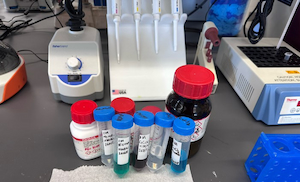
I hypothesized that cobalt would be the most optimal, but I am testing several metals, many of them forming bright and interesting colors when mixed into solutions. Whether I am right or wrong, the project will help fill a gap in what we know about the enzyme, which can support future drug development. I have already made a few mistakes along the way, like corroding a metal spoon while making an iron chloride solution. I even had to add a few microliters of concentrated hydrochloric acid under a hood to keep the metal dissolved.
Outside the lab, I have mostly been playing tennis. I have been on the court almost every day, joining leagues, and entering tournaments across the state. I’ve met lots of new people, but I have lost nearly every match. Just like in the lab, I am learning that improvement only comes from being willing to fail again and again. With one month left in my internship, I am excited for everything ahead.