
Week 5:
University of Iowa Department of Biochemistry
June 24, 2013
This week was markedly better than last week. I got my ligation of H33 and H34 to grow colonies and found in the isolation of the plasmids that constructs H33-11 and H34-3 looked clean and ready for linearization. These constructs were submitted for sequencing on Thursday and may be injected on Tuesday of week six if the sequencing shows no point mutations in my constructs and Sarah doesn’t need to inject three of her six prepared constructs. We’ll see what happens on Monday.
I also prepared some of the bigger tadpoles from constructs H30 and H28 for sectioning on Monday. This process involves many steps; the first being putting the tadpoles into a formaldehyde solution to prevent the proteins and cells from moving or decaying before we look at them. After removing the tadpoles from the solution, we then prepare them for freezing by shaking them in a sucrose solution. The sucrose will prevent water molecules from crystalizing in the cells which would cause the cell to burst and then we wouldn’t know what was part of one cell or another. We then change the solution to a mixture of the sucrose solution and an Optimal Cutting Temperature (O.C.T.) compound which allows the tissues to be frozen and then washed away after we use a Cryostat to cut sections of the tadpole roughly 7 micrometers thick. We’ll look at these sections and find our retinas which hopefully contain photoreceptors expressing our protein.
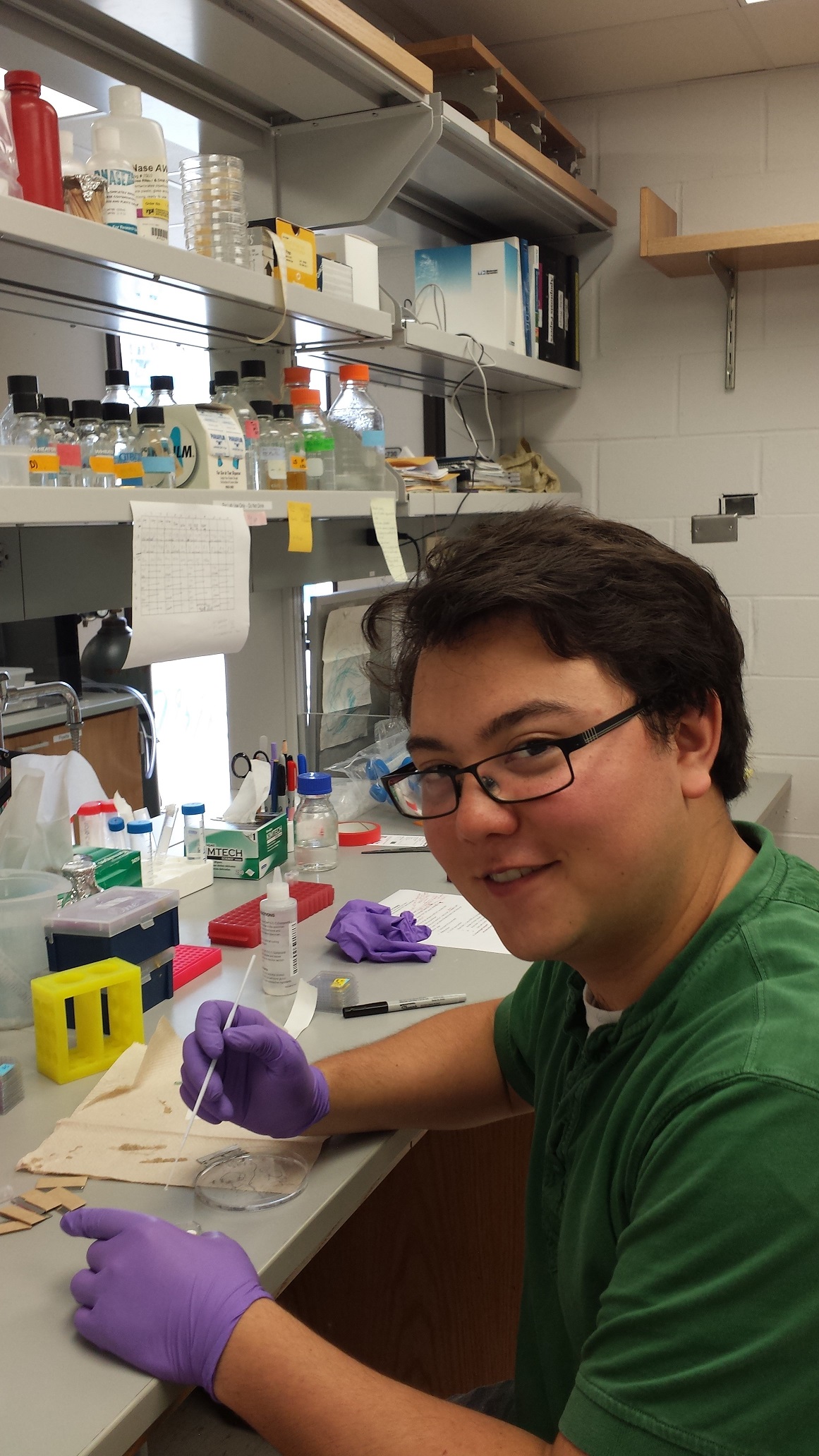
However, before we froze our tadpoles, we examined the eyes to check if the photoreceptors lost expression of the constructs. Some of them looked completely dark instead of the bright green florescence we were hoping for. Yuan suggested that after we section the dark eyed tadpoles, we should stain for GFP so we’ll be able to see if the GFP lost its florescence or if our construct simply lost expression in the eye. It sounds like that will be left for Thursday or Friday of next week.
Some exciting news (for me anyway) comes in the form of a new assignment. I’ll be looking N terminus of HCN1 of Xenopus tropicalis to see if there is a targeting signal contained within that section of HCN1. From my reading, other proteins do not seem to contain messaging signaling within this region, but because the signal recognition pathway is poorly understood, it seems very likely that the N terminus could very well contain some form of signaling that we haven’t observed yet. However, because Yuan hasn’t worked on the N terminus of HCN1, we don’t have a template plasmid to work with. This means that she needs to isolate the mRNA of X. tropicalis from brain and retina tissue to perform a Reverse Transcriptase-PCR to get the cDNA for all of the proteins expressed in these tissues. Once we have the cDNA, we’ll use touchdown and/or nested-PCR to attain the N terminus fragment we want to introduce to our vector. Touchdown-PCR involves starting at the highest temperature that will allow our selective primers to anneal to the cDNA and cycle at progressively lower temperatures to amplify the N terminus fragment where the nested-PCR involves two reactions where one set of primers are used in the first reaction which will produce a fragment we know will contain a little more than our desired N terminus, but then follow that reaction with primers which should contain exactly our N terminus fragment. I’m excited to see if this works.
Another huge boost to my week came from Dr. Baker and Yuan when they told me that I will be included as a middle author on the paper they are planning on publishing involving HCN1 trafficking in the photoreceptor. Not only does this look good on a resume for anything related to science, but it supports my idea that I’m aiding in the process Yuan has been working on for 3 years. I’m learning quite a bit and look forward to the second half of this experience.
Major: Biochemistry & Molecular Biology. Hometown:Erie, Colorado.
PreviousWeek 4: University of Iowa Department of Biochemistry
NextWeek 6: University of Iowa Department of Biochemistry