
Week 8:
University of Iowa Department of Biochemistry
July 16, 2013
With Thursday and Friday included this week, I was able to accomplish a much greater amount of work. Joe and I injected construct H28 for a second time because all of the tadpoles from the first injection lost their expression by the time we sectioned them and IHC didn’t reveal any GFP. For the purposes of creating a story from this project, this isn’t a very big setback. I also managed to finally linearize construct H33 with Not I so we’ll be injecting that in week 9. My first attempt at ligating my insert for H35 didn’t work. However, I have created a new H35 insert fragment which will hopefully work in my next ligation.
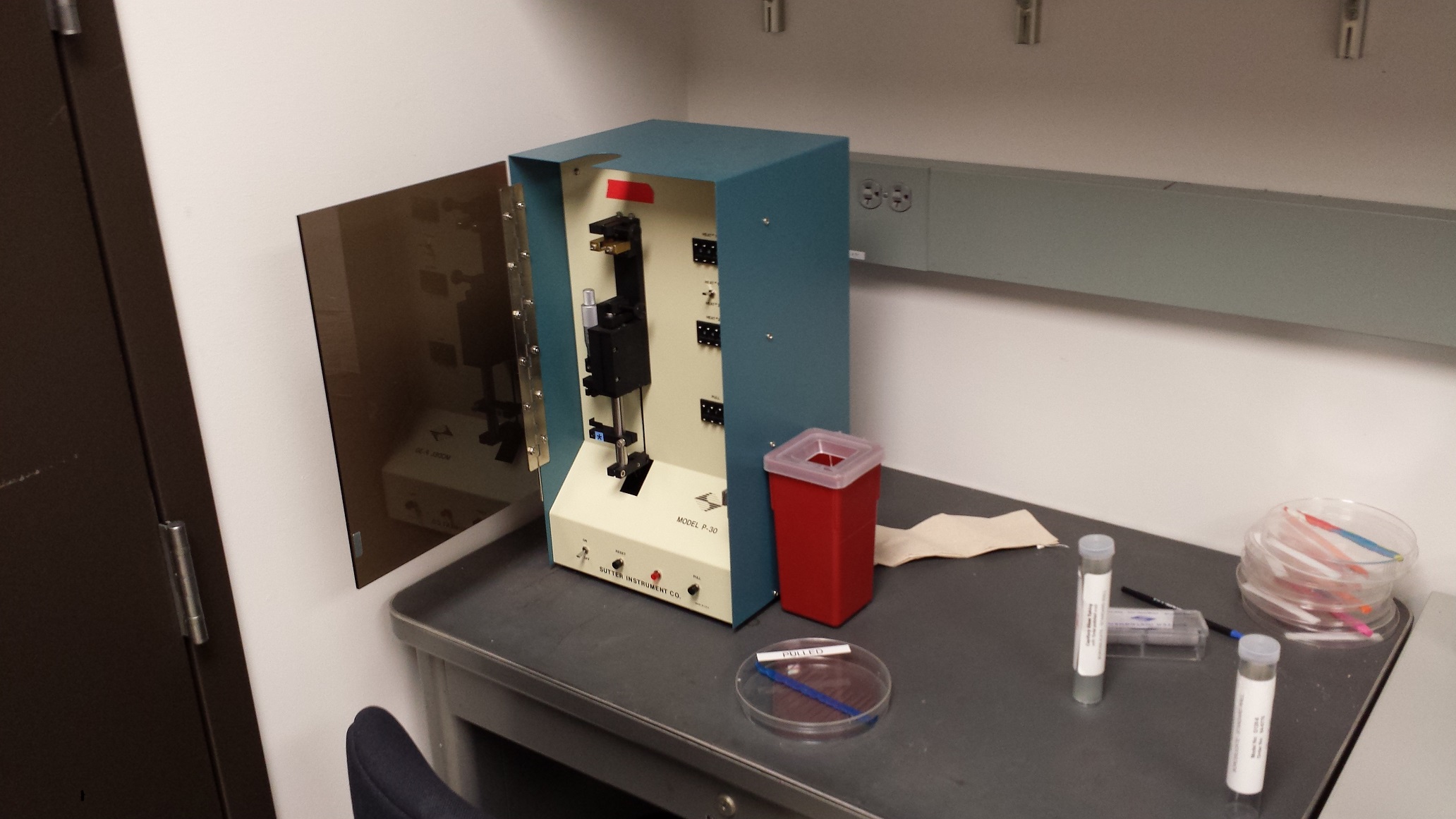
Joe also showed me the machine (pictured above) they use to pull the glass needles we use for microinjection of constructs into Xenopus oocytes. The needles need to be a certain length which means we can’t just use a Bunsen burner to pull the needles by hand, like our instructors in organic chemistry lab at Cornell taught us to. It takes much longer to position everything correctly, but the needles we pull are identical and are more likely to work in the injection process than if we used another method to make these needles. Joe also showed me how the Restricition Enzyme Mediated Integration (REMI) reaction worked and may let me prepare H33 in next week’s injection. In REMI reactions, the biggest potential for failure (which you won’t be aware of until about a week later after you screen for your construct) involves the very delicate and volatile sperm nuclei we work with. If you’re not careful, the nuclei will be sheared in the process of pipetting and your tadpoles will not be fertilized in the first place, or they will not express your construct (both of which will cause more frustration than any person should experience).
Dr. Baker called a data blitz lab meeting where everyone (but myself) presented what they were working on, what their results were, and what they were excited to start working on. This was incredibly beneficial for me because everyone spelled out very clearly what they were working on at a level that I could understand. The reason I did not present was due to the fact that I will be presenting slides to the lab on Friday of week 10. This presentation will be a practice run and a time to edit my poster which I will present at the Summer Undergraduate Research Conference and potentially the FUTURE in Biomedicine Research Symposium if there’s enough room for me. My work will start to transition from performing experiments to working on these presentations and organizing my lab notebooks for Yuan after I leave. This is a little sad as I have been having so much fun this summer working under the guidance of Dr. Baker, Yuan, Joe, and all of the other members of the Baker Lab, but know that I’ll keep in touch with them and that my work will help them form some ideas for their publication.
I also had time to meet with our very own Professor Barbara Christie-Pope and other Cornell students and alums to talk about what we were studying this summer and catch up on how everyone was doing. Because Barbara, my advisor, is doing research in the very same building I’m doing research in, I’m able to talk to her about what I’m doing, and get a detailed explanation of what Brianna and Barbara are looking at. I’ve made arrangements to visit the Cornell lab in week 10 and discuss with Barbara the possibility of exploring an honors thesis based on my work here this summer in conjunction with an additional block of study during the school year.
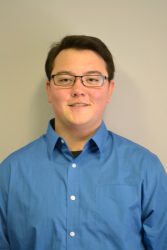
Major: Biochemistry & Molecular Biology. Hometown:Erie, Colorado.
PreviousWeek 7: University of Iowa Department of Biochemistry
NextWeek 9: University of Iowa Department of Biochemistry