
Week 7:
Baylor College of Medicine
July 21, 2014
There was something about Dr. Davis that made me admire. She made me feel safe when talking to her: no judgment and willingness to listen. It was maybe her crystal blue eyes and soft voice that made me feel that way. I talked with her for about 15 minutes in my second meeting with her. She just asked how I felt about working in the lab with each individual and she wanted to see my PowerPoint presentation before she left for a conference next Friday. She said that the people in the lab all had top compliments for my work and that she was glad that I got involved in all aspects of the experiment. If it were not for the job in the dining hall and the Resident Assistant position at Cornell, I would have not learned how to work hard, to commit, and to make the best of the situation. More excitingly, she said we would go out to eat sometimes next week before she would leave for a conference in Kansas City, Missouri.
I had a seminar at CNRC at 10:00 AM by Dr. Debbe Thompson called the qualitative skill: how to ask the right question. She has been conducting this workshop over 70 times nationally and internationally. Most recently, she had it in Sydney, Australia. She explained to us the difference between leading vs. neutral question, the 80/20 rule, closed- vs open question, probes vs prompts, all of which were very useful because I would see how crucial it was to practicing using open question, probes, and neutral question to gain the most insight from the patients. When I first came to seminar, I was expecting to leave with the knowledge of posing a question that I can help me identify a certain quality of a person because one of my side job is human resource. I told her that and she said we would not go into that that deep. During the seminar, I had two questions for her:
She mentioned that the interviewer should be able to multi-task, i.e. notes taking, observing, expressing attentiveness. However, human are easily to get distracted, even by minor actions as such. So how can the interviewer ensure that their multi-tasking, specifically taking notes, will not distract the interviewee and therefore affect the quality of the interview? And how can they ensure that they did not miss any relevant information from the interviewee?
She said that her team always video-tape the interview in her experiment. For this workshop to be useful to us now, the second question is: when the interview panel was taking note, should we talk slower to minimize the amount of information lost when the interviewers try to multi-task, e.g. taking notes and listening? But I guess that is also one of the reasons why graduate or medical school has a panel of interviewers and not just one interviewer.
I got a chance to talk to Dan and Andrianna. Dan explained to us a lot about how advanced animal nutrition is compared to human nutrition. He gave me some ideas for my presentation and also helped me in understanding better the experimental design and results we have had so far. Dan certainly knows what he does. He is good at explaining too.
The evening was very enjoyable. Brianna, Anvita, and I went out for dinner and enjoyed our crepes very much. The shop was small but elegantly decorated with European style. I got the chicken crepes.
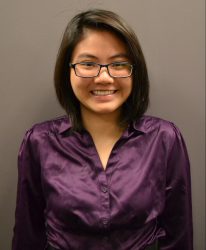
Major: Biochemistry and Molecular Biology. Hometown:Ho Chi Minh City, Vietnam.