
Week 9:
Baylor College of Medicine
August 5, 2014
Presentation week! Monday and Tuesday were for practice. It awed me when I got to know what my friends have been doing during the summer.
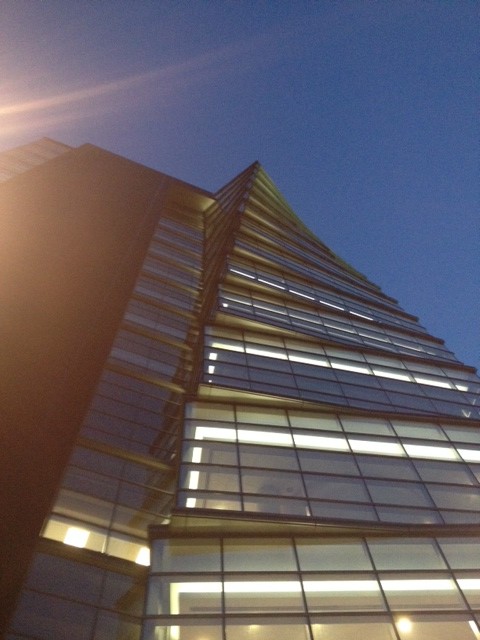
I practiced with Brianna, Anna, Luis and Manuel on the 11th floor of the NRI until 9:00 pm, on which Hugo Bellen’s lab is on. Breathtaking view! We took turn to present. It was just eye opening to see what projects my friends were doing. Ana worked on testing autistic behaviors in Ndfsdu4 gene.
Brianna did imaging in oral cancer and she is trying to come up with a method to image cancerous cells, just like a histological image, by using photograph. Manuel was working with genetic manipulation to quantify targeted proteins as method to eventually replace Western Blot. Luis was working in Dr. Zoghbi’s lab. After practicing, both Manuel and Luis went back to the lab to work.
I was impressed, amazed, and grateful for knowing such future researchers. What Luis told me lingered in my mind: “Research is 24/7”. Indeed, research is restless. Brianna told me about the Annual Biomedical Research Conference in St. Antonio this coming November and I wanted to attend. I have to submit an abstract and apply for funding. I will definitely do that!
Presentation day!
I was nervous, but I did well I thought. Rodrigo asked what I would do differently if I were to do this experiment again. I said that I would change the amount of essential amino acids because I suspected that leucine-stimulating protein synthesis pathway is substrate dependent. Elevating the reduction in EAA will potentially reach the minimal requirement for substrate.
Dr. Fiorotto asked a follow-up question: “Would you change the content of supplemented leucine too in the new diet?” I suggested against that because if we want to test the amount of Leu we were using is the right amount, changing Leu would mess it up. A friend from Vassar University asked why LD showed no difference while gastrocnemius showed significant difference between control and restricted, restricted plus Leu. I answered that in LD, there was a similar trend as in gastrocnemius but because this is a short term, that was why the result was not significant. I was glad that I was prepared to answer these questions.
It was fascinating and interesting to hear how diverse the field of nutrition research entailed. 10 students in CNRC presented their summer projects, such as inventing smart syringe for intravenous feeding, imaging the growth of mammalian gland,… to name a few. Afterward, the director of CNRC, Dr. Bear, gave us a short speech. His main point was that no one can know what the future holds. If we feel like we love research, go for it and don’t be afraid.
Being exposing to this research has reinforced my interest in research: the daily frustrations when study does not go well, the rare excitement when things work out. Sanjeeve told me that trouble shooting was what excites him about research. What he said really made me re-think of what made me like research. What compelled me the most is the process of trouble shooting, thinking over and over to see what are the possible flaws.
I had an “A ha” moment; I recalled when I took my first English class with Professor Shannon Reed. I wrote my first draft about immigration and exile and took it to Professor Reed. She read it, asked me questions to make me realized how unfocused my writing was. She explained: “most of the time, when you write something, you have to go back and start from the beginning, revise, revise, and revise!”
It is just like research: I have an idea, I wrote a manuscript, but as I find more and more literature, or actually do my experiments, most of the time it will not work. I have to step back and think, to revise and redo” It may takes years and years. It is long and draining. I can see it. I am praying to myself every night that I will have the persistence, perseverance to make it to the end.
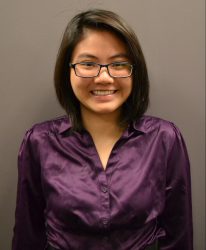
Major: Biochemistry and Molecular Biology. Hometown:Ho Chi Minh City, Vietnam.