
Week 2:
Audobon Center at Francis Beidler Forest
May 30, 2014
This project I am working on is called Project PROTHO and in this blog post I am going to make it a clearer what that project is. This description of banding and Prothonotary Warblers is from a pamphlet that Matt made before I arrived. It is an official description of Project PROTHO and will give you a good idea of how Beidler Forest visitors can help me and Audubon South Carolina complete the project.
“The Prothonotary Warbler is a small songbird that lives in swamps and river systems throughout the southeastern United States. Project PROTHO is a citizen science project started at Francis Beidler Forest to further our understanding of this iconic bird of wetland ecosystems. PROTHO is an acronym for Protecting Resident Ornithologically Tantalizing Hole-dwelling Occupants, and it describes these bird’s love for cypress knees and hollow trees for building their nests.
The Prothonotary Warblers at Beidler Forest were first studied in 2008. From 2008-2011, birds were fitted with leg bands so they could be uniquely identified and studied. During that time, and even now, we’ve learned important information about the movements of these birds around the swamp. In fact, some of the birds fitted with leg bands in 2011 can still be seen from the boardwalk. This is an amazing fact, especially given that Prothonotary Warblers are one of many species that spend their winters in Central and South America, migrating back and forth each spring and fall.
Each bird that we capture at Beidler Forest is fitted with a unique four-band combination. To begin with, every bird banded receives a silver aluminum band on its lower left leg; this band has a tiny number on it which corresponds to a national database. The other bands seen on a Prothonotary Warbler are arranged in a unique way to allow us to identify each bird.”
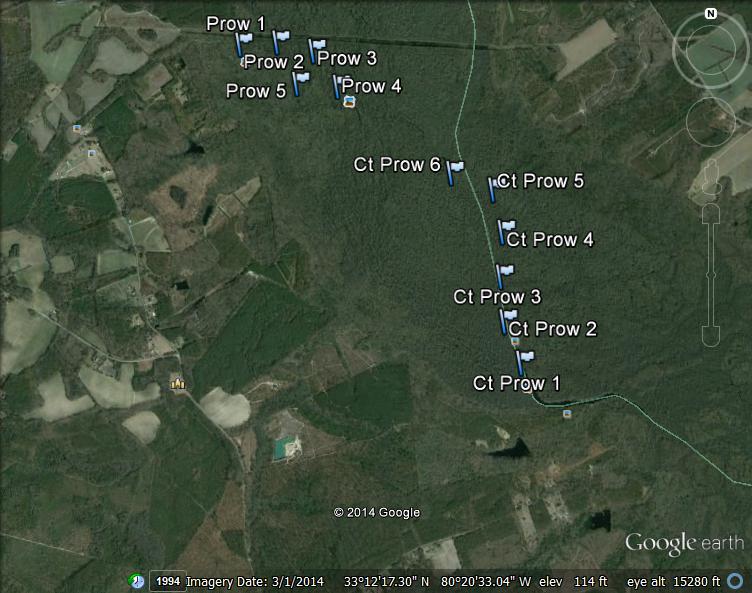
Visitors who decide to take a flyer and help with this study will walk the boardwalk and if they see a Prothonotary Warbler, they’ll write down what color bands they saw (there are 4 including the aluminum USGS band), where they saw it on the boardwalk, and what it was doing. With all the Prothonotary sightings we will gather, we should be able to map out territories for each male on a program like ArcGIS or Google Earth.
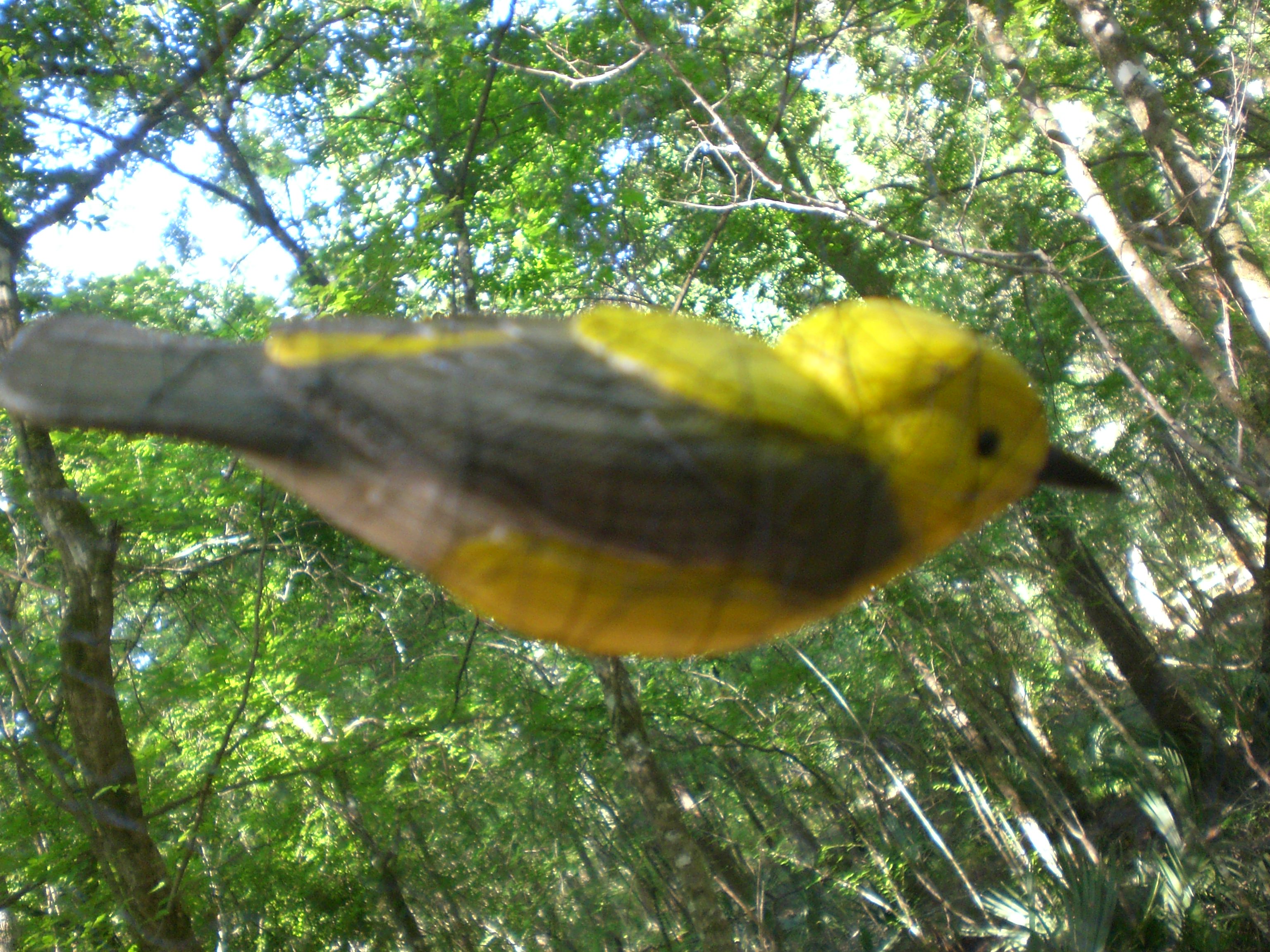
On Monday this week, Matt and I had a lot of fun walking around the boardwalk finding all the Prothonotary Warblers we could. We were looking for them so we could actively catch and band unbanded Prothonotaries. Active capture means that we were targeting specific birds. We were targeting male and female Prothonotary Warblers that had not previously been banded. We caught them using two different methods. A mist net is a very thin net that we put up to catch singing males. The idea is that the bird cannot see the net and will fly right into it and get caught. Because we are actively targeting singing males with this method, we set up a dummy male Prothonotary and played a mating call. The target bird, in an effort to chase the dummy male out of its territory, will sing back, fly toward the dummy, and get caught in the net. The other method we used was for catching momma birds. We found 4 different nests that mom and dad were bringing food to, so we waited for the unbanded ones to come back to the nest and then placed a butterfly net over the opening. Both methods took a lot of patience because the birds don’t really intend to be caught by anything. If we weren’t quick enough, they would fly off scot free. But we did successfully catch and band 2 birds. We named them A915 (female) and A916 (male). There are 2 males that hang around still that were banded in 2011 named A014 and A012. Along with these 4, Matt caught and banded 4 others a month before I arrived named A911, A912, A913, and A914.
The rest of the week I focused on conducting density estimates. To conduct density estimates, you have to know the Prothonotary Warbler song very well and be able to distinguish it from distances up to 125 meters away. You must stand at one point for 9 minutes silently listening and watching for Prothonotary Warblers. If you hear or see one, you must record if it was chipping or singing and you must estimate its distance from you in intervals of 1-10m, 10-25m, 25-50m, 50-75m, 75-100m, and 100-125m. The sex of the bird is recorded as well. This information will then be used to create a density estimate of our Protho population. Many different sites in the southeast are conducting density estimate surveys on their Prothonotary Warbler populations in order to gauge the population densities of this iconic bird. A professor in Virginia is compiling all of everyone’s data and using it for her study on these warblers.
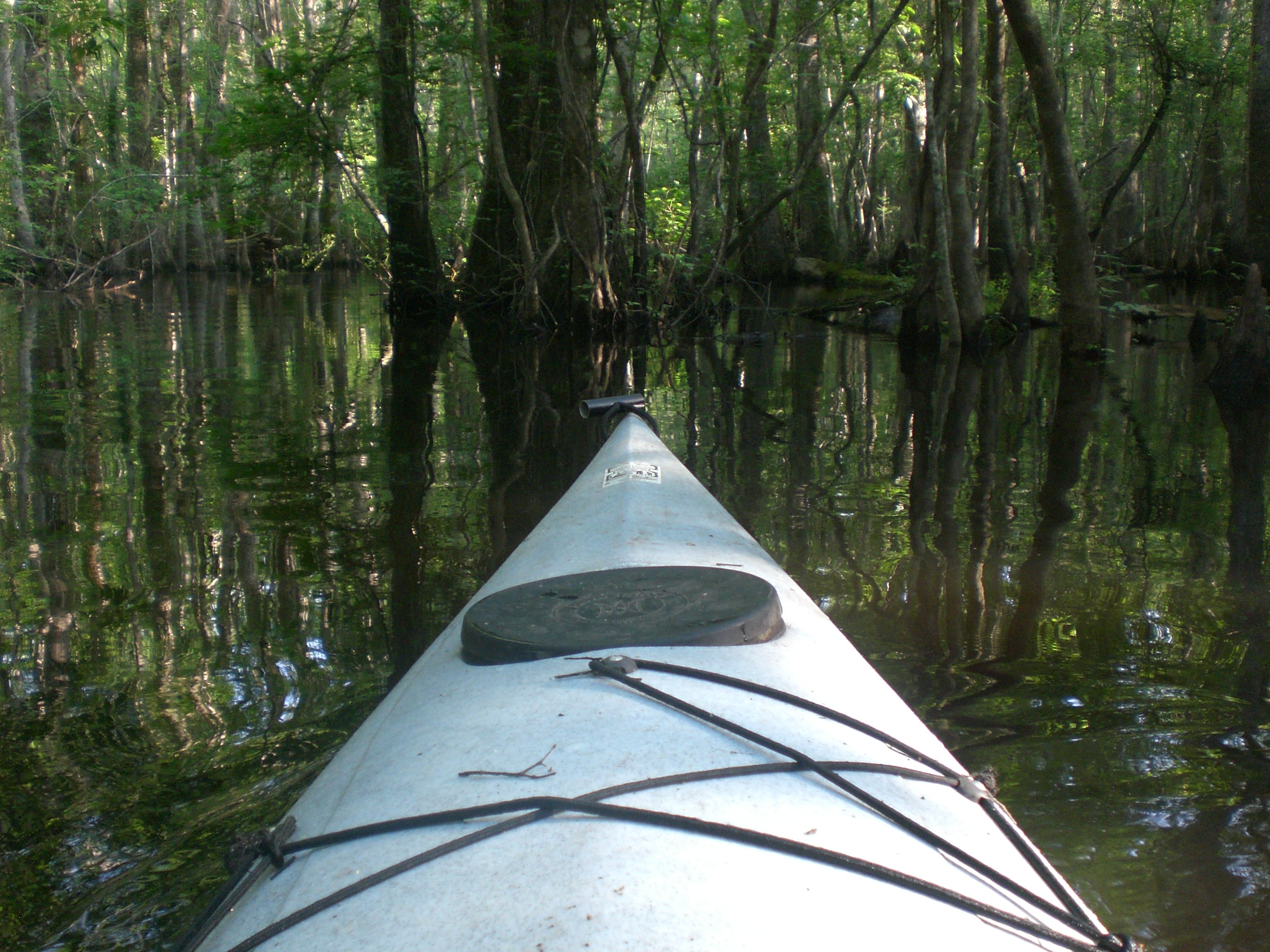
I get to conduct these surveys along the boardwalk I mentioned in my first post as well as on a canoe trail that Audubon SC maintains. The canoe is fun. There are canoes and kayaks to choose from at the landing site. I usually take the kayak because that is what I am used to floating in.
Starting in June, I will be able to go with Audubon’s seasonal employee, Ricky, to Charleston to help with and watch the seabird warden project. They go out on the ocean to different islands and count up all the breeding shorebirds. They also work with the public on the beaches every week to educate about shorebird awareness: things like why you shouldn’t bring your dog to certain beaches, and why in some circumstances, it is not a good idea to chase down flocks of shorebirds chilling on the beach. Both things I love to do but I’m interested in hearing why and when that is not a good idea.
Audubon employees get Memorial Day off so I will start my week on Tuesday. I’ll continue my adventure then.
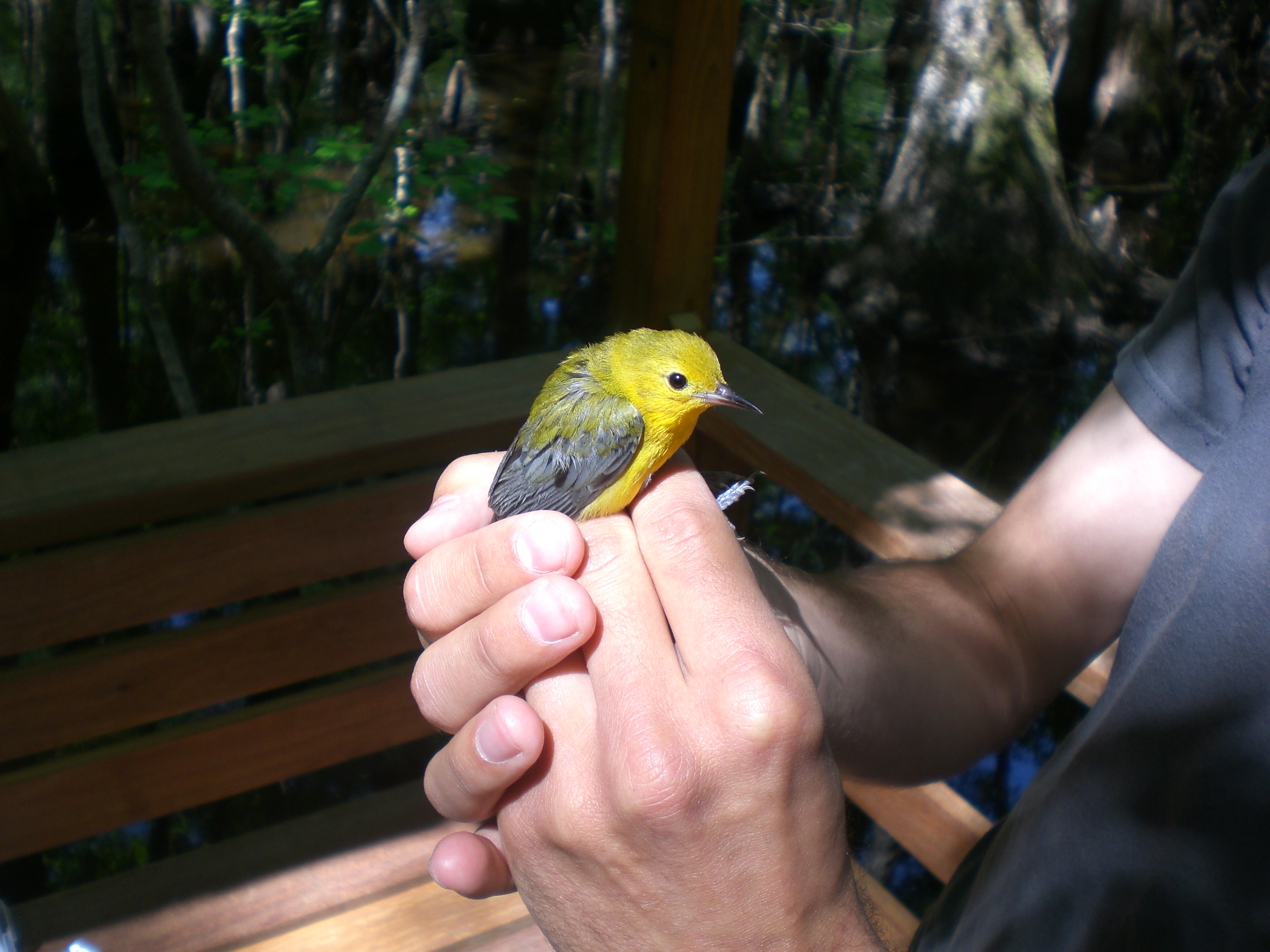
All of the banding that I talk about in this blog will be done under a SCDNR permit and with the assistance of an SCDNR Biologist.
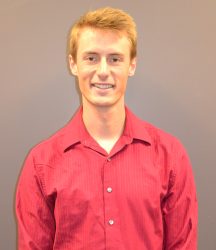
Major: Biology and Environmental Studies. Hometown:Downer’s Grove, Illinois.
PreviousWeek 1: Audobon Center at Francis Beidler Forest
NextWeek 3: Audobon Center at Francis Beidler Forest