
Week 3:
Carver College of Medicine
June 10, 2014
This week we definitely focused on projects 1, 2, and 4.
Project 1: last week we ran gels with PCRs prepared with many different conditions, in order to check for the mutations we attempted to introduce into the gene for Nav 1.5. Since the gels didn’t work, we decided to use the original protocol again (because we found a couple of bands on the gel containing samples from the origin protocol). For some reason, this gel didn’t work. So then, we decided to make new PCRs following the initial protocol, although dividing the reactions. We ran two tubes for each annealing (62, 63.5, 65, 66, 66.5, 68°C) temperature. Each tube contained half of the reaction plus one of the primers of the set. We stopped the program after the first ten cycles, combined the two tubes, and ran the next 20 cycles. We were again unsuccessful. Therefore we decided that instead of trying to make 5 mutations (QQQQQ), we would try to make only 3. For that we’ll be using two different types of primer sets. One will form a bulge on the mutation site once it binds to the DNA template. The other set is one in which the two primers don’t align perfectly (this avoids the formation of primer dimers in the reactions tube).
Project 2: More minis were prepared (5 each) from shu,sdw, and wild type, and test cuts were run on them. The test cut showed that the new three mutations didn’t work either. We’ll probably try a different approach next week.
Project 4: we sequenced R4C (3 samples); R5C (2 samples); R6C (3 samples);and wild type (3 samples). After checking the sequences, we saw that none of the R6Cs worked; so we transformed R6C again. We also retransformed wt-5, R4C-2, R5C-1, and R5C-4, using stable cells. We’ll be preparing more minis next week.
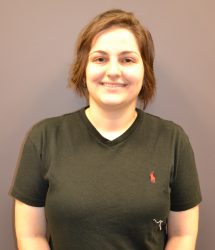
Major: Biochemistry and Molecular Biology. Minor: Spanish. Hometown:Varginha, Brazil.