
Week Three:
Casa Verde
September 7, 2015
Hello again! I hope that readers are having a good summer! The third week of my internship has proven even more eventful than the last, and included everything from an amazing 13-14 hour work day, to a visit to the old cathedral in the city of Granada, to a solitary 6 hour boat ride across Lake Nicaragua. My Cornell experience has also once again done much to enhance my experience by giving some context to the socio-economic patterns I have seen, and to remain calm during potential crisis situations. This might end up being quite a long post, so get comfy, and enjoy the ride!!
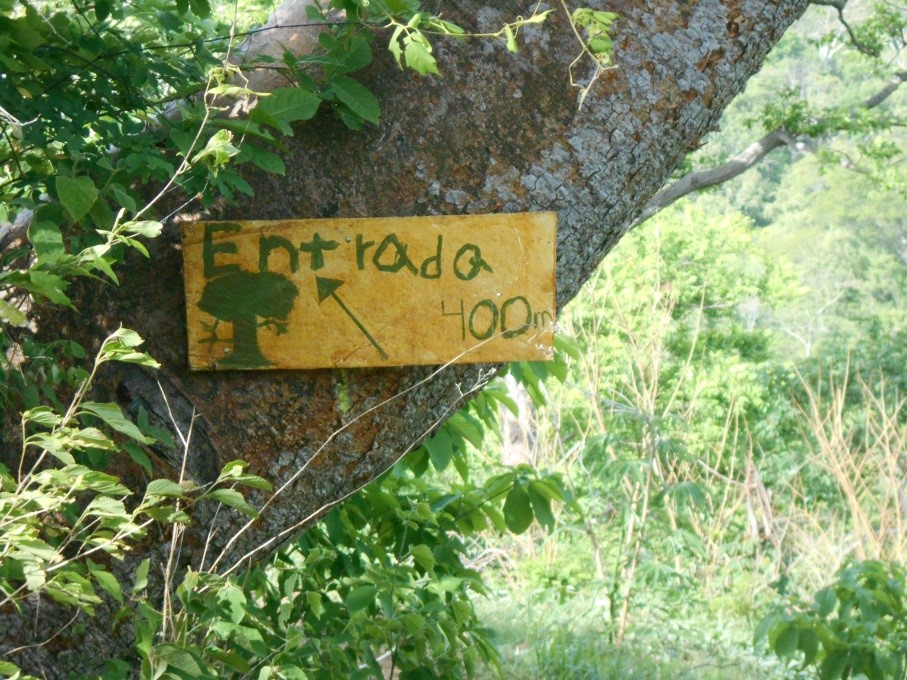
I have actually decided to start the week from July 4th, because I have not talked about it in the last post. If anyone was worried that I would miss a 4th of July celebration, they can put those concerns to rest! The 4th of July also turned out to be the longest work day that I have had since arriving here on June 21st. The work day started nice and early at the public library at around 7:00 am. I had an early start because on July 4th, Casa Verde staff with the support of local and international partners planned to travel to Casa Verde’s 31 acre property (hereafter called La Loma) outside Limón to plant trees there. A total of 68 people came for the event including past Casa Verde interns, a volunteer group from Seattle University, a team of gardeners from the Rancho Santana resort, and of course volunteers from the Sunny Side service learning team, and from Formación Fenix.
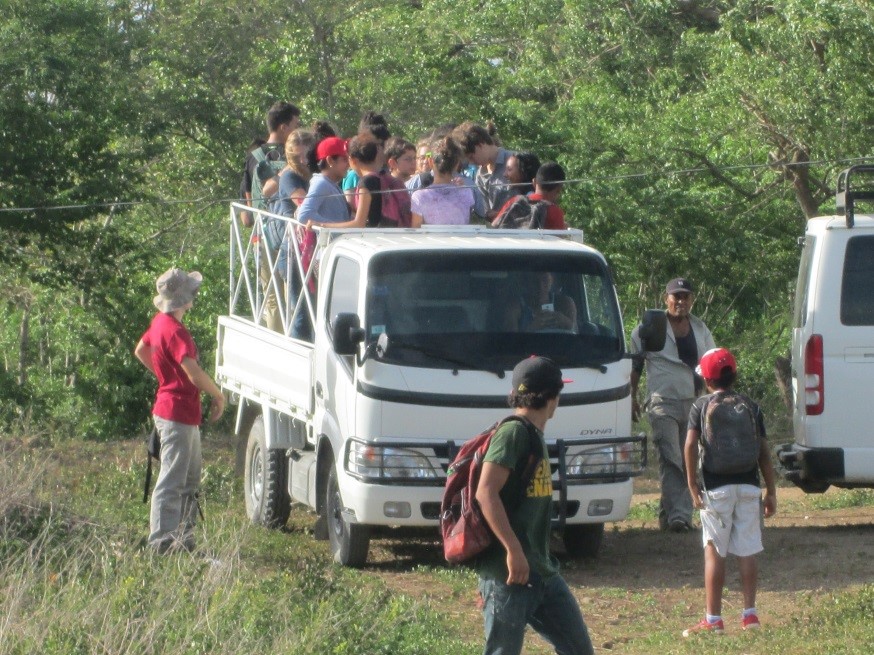
I spent a significant amount of time in my internship last year working at La Loma, so I worked as a guide for the groups traveling there that morning. For example, I sat next to the driver in a truck full of equipment and passengers and told the driver where he could drop us off that would allow us to reach the project site fastest. I also helped a pair of older volunteers make it to the site by taking them on a trail I worked on last year with a smaller incline than the main trail. By 9:00, all of the volunteers had made it to the top of the hill that makes up the entire property. I know, it’s a very big hill!
After everyone got herded into one place, we divided the group into teams of about 6 or so, and began planting trees. I was one of the team leaders, and I found that my RA training significantly improved my ability to not only keep all of my team members on task, but to make sure that I knew where they all were throughout the day. Being an RA requires you to constantly have an awareness of how your residents are doing, and how you can help them feel comfortable, and safe. This easily translated into my work team, which stayed close together, and worked at a high level of efficiency throughout the day.
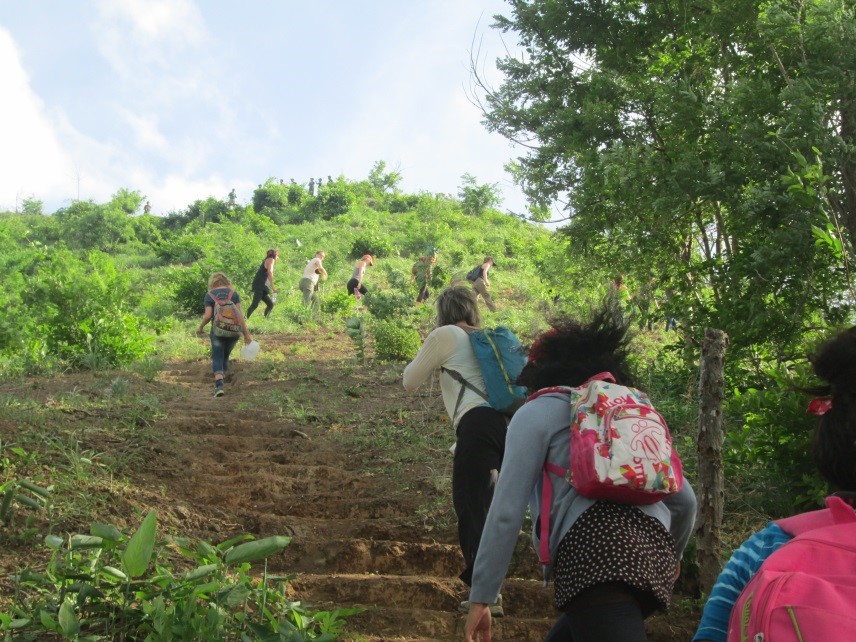
A group of local workers and volunteers had dug several rows of holes at the project site prior to our arrival, so our job involved removing the plastic covering around each tree, placing the young tree in a hole, and filling the hole with compost and water. We did this for roughly 3 hours, then had a light lunch, a reflection activity, and returned to the road on foot to get picked up by trucks. That morning, we planted over 1,000 trees! Though it doesn’t sound too bad, pretty much all of the volunteers felt exhausted by the time we finished in the afternoon. I got back home at 2:00PM, relaxed for a bit, and then headed to the beach at 4:00 to help with a 4th of July celebration for Fenix, and Sunny Side. I helped make a bonfire, prepare food stations, and moved rocks down the beach that the students could use as seats. Once everything had been prepared, I helped serve volunteers food and soda. We spent the rest of the evening singing songs, talking, and watching fireworks go off from Rancho Santana.
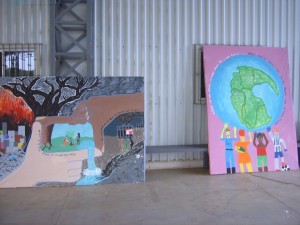
Over the next few days, members of the service learning team finished up the last of their projects, and prepared to return to the states. The art project that I mentioned last week was finished by July 6th. On this day, we held a community celebration at a local community center funded by more permanent residents of Rancho Santana. Part of that celebration involved showing community members the completed murals. This celebration has been one of the highlights of my internship because it was one of the first opportunities I had to step back and look at the work I had done over the past weeks, and where this work could take me in the future. Even now, I can’t fully describe how I felt that night seeing students from Sunny Side playing, and having fun with students from Formación Fenix while serving food to people from Limón who told me how grateful they were that I was there. It was especially amazing to see kids from Fenix and Sunny Side playing together. Here were these two groups of kids who didn’t speak the same language playing and having fun together as a fully integrated group of people who could see each other as just friends with unique personalities and experiences despite the huge cultural barriers between them.
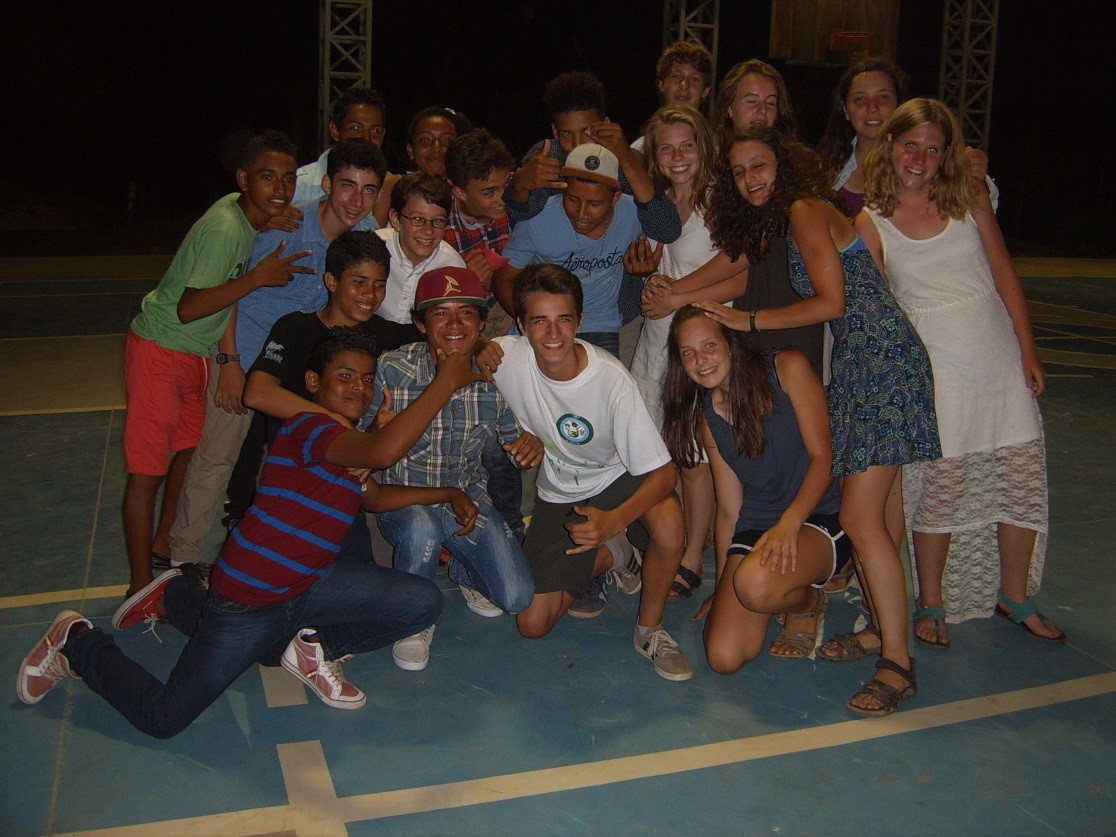
Building integrated communities like this makes up a significant part of my job as an RA, and watching this community develop over the past few weeks has provided me with some valuable insight into how to construct these relationships. Throughout the time that Sunny Side volunteered with us, they spent a little time each day interacting with members of Fenix in activities that forced them to interact with each other more and more over a longer period of time. For example, each mural had members from both groups who had to agree on what they wanted to paint. Perhaps by organizing activities for my floor that have elements of the same interactivity, I can find a way to bring what I have seen here to my floor next year.
On Tuesday, we left for the city of Granada to see some of the sights before Sunny Side students left for Portland. This involved a visit to the old cathedral in the city, which has stood for hundreds of years. By Wednesday morning, Sunny Side had left for the United States, and I finally found time to start writing up the first of my blog posts, and get some work done on my handbook, which I will talk about much more next week.
From Wednesday to Tuesday of the next week, I spent my time on a very poorly planned, and wonky journey to the city of San Carlos, located at the mouth of the San Juan river on the eastern side of the gigantic Lake Nicaragua. After a series of unfortunate events, and planned decisions, I found myself spending a night in Colón, one of the communities near the border with Costa Rica. Decades of low level conflict between the militaries of Nicaragua, Costa Rica, and even Nicaraguan rebel groups have left the now peaceful communities along the border terribly poor, and extremely suspicious of outsiders like me. This experience did a great deal to supplement what I have learned about conflicts, and their aftermath at Cornell.
In several of my international relations classes, we talked extensively about various conflicts between states, and why these states made the decisions that led to conflict. We also discussed in some of these classes how these conflicts unfolded at the local level, like how disputes over land between various communities in the Eastern Congo seriously mitigated the ability of international actors to stabilize the region from 2003 to 2008. However, so much academic discussion of conflict made it easy to forget about the long term personal impact that it has on the people exposed to violence. Just seeing middle aged men with grisly scars, or military fatigues dating from the last outbreak of violence in the 80s, or almost spending the night at a small Nicaraguan military outpost for safety gave me a glimpse of a history far darker than anyone could convey in a book or a class. There was just something different about the way people carried themselves that has helped me see conflict as a far darker affair than I could see by looking at casualty statistics, or policy papers in a class, and I will doubtless carry these images into the classroom, and other situations throughout my life.
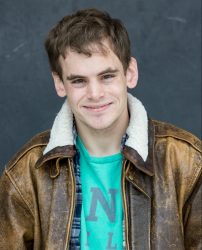
Jared is an International Relations and Russian Studies double-major from Sammamish, Washington.