
Week 2:
Achieving Gold Status

Cathryn and I at Rochester fest, enjoying some incredibly unhealthy and delicious fried food.
June 28, 2017
My hard work finally payed off. After much time spent scoring practice polysomnograms (PSGs) my first week at Mayo, I was able to take my Gold Standard on the Monday of my second week. The Gold Standard is a sort of test that Dr. St. Louis’ lab uses to validate that someone is ready to score patient PSGs that will be used as data in the various RBD projects. The Gold Standard works by having you score a multitude of PSGs, and the computer lines up how many of the mini-epochs match. To pass the Gold Standard you must score >0.8 agreement. Now that I’ve passed my Gold Standard, I can start helping to score PSGs for the various projects we are working on in the lab, which is what most of my week consisted of.

On Monday, we also went to the Medical Grand Rounds. The speaker was from WASHU and was speaking on the development of RNA treatments for ALS. He explained that particular genes are believed to be responsible for ALS, and this treatment works with antisense mRNA oligonucleotides that will down-regulate the production of the enzyme that is playing a part in the development of ALS. If this method is successful, a new way of treating neurodegenerative diseases may be on the rise. If I were not at Mayo, I would not have known about this type of research or the small but pivotal steps that are being taken in the field of Neurology. My experience is exposing me to many new ideas and a novel way of thinking about disease.
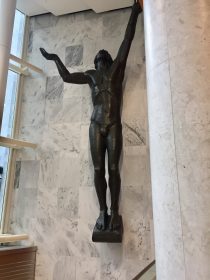
One of my favorite moments of this week was at the Medical Grand Rounds on Wednesday. The lecture was about race and inequality in medicine. An incredibly interesting point the speaking physician made was that when looking at racism, we need not look at the person but the structure and social aspects of the system. He talked specifically about how little treatment we have in the United States for sickle cell anemia. Sickle cell anemia has been around and diagnosed since 1910. To date, there is only one drug used to treat sickle cell, and it is no coincidence that in the United States, only African Americans are affected by this disease. He also pointed out that in a survey to providers, many physicians know about this treatment, but do not utilize it when treating their patients because of their lack of knowledge about its effects or suspicions about this specific drug. The implicit biases we all have are undeniable, but we can work to address them and work to actively provide each human with the same medical care. This starts with the medical provider recognizing their implicit bias and working against it in their every day practice. It was very encouraging to me to see this type of presentation in a world renowned medical institution. We have these discussions frequently at Cornell, but to see them in an environment like the Mayo Clinic gave me hope that some progress is being made.
After a long week of scoring and going to lectures, my housemate Cathryn and I decided to go to Rochester fest. Rochester is such a cute little city, and you could see the pride the natives have in it. At the fest, they had live music, food trucks, games and dancing. It was really great to get out of the lab and have some fun!

Next week will undoubtedly bring new experiences, new knowledge, and a lot of looking at squiggly lines on a computer. I can’t wait to share what happens next.
Charlotte is a biochemistry and molecular biology major from Mokena, Illinois.