
Week 1:
Jennifer Davis, Student Research Assistant
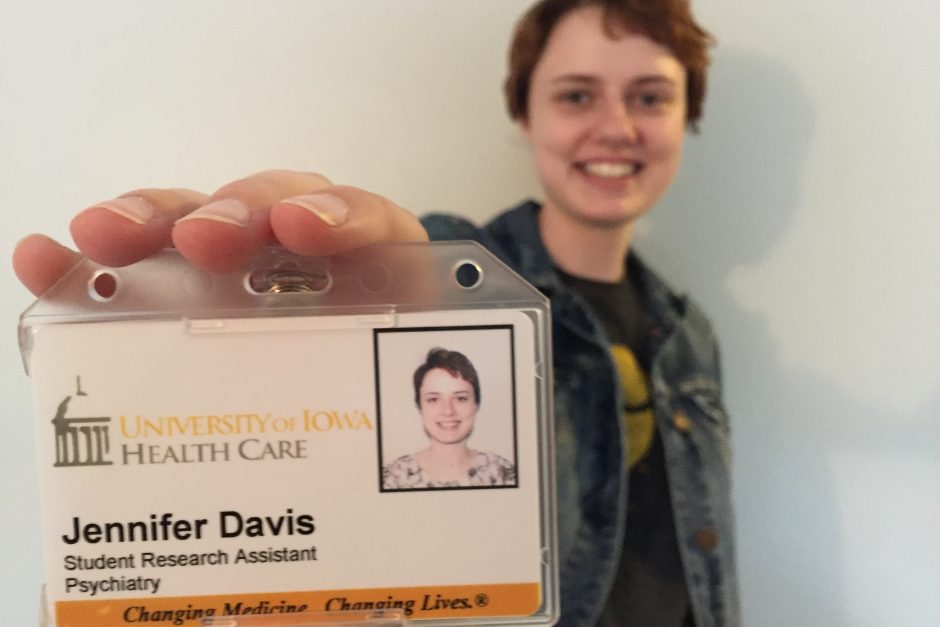
My University of Iowa Health Care badge!
May 29, 2017
I’ve walked the halls of University of Iowa Hospital and Clinics many times, but on Monday it was different. I was nervous. I wasn’t going to my familiar old haunts, but the wing of the hospital that I hadn’t spent much time in. The wing of the hospital in which I would be contributing to the lab of Dr. Fiedorowicz, neuropsychiatrist. Don’t get me wrong, I was excited, but the nerves outweighed all other feelings. After some searching, I made it to the office, and found my desk with my very own nameplate! That set the tone; it made me feel like I would be a significant member of the team.
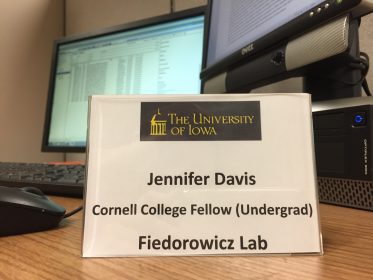
The first couple days were fairly slow because the research assistant of the lab was on vacation. However, I did meet some of my other coworkers, and learned a lot about what the lab does, where it carries different tasks out, and what everyone’s different role is. I was able to help another research assistant out in a partnering lab, with some file organization of data from a past research project. The job seemed mundane, and it was, but I realize even the smallest tasks are imperative for research. The files had to be organized, or else it would be next to impossible to enter all of the data in a timely, organized, and efficient manner.
One afternoon Dr. Fiedorowicz connected me with a great opportunity- shadowing an OB/GYN that specializes in high risk pregnancies. This was my very first time shadowing a physician, and I was thrilled. Not only did I learn a lot about pregnancy in the few hours I was there, but I also got to experience the amazing upbeat atmosphere that was maintained in the clinic. Everyone was friendly and smiling, completely happy to have me join them in patient visits. I found it fascinating how the doctor would discuss each patient’s situation and ask the medical students related questions to quiz their knowledge. One student in the office gracefully took me under their wing and answered all the questions I had about the medical conditions I was hearing about. Overall, this afternoon only cemented my desire to be a physician, and to be a part of this community. I was incredibly grateful for the opportunity, and for the warm welcome they extended to me.
The student from OB/GYN wasn’t the only student I have come in contact with. There is a new medical student in the lab that I have spent some time with. Their generosity has also impressed me, offering to answer any questions I have about medical school or the MCAT. I am still feeling a little overwhelmed by all the amazing people I have met. Many of these people are living my dream, and I hope that I can one day achieve as much as they have.
Once the research assistant for the lab was back, things were rolling. There were patients coming in to be a part of a study, and I was present for the informed consent process needed to enroll each one. I never knew what a long and detailed process it was. Every aspect of the study must be fully explained, because, after all, to give consent you need to know everything that will happen. Another aspect of this study are mood and mania surveys, which are very informative when working with many patients who have bipolar disorder. The amount I have learned about bipolar disorder just by hearing personal accounts from patients has been incredible.
When I have not been running around, trying to keep up with the lab, I have been reading research articles. Dr. Fiedorowicz has many publications, and a decent variety of studies. I took notes over every article I read, per Dr. Fiedorowicz’s advice, and have been paying close attention for things that peak my interest the most. One thing that caught my eye was a paper of his about suicide prevention, and how many primary care physicians do not have the education to properly identify patients who are at risk. This paper reminded me of a class I had recently taken at Cornell, in which I learned a lot about narrative medicine. Narrative medicine is essentially paying close attention to the stories of patients, and using this background to connect with them in order to properly diagnose and help them. It seems as though, to me, that the use of narrative medicine could help primary care physicians better identify a psychiatric emergency. It excites me that Cornell has given me this background knowledge and ability to make logical connections in my everyday life, connections that can help me be a better student and better physician some day.

Jennifer is a double major in philosophy and biochemistry and molecular biology from Cherokee, Iowa.