
Week #5:
Digging Up Adventure
July 1, 2017
Hard to believe that I have already been here a little over a month now!
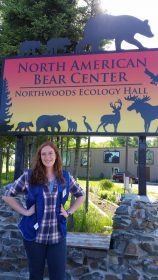
The highlight of my past week would have to be my family coming up and visiting me. I was really excited to show them everything I had been doing in Ely and have them meet the bears I had been working with! They all really seemed to enjoy meeting Ted.
When they were up here we visited sites that I had already been too such as the International Wolf Center and Kawishiwi Falls, but we also went to places I had not explored yet like the Dorothy Molter Museum and the Soudan Underground Mine.
Dorothy Molter was the last non-indigenous person to live in the Boundary Waters Canoe Area Wilderness (BWCAW) when it was established as a wilderness area. She was a famous stop for people traveling through because of her skills as a registered nurse, but perhaps more famously for her root beer. Her recipe is still made, bottled, and sold in Ely today.
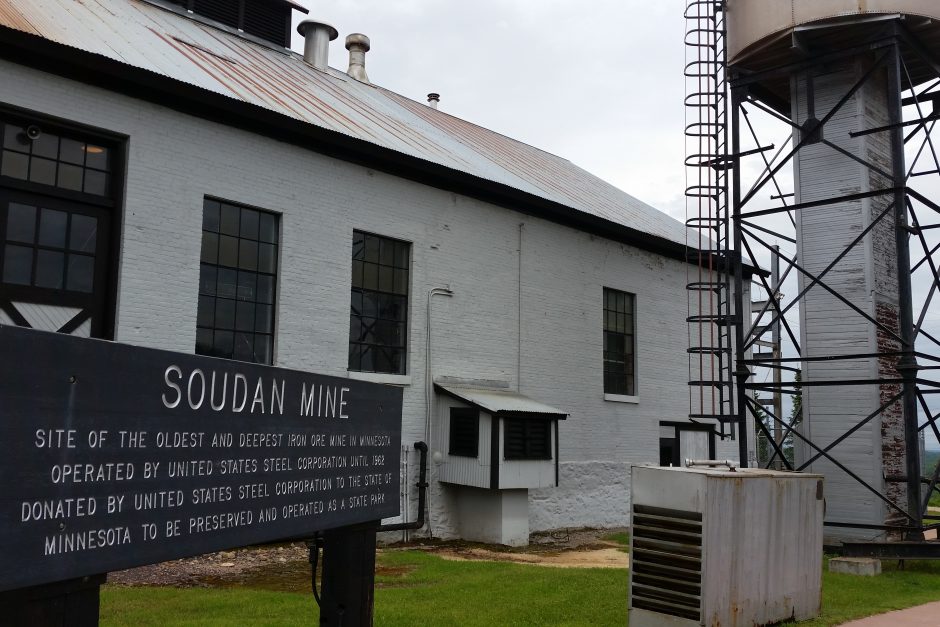
On the rainy day, my family and I went to the Soudan Underground Mine and went on the tour. We went a half mile underground to the 27th level of the mine. My ears popped when going down the shaft and then again when we returned to the surface. The Soudan mine was the “Cadillac” of mines because it was much safer than open pit mines that were common. Miners of the time collected hematite which was almost pure iron ore, but due to improving technology and processes it became more cost effective to mine less pure iron and the mine was closed in December of 1962. The tour itself was really intriguing and really showed how the life of a miner was back when it was open. It was a great stop for a rainy day.
It was also nice to explore Ely with my family. It is a nice small town like Mt. Vernon, but more geared to summer tourism and people stopping by to grab some extra gear before camping or canoeing. I love seeing all the trees and the availability of trails to hike. When we were exploring the downtown, I was able to find a cute little bookstore on the second floor of one of the shops and another little store that was full of quirky, but functional items.
After my family left, I was able to meet with Dr. Roger Powell and his wife Consie. They have a lovely home and two very sweet, large Newfoundland dogs. We talked about my summer, their backgrounds, and my possible future. I told them that my current plan was to take a gap year, do something interesting, then go to graduate school studying reproductive endocrinology of endangered species (in hopes of reintroducing those animals to the wild). Only problem is, I don’t know what species I want to focus on, and I want to figure out what I want to do before committing to graduate school. They were very helpful. Dr. Powell thought a gap year was a great idea, and retroactively thinking, he wished he would have taken one. When he was a professor in North Carolina and was taking on graduate students, he also looked for those who had that extra experience. I am still nervous about life after graduation because there is no path that is the “right” path.
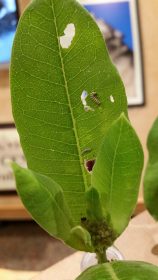
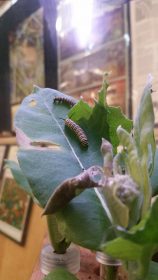
At the bear center, we have set up a new exhibit of Monarch caterpillars! They have already grown so much in one week. I know that Dr. Mildenstein has her summer research on Monarch caterpillar densities in prairies, and I can understand their excitement at seeing a caterpillar or even an egg! I have never seen a Monarch caterpillar until this year. I can only hope that my internship lasts long enough for me to see them emerge from their chrysalis.
As for bear behavior, our females have become more and more mischievous. One night Holly and Tasha were climbing trees trying to play with each other (Holly was in her personal enclosure, while Tasha was not). Then Holly started digging in her enclosure so we moved her to one side of Lucky’s two-part enclosure so we could fill in her hole with more rocks and dirt and then Tasha started to dig into Lucky’s enclosure. Apparently, she got far enough to stick some of her face in, and then at that time, Ted wandered up to see what was going on which made Lucky uneasy. A “hole” dramatic show.
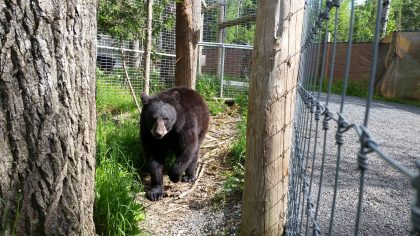
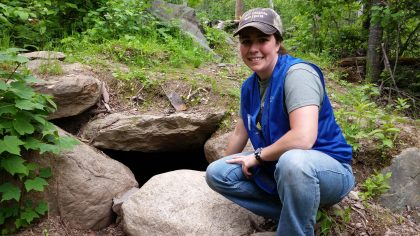
All we can really do is fill up the holes that they keep digging. Holly started digging again at the end of the week and actually dug underneath the fence. I called her name and she stopped digging, shook the dirt out of her fur, and pretended that she was the most innocent bear in the world and that that hole had been there the whole time.
Lucky, on the other hand, has learned that if he waits right outside of his enclosure long enough, that we will go and get him extra food to entice him to go inside for the night. One day he wouldn’t come down to dinner because he was too enthralled with every stick in his path and would have to play with it before moving on.
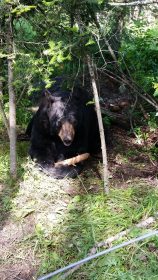
Ted, was the only truly innocent bear this week. He got a nice treat that was also a necessity. Due to all of the rain we have been having the past couple weeks, Ted’s enclosure has turned into a horrible smelly mess. We clean it each day, but to no avail, so he received a bag of cedar chips and eight bags of red cedar mulch to cover up all of the mud and soak up that extra water. Bears love to rub cedar on their ears, neck, and face because the cedar oil helps protect against the bugs, so Ted has been rolling in and napping on that new mulch.
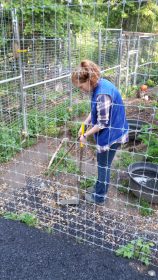
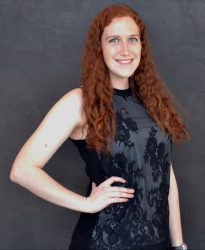
Kelly is a biology major from Burlington, Iowa.