
Week 3:
Diving into the Data
June 28, 2019

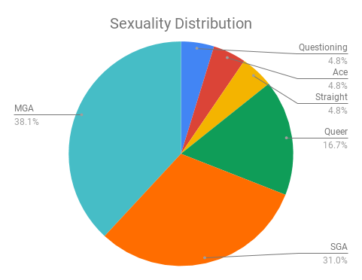
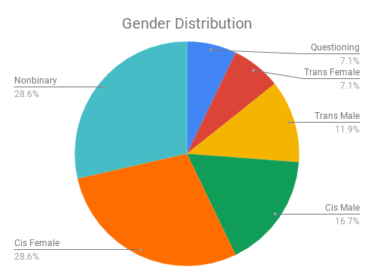
This past week I’ve had the opportunity to dive deeper into a few of my projects, namely our youth evaluations. This has given me a greater understanding of the identities the young people we serve hold, as well as their needs and attitudes. In both December and May, young people grades 5-12 in our programming answered 70 questions or so about their identities, attitudes about their school, family, community, friendships, self-image, sexual and relationship health knowledge, mental health resources, substance use, and other program outcomes. At Youth Services we want young people to describe themselves in their own words, so gender, sexuality, and race demographic questions are all write-in. Before starting my data analysis, I code youth responses into the categories displayed below in the pie charts.
For clarification, Ace is an umbrella term for asexual identities. MGA, or multigender attracted refers to individuals who are bisexual, pansexual, or generally attracted to more than one gender. SGA, or single gender attracted includes gay and lesbian folks. Just under half of our respondents are transgender, with the majority of them being non-binary.
As a data geek, I’ve thoroughly enjoyed this project, especially when it confronts or contradicts my expectations of who the LGBT+ community is comprised of. The data is pretty messy, so this week my focus has been on cleaning it up, sorting the different components, exporting the written feedback, and writing formulas to display consolidated information about different demographics so we can compare their experiences. Overall, my goal is to be done sorting through this data and begin writing observations for our reports by the end of next week. During my weekly supervision meeting, Lizzy and I walked through my initial findings and she helped me understand what information is a priority for internal and external purposes.
We also discussed the learning assignment I did last Friday during another Action Camp planning meeting. Besides the initial check-in, I did not participate in the discussion as I was in observer mode. My task was to take process notes on when and how Nat and Lizzy facilitated the discussion and when and why I wanted to interject. I am a very talkative person, so I definitely found this task frustrating and challenging at some points. This exercise taught me that I am extremely detail-oriented and helped me better understand the role of an adult facilitator in youth spaces. I learned that the adult facilitator’s role is to facilitate the process and allow young people to develop the content. I look forward to learning more about how to interact within youth spaces as an adult.
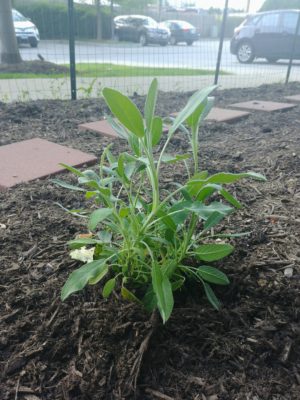
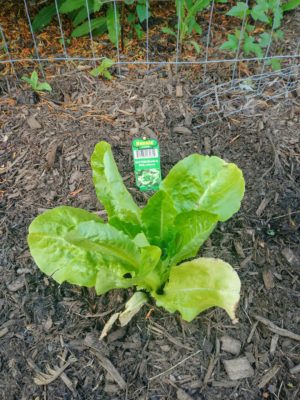
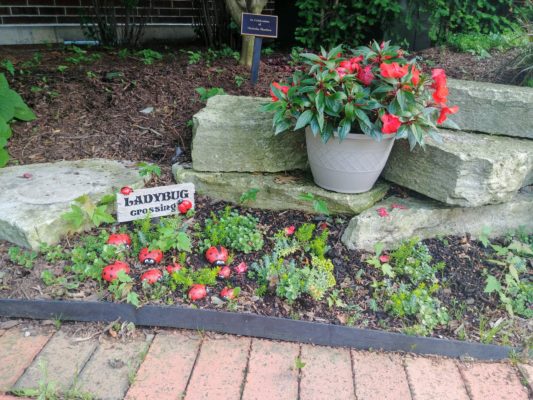
The second week of Trail Mix was a great success, and we had double the participants as last week, which could only mean there was double the energy! Our outdoor activity was vegetable gardening, where youth took turns planting tomatoes, basil, lettuce, sage, rosemary, and other plants into the ground. Then, we went inside and started making bird houses from recyclable materials. I really enjoyed seeing youth who did not previously know each other work together so well on painting a birdhouse.
Next week will be a short week due to the Fourth of July, but Sunday is also the Chicago Pride Parade, so look forward to exciting pictures from that.

Oliver is a politics and Spanish major from Chicago, Illinois.