
Week 6:
An Exciting Week
July 19, 2020
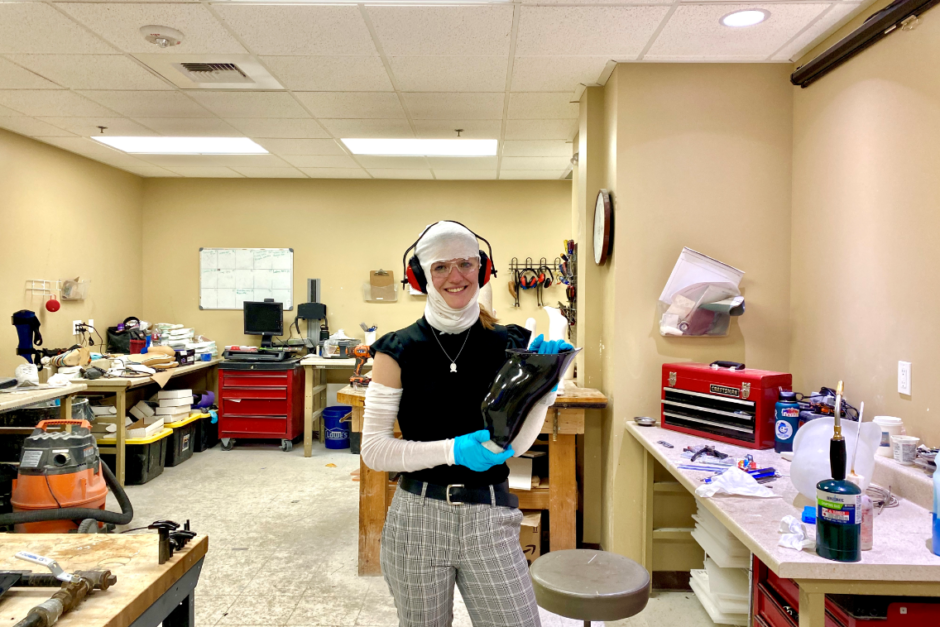
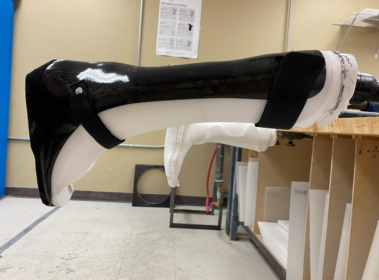
I want to start this week by wrapping up the AFO project with the big lift that I introduced last week. The fabrication went very well and the final brace fit the patient and helped her mobility. She will come in for a follow-up in a couple weeks to address any issues that may have presented while using the brace in her everyday life, but we were very happy with the results of this fabrication.
A really exciting part of my week was getting to see, and assist with, an upper limb prosthetic. Everything I have worked on at MPO before this week has been for lower limb prosthetics and orthotics so this was a very exciting change in pace. Upper limb prosthetics are more rare than lower limbs, some prosthetists may only see one or two in their career. One reason that upper extremity prosthetics are fairly uncommon is because they are typically more complex, which makes them very expensive. Unfortunately, many insurance companies currently have very poor coverage of these expensive prosthetics, making them unattainable to most patients.
This arm was particularly interesting because it was myoelectric, this means that a computer controls the arm using electrical signals from the patient’s muscles. In the socket there were electrodes that sit against the patient’s skin and forward the muscle signals to the prosthetic arm. This was a Coapt arm, which means that the arm is programmed to learn and improve as it is used. We calibrated the arm to do four basic motions: hand open, hand closed, elbow flexion, and elbow extension. To achieve these motions each is associated with a specific pattern of signals from the muscles. These patterns are given from imitating different motions that activate chest and back muscles. We calibrated the arm so that pulling his shoulders up towards his ear caused elbow flexion, pushing his shoulders towards the floor caused elbow extension, pushing his shoulders forward/closing his chest caused the hand to close, and pushing his shoulders back/pinching his shoulder blades caused the hand to open. To activate the muscles for each of these actions the motions do not need to be big, in fact, the prosthetic arm can be signaled with very little visual movement of the shoulder. As the patient practices with the arm it will learn and adapt so that it becomes easier and easier for the patient to control. Once the patient is confident in those four controls more can be added to get more specific movements in the arm.
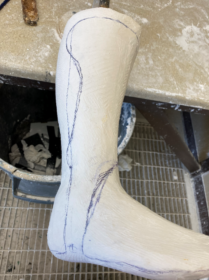
I got a lot of hands on work in the lab this week with some new skills and I loved having that opportunity. I made sure to snap some pictures of my work to share with you!
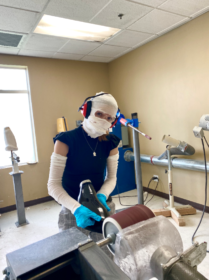
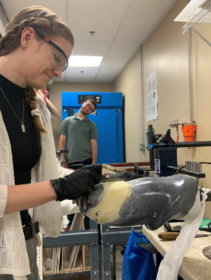
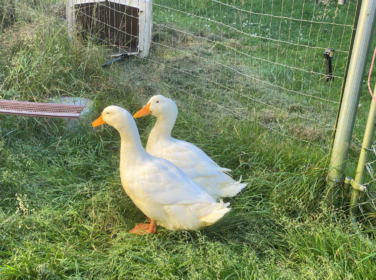
Only two more weeks left here in Washington! These six weeks have flown by and I have loved every moment of it. I am going to do everything I can to make the most out of the last two weeks of my fellowship at MPO.
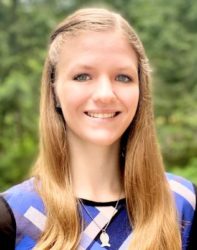
Sarah is a kinesiology and psychology double major from Broomfield, Colorado.