
Week 7:
Science is Cool
July 14, 2021
Science is Cool
I officially finished testing all antibody ELISA samples this week and have done some preliminary data analysis. Everything from this round of the study seems to match up, as expected, with the previous two rounds. This is good news, showing that our data is consistent, which will allow for better analysis.
I also began introducing myself to the other tests that our lab has been working on. My favorite so far is cell culture immunofluorescence (CCIF). We use this to determine the amount of virus shedding that happened when a sample was infected with rotavirus. Dr. Peng Zhou showed me the cells that had been stained with a green fluorescent tag under the microscope. Each cell that glows green has been infected with rotavirus and has begun producing antibodies. Less glowing green cells means less infection, which means less virus shedding. This is what we want as a result of the vaccine because virus shedding is how rotavirus spreads. I loved seeing the actual stained cells under the microscope. The antibody ELISA assay does not yield any visible results until the very last step, and even then, all I see is color in a well. Seeing the individual infected cells is so interesting to me and makes all this science we are doing feel way more real.
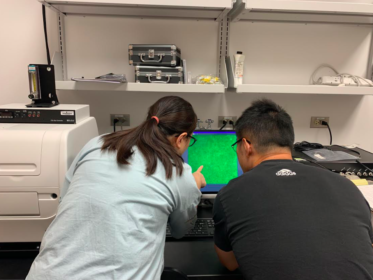
This upcoming week I expect to begin working on antigen ELISA assays. This monitors antigen numbers instead of antibody numbers. The assay is a bit different in design, but the overall concept is similar to the antigen ELISA I have been working on. I am extremely excited to work on yet another assay!
Happy Fourth!
I was also able to get together with a friend from high school for a Fourth of July barbecue! I haven’t seen her in years, so it was exciting to catch up with her after this long. It also allowed me to road trip to the northern part of Virginia and explore the state outside of Blacksburg, which I always enjoy.

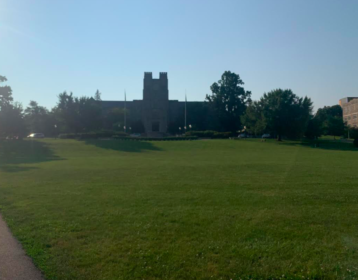
Speaking of exploring, I took a bike ride around Virginia Tech’s campus and saw the amazing “Hokie Stone” buildings. Hokie Stone is dolomite, a mineral mined from the Appalachian mountains and most commonly found in Virginia and other surrounding states. It reminded me of King Chapel on Cornell’s campus, another breath of something familiar.

Samantha is a biology major from Evergreen, Colorado.