
Week 3:
Getting Down to Business
June 25, 2022
We began this week completely putting the Gold Standard behind us and beginning our project: how does the level of hypocretin affect REM sleep without atonia (RSWA)? Hypocretin is one of the chemicals in the brain that controls the wake/sleep cycle. It helps us stay awake when we are awake and, conversely, helps us stay asleep when we are asleep. It is understandable that hypocretin levels could be a factor in individuals with RSWA.
Dr. St. Louis gave us some lectures this week about sleep disorders, going particularly into detail about narcolepsy. We had covered sleep apnea last week, and this presentation covered type 1 and type 2 narcolepsy. Type 1 narcoleptics have abnormally low hypocretin levels (this is one of the key diagnostic thresholds) and usually demonstrate cataplexy, or the sudden onset of muscle weakness when laughing or a similar event.
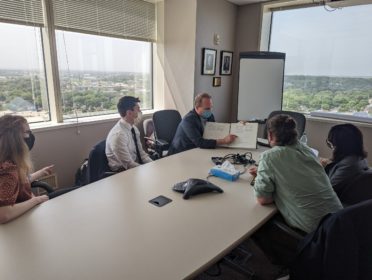
My favorite part of the week was starting to patient chart using the hospital database, Epic. This includes recording what kind of narcolepsy/hypersomnia the participant has, as well as their hypocretin levels. It also includes a medication list that includes beta blockers, antidepressants like SSRIs, and antipsychotic medications. Cataplexy, restless leg syndrome, and history of neurodegenerative disorders are also recorded. All of these have potential to affect RSWA, so we wanted to document them to make sure hypocretin was the only factor influencing our data. We also collected the Epworth Sleepiness Score to see how tired the patient was at the time of the sleep study.
The multiple sleep latency test (MSLT) and actual PSG data are also recorded. MSLTs show how fast people fall asleep and/or hit REM. The PSG shows their arousals, REM time, apneas, BMIs, O2 saturation, and percent of different sleep stages. All of this information is used to compare the participants’ PSGs and again focus on the hypocretin in the study.
I liked patient charting a lot. I enjoyed seeing the journey the physicians had to come to an eventual diagnosis, as well as learning what a bunch of new medications did.
RSWA scoring was, of course, another key component of this week and this project. After completing the Gold Standard, we began to score real files for the project. Most of them were cleaner, though files from a lab in France did have distinctive differences due to the differences their electricity system has compared to ours, which I found interesting. After scoring files for RSWA, we reviewed each other’s files to makes sure none of us missed anything or scored anything too harshly. I personally enjoy the charts more than scoring, though each are a critical part of this project.
The other thing I really enjoyed was something we did last week with Dr. St. Louis: looking at a real patient’s case. Last week it was an MSA case. This week he presented us with different cases. The first was a classic sleep apnea case using a home test, of which he highlighted the benefits to us. Another case was a more conflicting one. The patient had some signs of REM sleep behavior disorder, but much of his issues did not occur during REM, meaning a non-REM parasomnia was more likely. I enjoyed the process of hearing Dr. St. Louis go through how and why he eliminated certain conditions.
In an update to the shadowing experiences, I was offered the chance to observe a cardiovascular surgeon in the OR perform an open mitral valve repair. Though not regarding sleep, surgery is something I am super interested in, and I hope this gives me an idea of what that is like in a career. This is currently scheduled for Wednesday the 29th, and I am looking forward to it immensely.
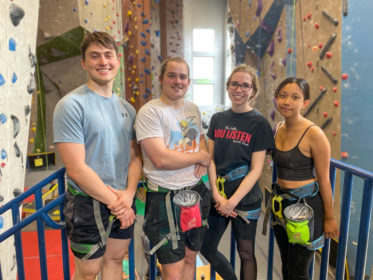
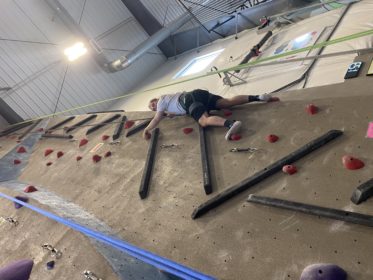
In addition to going to Thursdays Downtown, Makayla, Carter, Dalin and I all went rock climbing on Friday afternoon after we finished up for the day. It was a fun bonding experience and made me remember how much I enjoyed the sport! Friday activities seem to be becoming regular, so hopefully I will have a new one each week.
Nolan is a biochemistry and molecular biology major from Omaha, Nebraska.
PreviousWeek 2: The Gold Standard
NextWeek 4: My First Shadow Experience and the Start of the Manuscript