
Week 6:
The Children’s Hospital
July 4, 2013
This week I have been continuing to collect the necessary clinical data as well as measuring x-rays. I have finally been given access to the x-rays I need (which I couldn’t access before), so I have been able to make quite a bit of progress these past few days. After I measure the x-rays for pre and post-op degree of curve(s) and pelvic obliquity, I check in with my site mentor. She has been very patient with me as I work on perfecting this skill. The most difficult part for me is seeing many of the anatomical marks on the x-ray because sometimes the x-rays are not super clear. My site mentor assured me that it is indeed difficult to make these measurements, especially on the post-spinal fusion x-rays when the patient has hardware in place. However, at our last meeting she told me the numbers I was getting were, on the whole, pretty good (which made me really happy). One of the most valuable aspects of this experience has been the mentorship I have received from my supervisor, an orthopedic surgeon. The last time I met with my site mentor, she decided I should also collect the amount of levels fused during surgery, so she gave me a spine model to help me visualize the information I was collecting. Typical spine anatomy includes 7 Cervical (neck) 12 Thoracic (upper back) and 5 Lumbar vertebrae (lower back) with the sacrum below. In order to stop the motion at one segment, two vertebrae need to be fused. So, for example, an L4-L5 fusion is a one-level fusion. Many times the surgical notes may indicate that the level of fusion was T2 to the sacrum, posteriorly. From this information, I determine the number of levels fused. The spine model was especially helpful when thinking about the number of levels fused for such a large range because I am more of a visual person. It also just helped me become more familiar with typical spinal anatomy in general.
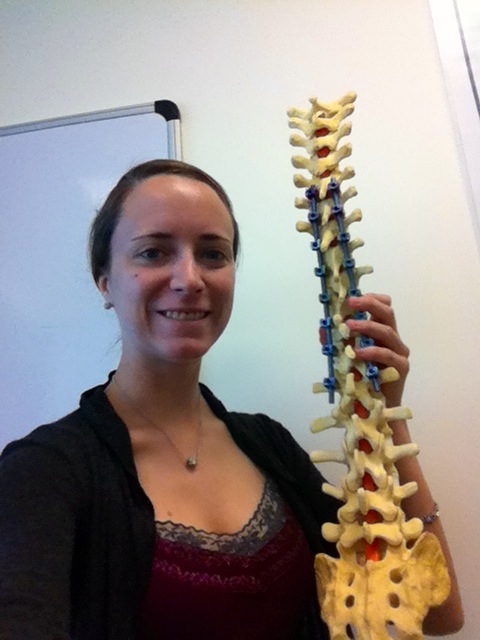
This week I have also been thinking about how Cornell has helped prepare me for this experience. There have been moments when I have felt overwhelmed by the workload, especially as a result of the unexpected issues with gaining access to “missing” medical records/x-rays I discussed in my last blog. I feel like the block plan has more than adequately prepared me to keep working despite feeling overwhelmed. Balancing the intensity of the block plan with extra-curricular activities has forced me to learn how to function under a stressful environment, and to just keep “chugging along”.
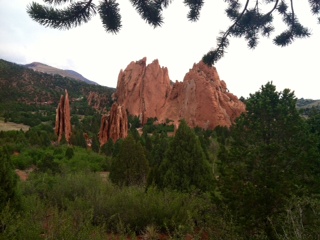
I have continued enjoy the beauty of Colorado in my free time. This past weekend I had the chance to visit Garden of the Gods. It was absolutely beautiful with lots of wonderful sights to see. I am so glad I have been given the chance to spend a summer in place filled with so much natural beauty.
Major: Biochemistry & Molecular Biology. Hometown:Maroa, Illinois.