
Week 4:
Mayo Clinic
June 17, 2013
In the mornings, the other summer students and I continue to practice our RSWA scoring skills in order to prepare for the Gold Standard test. After we complete the Gold Standard test, our scorings will be considered reliable to use in the studies. After a week of experience with RSWA scoring, I have been exposed to a variety of patients. Every now and then I come across segments that I am not sure about, but I am getting much more comfortable scoring by myself.
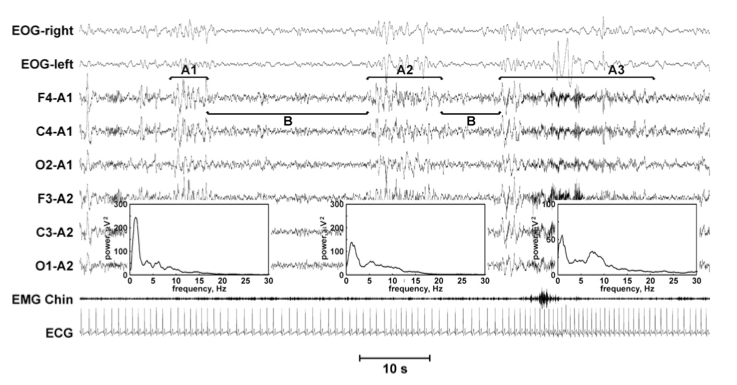
The afternoons are spent with Dr. St. Louis. This week we delved into the subject of Cyclic Alternating Pattern (CAP). CAP, which can be seen in an EEG lead during non-REM sleep, represents unstable sleep. To be considered CAP, the waves must be 1/3 greater in amplitude than the background. We can also classify CAP into three subtypes: sleep preserving (A1) and sleep fragmenting (A2 and A3). We have been learning how to conceptualize CAP by scoring a case together as a group. CAP scoring can be much more subjective than RSWA scoring, so it is important that we are all on the same page. CAP scoring can be tedious but hopefully it will get faster once we are more familiar with the process.
I attended two Clinical Pathology Conferences (CPC) this week. These conferences provided great insight into how challenging cases are diagnosed. The conference begins with a description of the case including past medical history, lab results, etc. Then, a clinician presents their opinion on the diagnosis while demonstrating their process of reasoning. First, the clinician, through a process of elimination, decides which types of diseases to consider. From this, they discuss possible diseases that fall under these types. They determined the probability by assesing the symptoms for and against the particular disease. After the clinician decides on a final diagnosis, a pathologist reveals the final diagnosis. After completing a biopsy, both cases were diagnosed as Central Nervous System (CNS) lymphoma. In the conferences I attended, both clinicians made an incorrect diagnosis, however, I think this shows the importance of collaboration in medicine.
“No one is big enough to be independent of others” – Dr. Will Mayo
Major: Biochemistry & Molecular Biology. Hometown:White Bear Lake, Minnesota.