
Week 9:
Audobon Center at Francis Beidler Forest
July 15, 2014
Everything is slowing down here at Audubon. It seems like this is the time of year when a lot of people like to take their vacation days. Good work is still being done, it is just done in a nature center that is a bit quieter than normal. That said, some exciting things still managed to happen this week. But first I need to mention a food item that you will only find in the south.
I’m going to introduce a new and bizarre food item that I do not believe most Northerners (Yankees) have heard of. I am a “Yankee,” I grew up near Chicago and I’d never heard of this until now. Erin told me about boiled peanuts last week and I got to try them today. Yes, that’s right, I said boiled peanuts. You may be wondering: what is that!?, as I did. They are exactly what they sound like. Peanuts still in their shells are boiled for 12+ hours in water with an ungodly amount of salt. The result is a soft, messy peanut that is very salty and has a unique taste to it. Mackenzie got some for me from a gas station this week and I was actually pleasantly surprised. I don’t think they are anything to rave about but I enjoyed this bizarre little southern treat.
But, back to business. I went out to find A914 on Monday and the whole swamp was silent. There were some frogs and cicadas still croaking and buzzing away, but bird-wise it was like a race-track seconds before the starting gun goes off: silence. The only thing I saw was one unbanded male Prothonotary, probably a fledgling, on Tuesday. Matt and I were getting a little worried that we weren’t able to find our long-shot A914, so Matt took his PROW song recording and played it over where we had seen him last and he flew right over. PHEW! We were all a bit more chipper after finding him.
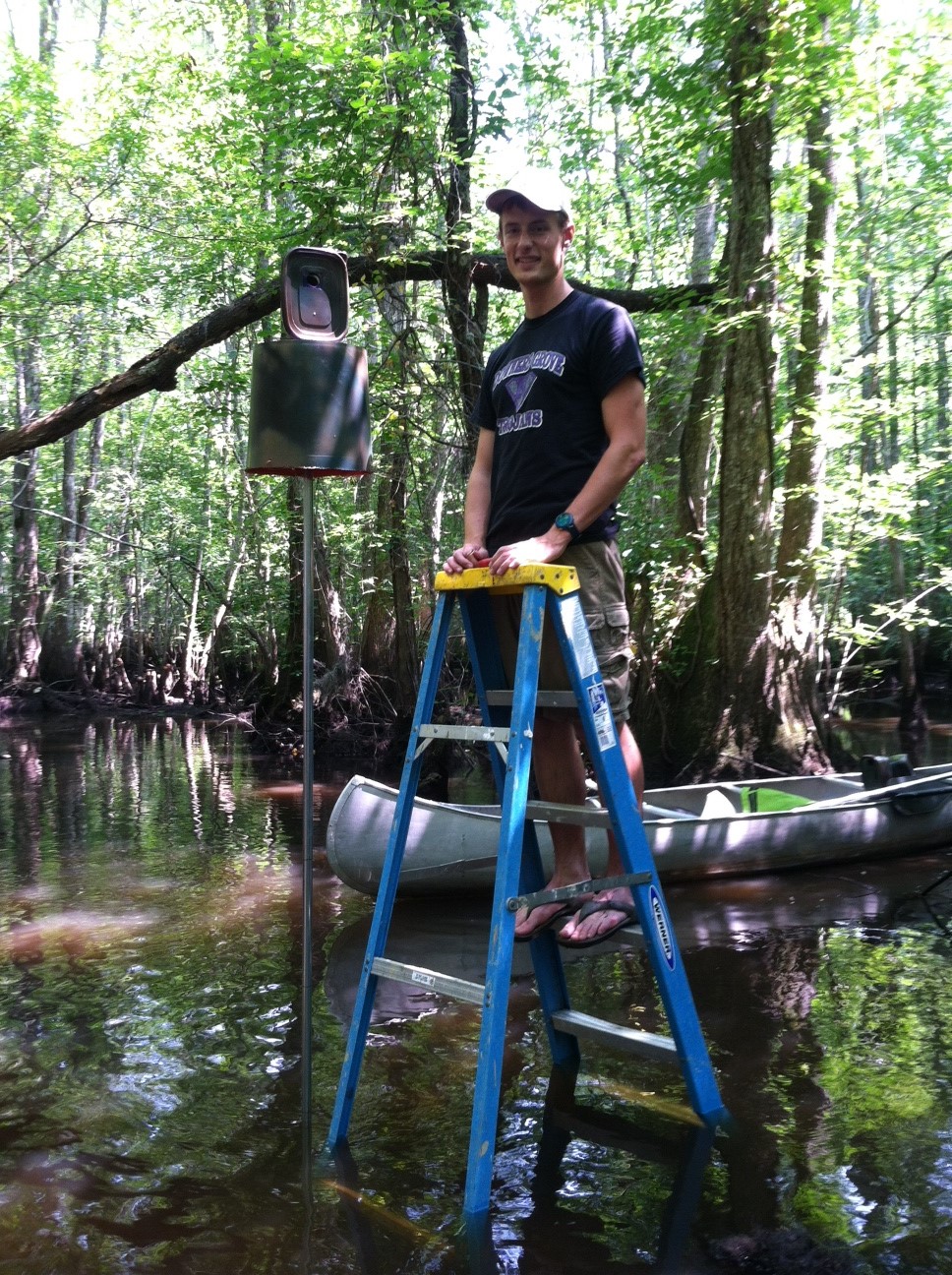
The other update on the Prothonotary front is about the nest boxes I have been constructing. I am almost done building my goal of 20 nest boxes and I have only just started installing them. On Monday, Matt and I went out to experiment with installation. What is the easiest way to drive the metal post in to the ground? How will we stabilize the nest box once it is in the ground? How far away should they be from each other? How many can we realistically install in one trip if our canoe can only hold so many? After an afternoon of playing around in the boat and getting our legs and feet wet, we installed three boxes and made it back right when everyone was leaving for the day. Based on past Prothonotary Warbler nest box studies, we decided to space them 50-100m apart so if consecutive boxes are used, they won’t be uncomfortably close for the territorial yellow-feathered friends. I won’t bore with the other minute details but if you are interested you can email me at Nschillerstrom15@cornellcollege.edu. We installed 3 nest boxes that were still standing at the end of the week when Mike showed me the rest of the canoe trail off-shoot where I will be installing them.
I sat in on a meeting with Sharon, the lady who, among many other things, writes grant proposals for Audubon SC. She was asking Matt questions about the costs and potential growth of Project PROTHO and I decided to chime in to say that a lot of professors like to add an extra $5,000 or so in to their research grant proposals in order to have an intern over the summer. I have learned that organizations like the National Science Foundation love when education is part of a professor’s research and are usually eager to supply that extra money. Sharon and everybody else in the room loved the idea of including money for another intern next year so I volunteered to write a program for next year’s possible intern. Who knows… maybe I will apply for it if it happens. It would be pretty cool to say that I was the beginning of a project with so much potential like Project PROTHO.
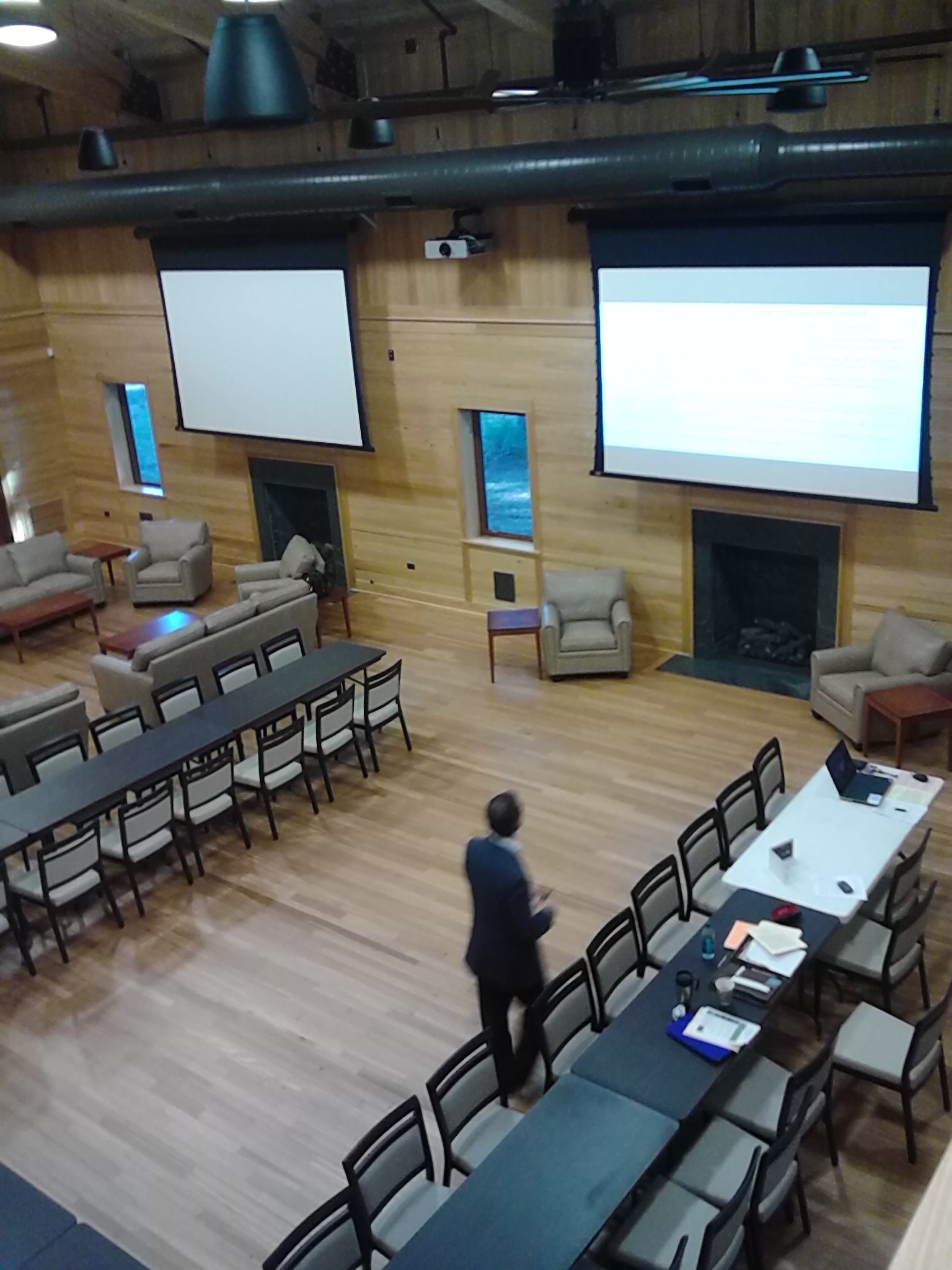
On Wednesday I went with everyone from Audubon SC to a meeting hosted by Audubon. They invited conservation leaders from all over South Carolina to learn about and discuss how rising sea levels will affect bird populations along South Carolina’s coast. The meeting was held in a brand new meeting room at Dixie Plantation with a state of the art PA system. About 50 conservation leaders attended the meeting and I was almost stunned by how many important and influential people were there. I got to talk to a handful of them about their careers and learned a good deal about how the DNR, Fish & Wildlife Service, The Nature Conservancy, and other companies all work together to protect land. As sea levels rise, salt marsh habitats are being pushed farther and farther inland. But with development and the urge to protect developing areas from high tides and rising sea levels, many dikes and sea walls are being built. While these barriers will protect structures from the rising water, they also prevent salt marshes from shifting to higher ground, effectively killing off this essential habitat for many birds and other animals. This meeting really made me want to play a bigger role in movements like this one. I think I see the direction I want to take with my career. But I don’t think I will ever be able to see very far ahead of me with any accuracy.
On Thursday I attended an interview-style webinar with the President and CEO of The National Audubon Society, David Yarnold. It was very interesting to hear how he answered the host’s questions and it was cool to see how enthusiastic he was about answering the questions of interns like myself. Apparently there were interns from all over the US listening in on this webinar. I got two questions in before the hour was up and I would like to point out that twice David said he was impressed with the questions people were asking, both after reading the ones I had asked. No big deal though… The most interesting thing he talked about was a climate initiative that will be made public on September 9. A scientist working for Audubon that is really good with territory maps looked at the habitat ranges of every bird species in North America and how rising water levels will affect them. He concluded that 100 species of birds are in danger of going extinct or being seriously damaged due to rising water levels. I am excited to see this study and to see what actions are taken to preserve these birds. It is a perfect connection between my two majors: environmental studies and biology. The other thing I pulled from this webinar was a quote from David: “The scientist who is a better blogger is more valuable that the scientist with a PhD who cannot communicate.”
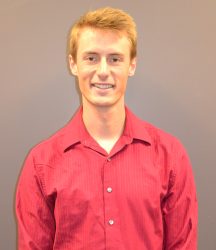
Major: Biology and Environmental Studies. Hometown:Downer’s Grove, Illinois.
PreviousWeek 8: Audobon Center at Francis Beidler Forest
NextWeek 10: Audobon Center at Francis Beidler Forest