
Week 1:
The Iowa Labor History Oral Project
January 14, 2016
Elizabeth Flick ’17, Arthur Vining Davis Fellow in Translation
Well, my first week of interning for the University of Iowa Labor Center has drawn to a close. It has been a bit of a crazy week; I drove back up to Iowa Saturday night (if you saw the tornadoes, wind advisories, severe thunderstorm warnings, and flash flood warnings on the news, those kept me in good company as I drove in from Texas) only to be greeted by a winter storm advisory Monday. Thankfully, my wonderful site mentor here let me know I was fine to work from campus translating some release forms and other documents rather than braving the weather. I still had fun uncovering my car from the snow later last week when I did make it in to the office, but at least the roads were clear before I put my winter weather driving skills to the test.
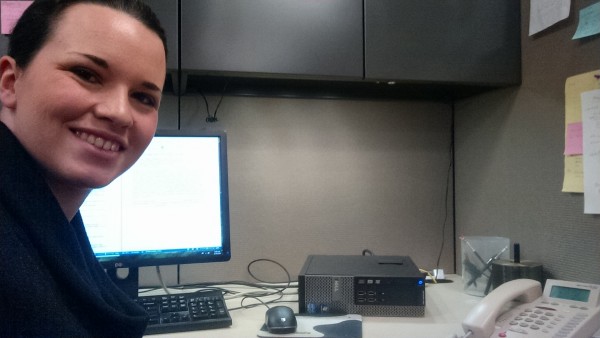
However, I should back up a little. The Labor Center which I am interning with has an ongoing project, the Iowa Labor History Oral Project (ILHOP), with which I am assisting in my own small way. ILHOP has been going on for more than forty years, interviewing the diverse individuals which have built the history of labor in Iowa, organizing unions and going through many struggles in their day to day lives to make things better for themselves and for future workers. In recent years, many of those workers have been immigrants, including a large number of Spanish-speaking immigrants.
That’s where I come in. For this first week, I have primarily been taking release forms, data sheets, a brochure, and other documents and translating them into Spanish. While many immigrants who first arrived in the 1980’s or earlier are more than fluent enough to tell their stories in English, there are also those who are not. By making materials available to them in Spanish, we can reach out to more individuals for this important project.
Of course, long term we need to actually interview Spanish-speakers as well. Later on I will likely have the opportunity to help conduct such an interview, but for right now I am learning how to properly transcribe one that has already been conducted. Though it is still early, of course, I have already had an opportunity to learn of some of the struggles these individuals go through upon immigrating here, only to work in industries which can often take advantage of them. More than learn of their struggles, I am able to hear them in their own voices.
From a technical standpoint, this week has also been a week of learning exactly where I stand in relation to Spanish skills. I am an English-Creative Writing major, simply filling in almost all of my electives in Spanish, so it can be a bit difficult to determine my exact skill level sometimes. As I am looking to go into translation for future study and as a career after graduation, I was very curious to learn the areas where I need improvement, and areas where I am relatively strong already.
My conclusions thus far: 1) My vocabulary could stand some expansion; while I can find a way to say basically whatever I need to, for exact terminology that simply is not good enough. 2) Clearly, I am most familiar with Central and South American accents, as well as with Castilian Spanish. It’s worth noting that many of the immigrants likely to be involved in this project will speak Mexican dialects, and 3) like many non-native speakers, I am far more confident with writing and comprehension than with speaking.
On the other hand, my vocabulary has grown significantly just over the last week and should only continue to do so. Furthermore, even the first transcript I am working on has over two hours of recorded Spanish, spoken naturally in a Mexican dialect. Intentionally or not, I seem to be strengthening my weaknesses.
I am proud to be a part of such a project, especially while improving my own Spanish skills, and very thankful to Cornell Fellows for allowing me the opportunity to do so. On a lighter note, though, I can’t not comment on the beautiful countryside around here. Iowa City (or Coralville, as we are actually located), is quite close to campus, but since this is my first semester with a vehicle on campus I have had little opportunity to see anything up until now.
So, I have a new goal of remembering to pull aside and take a picture of the view I am blessed to see nearly every day as I drive in to the office. Over the next week, I also have the pleasure of continuing my current transcription work and meeting with the assistant curator of the Iowa Women’s Archives to learn some background on ILHOP and context for how the work I am doing fits into a broader project and the oral history work with the Mujeres Latinas project, which sounds interesting but which I know nothing about currently. I can’t wait!
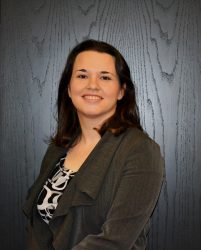
Elizabeth Flick is an English and creative writing major from Paris, Texas.