
Week 2:
Transcription and the Immigrant Experience
January 14, 2016
Elizabeth Flick ’17, Arthur Vining Davis Fellow in Translation
This second week has been quite busy. Wednesday (January 6) I had the opportunity to meet with Janet Weaver (seen below). She is one of the chief individuals responsible for creating an index of the interviews for ILHOP several years ago, essentially enabling historians, labor activists, and any other researchers to quickly look up a given topic and find which interviews contain relevant information. Considering that ILHOP has accumulated over 1,000 interviews, many lasting about two hours, such a tool is invaluable.
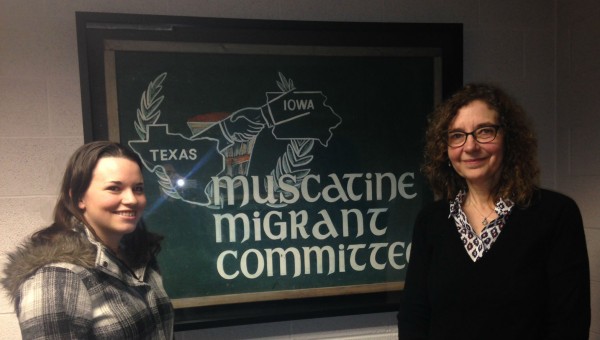
However, Janet has since moved on to new projects; she is currently the assistant curator of the Iowa Women’s Archives and part of the Mujeres Latinas project, seeking to document the lives of Latin American women in Iowa through their own words and artifacts. Some of the interviews I am and will be working with will eventually contribute towards this project.
Friday was a meeting as well, this time with Mary Bennett, the Special Collections Coordinator at the State Historical Society of Iowa. Mary was kind enough to show me around Special Collections, where an absolutely immense collection of interviews, artifacts, and union records is stored among many other things. The interviews I am working to transcribe and translate will be stored here where future researchers can access them.
Of course, I did not simply spend all my time meeting and touring around. This week I completed a time index to the first Spanish interview and have started transcribing it as well. The work is consuming; for the time index, I needed to note each time a new subject was introduced, check with Janet Weaver’s index to see if there are similar terms which I should try to match with for continuity’s sake, and note the subject. In an often fast-flowing conversation, this sometimes means rewinding repetitively to ensure nothing is missed.
Transcription is even more challenging. In natural speech, we all tend to cut ourselves off, interrupt one another, introduce slang, or drop consonants or even entire syllables of words (for instance, dropping the ‘g’ off of the end of an -ing word). Generally, this doesn’t really matter; meanings are still readily conveyed.
However, I am working with a second language, in a specific accent of Spanish, with terminology that is often new to me. It has been fascinating to note the differences between Castilian Spanish and Central Mexican Spanish, which is largely derived from Andalusian Spanish back in the days of the conquistadors but has some influence from the native community and of course from the natural progression of time.
From a less technical standpoint, the interview I am currently working on has proven intriguing for entirely different reasons: the subject matter. While in 2008 I was not paying close enough attention to the news to notice it, a raid was carried out by U.S. Customs and Immigration Enforcement in the small town of Postville, Iowa. There, at a meatpacking plant known as Agriprocessors, Inc., some 300 workers were convicted on charges of document fraud. This was the largest raid of its kind in history up to that point, and the first of several such raids in 2008.
Many of the undocumented immigrants were put in prison for around five months before being deported. For a town the size of Postville, with just over 2,200 individuals, the loss of so many at one time was devastating. Moreover, many immigrants in the community who were not part of the raid became scared and left, virtually overnight, as well. In part due to the impact at Postville, many all over the nation began reviewing immigration enforcement policies more closely.
I knew none of this before listening to the interview, but hearing of the interviewee’s first-hand experiences during the raid brought home in the most significant way possible some of the real struggles many such individuals, as well as the communities they live in, face far more than we could ever see on the news. Background research elaborated on many of the issues she described briefly, including poor work conditions and discrimination, and showed me a slice of America we often seem to overlook.
So, at the end of another week, I have much to think about. I’ve learned far more than I could have anticipated already about at least one immigrant’s experiences here in the States and furthered far more than I could have hoped for my hear for Mexican Spanish as I constantly repeat the audio and transcribe word-for-word the two hour interview. What’s more, I have started learning more about labor history in Iowa, unionizing, and how all of this fits together (as well as where to access similar resources in the future).
On a side note, I never did manage to get that photo of driving in to Iowa City— I blame the fog. Hopefully it will be included at some point, though. Next week, I will be able to share my first-hand experience travelling to Storm Lake, Iowa for a fresh Spanish interview.
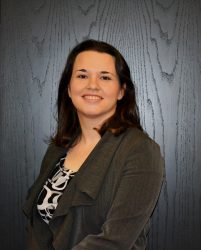
Elizabeth Flick is an English and creative writing major from Paris, Texas.