
Week 4:
Don’t Blink
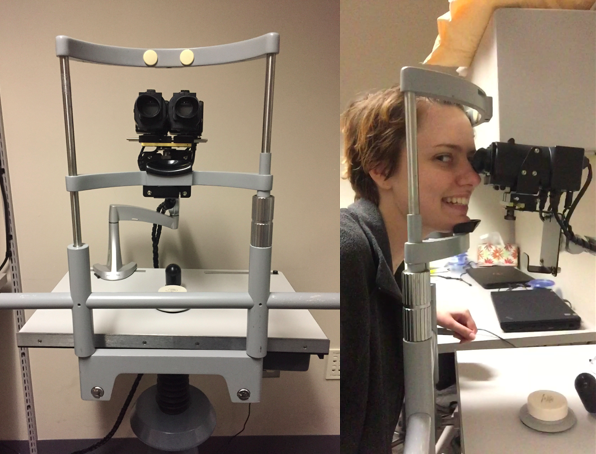
The camera used to perform pupillometry.
June 20, 2017
A very interesting part of my experience in the lab is just seeing the differences between participants. Everyone has a different experience and a different background. Everyone’s different, and this includes our eyes! In the study that examines vascular health in people with mood disorders, we perform pupillometry. Pupillometry is not exactly an easy process; it involves going some time without blinking, all while being exposed to bright lights. I find it very interesting how much this task differs in difficulty for individuals. One participant has no problem and does not blink or have to redo any tests. Some participants cannot keep their eyes open through the lights at all. So far it seems that there is not really any indicator of who will do well and who will not. When you take a participant back and set them up, you really have no clue how it will go. The whole lab has given it a try, and for me it is not very challenging at all. For others, it causes watery eyes and discomfort. However, it seems like everyone is always willing to give it their best.
Though sometimes these studies are uncomfortable, participants seem to power through them. Most participants say they come in and do their best in hopes of helping people like themselves. They don’t want others to suffer in the ways they have, they want life for people with mood disorders to get better. This is such a noble thing to me; spending so much time, and risking one’s comfort, just to try to help people like them. I find it to be a beautiful thing. It reminds me that there are lots of good intentions and kindness in this world.
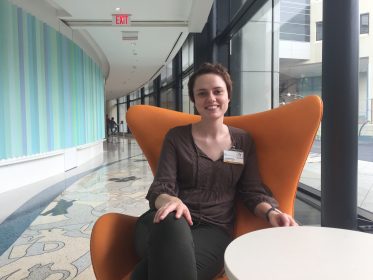
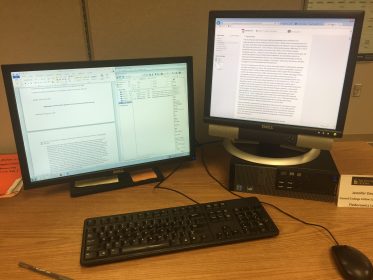
When I am not doing pupillometry or appreciating the participants, it seems like I am always doing research! This is a great chance for me to improve my research, reading, and note taking skills, not to mention it allowed me to learn to use EndNote, the bibliography software. I will also be getting the opportunity to practice some writing, as Dr. Fiedorowicz said I could take a stab at writing a section in a literature review he is working on. So, I have been doing a lot of research on insulin resistance in people with bipolar disorder, and have started working on writing about the current literature. This is definitely a lot of work, particularly the reading paper after paper part, but I’m glad I’ll have the chance to hone some of my skills. Cornell has given me a good base of research and writing skills, and now I’m really able to put these to the test!
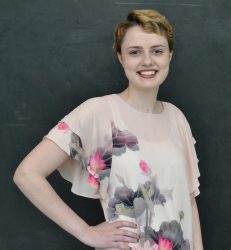
Jennifer is a double major in philosophy and biochemistry and molecular biology from Cherokee, Iowa.