
Week 7:
Going Wild
July 14, 2017
Such an active past week!
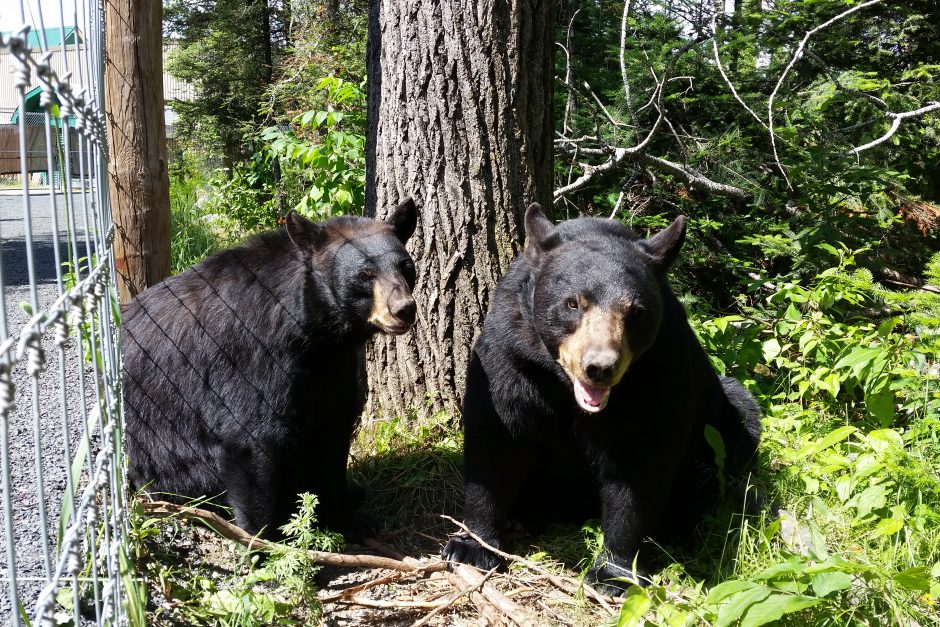
It has been a joy to see our two females, Holly and Tasha, playing with each other in the mornings. However, complications have arisen this past week as Holly grows tired of play. She plays with Tasha all morning and then she plays with Lucky all afternoon- leaving her tired, if not a little grumpy.
Lucky, however, in the afternoon still wants to play with Holly despite her not wanting to, which led to her being very vocal to him one afternoon and swatting him with her paw. Because of this, we think Lucky is jealous of Tasha’s morning playtime with Holly.
This has left us scratching our heads as we try to figure out the best bear rotation to avoid conflict and to keep Holly happy and not overplayed since two other bears demand her attention.
Our current setup is having Tasha and Holly out in the morning then bringing Holly in at 11, Tasha is brought into her personal enclosure at noon and then Lucky is let out into the big enclosure. Then at 2, Holly is let out into the big enclosure again to play with Lucky during the afternoon. This allows Tasha and Lucky to have their “Holly-time” while giving Holly a couple hour break.

I also had the joy of seeing wild bears this past week. All of the interns were invited to go to the Wildlife Research Institute (WRI)- Dr. Rogers’ other non-profit organization he founded whose mission is to “conduct scientific research on bears, other wildlife, and their habitat, and provide that information to decision-makers, the scientific community, students, and the public”.
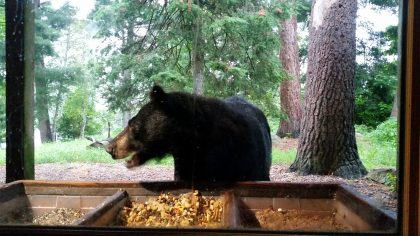
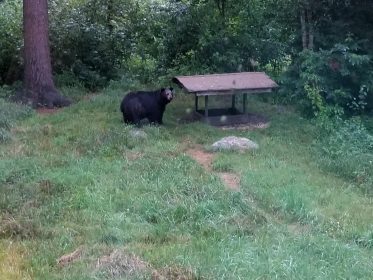
The WRI has feeding stations set up for wildlife to graze at and when we arrived there were two wild bears there. One was RC, an 18-year-old female bear. RC gets her name for the white “Right Check” mark that she has on her chest. She looks similar to her mother, Shadow, and has the same wariness around people, so we kept our distance when we arrived so she would be comfortable.
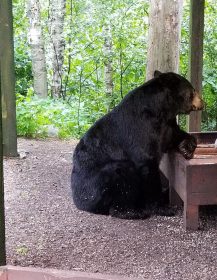
The other bear there was a large, male bear named One-Eyed Jack. He was named so for having only one eye. He didn’t start out that way- we suspect he was on the receiving end of a shotgun. He also has many scars from surviving hunting seasons and mating seasons. Dr. Rogers believes that One-Eyed Jack is almost as old as Ted (20) at the North American Bear Center. Although Jack has been shot at and sought after by hunters, he is very calm at the WRI and happily munches on nuts and pays us no mind. However, as soon as he leaves the WRI he won’t be spotted again until he returns to the WRI. This emphasizes how black bears are location specific and have excellent long-term memories. Jack has consistently returned to the WRI each year between July 11-14 and will only trust humans in this location, whereas other locations may get him killed or he may be unwelcomed.
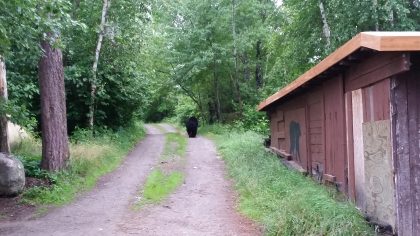
We thought those would be the only two bears we would see that night as we watched them walk away. Then, THE bear arrived. Shadow, the matriarch of Dr. Lynn Rogers research and the oldest documented living bear in the area (30 years old). She is very cautious which has helped keep her alive this whole time. She came to the food stations furthest from the WRI and was always prepared to bolt into the woods if something were to startle her. Since she has lived so long, we could all see her grey face stand out from the rest of her black body. It was awe-inducing. And then just as quickly as she arrived, she was gone.
I have had some mental challenges this week as I read articles about the 16- year old who was killed by a black bear during a race in Alaska and then a Kenyan who was chased by a black bear in Maine. For those of you who joke, that “of course, a Kenyan would outrun a black bear”, I would like to point out that black bears can run 30 mph while Usain Bolt, who many consider to be the fastest man alive, maxed out at 28 mph.
These articles challenged what I know of typical black bear behavior. Black bear attacks are rare- 1 in a million of black bears are predatory black bears, so why does this make it seem like there have been so many? Why does this anecdotal evidence of one or two cases carry so much weight when stacked against research and statistics? I can only guess it is the emotional appeal that overrides the logic. Because what of the stories that people have when they encounter bears and nothing happens? How many bears were in that area, how many people walk through that same area each day and never encounter a bear, how many people walk through that area and do encounter a bear but the bear runs off?

Kelly is a biology major from Burlington, Iowa.