
Week 8:
Butterfly Life Cycles and Den Digging
July 21, 2017
This week started out with high hopes of seeing the Northern Lights. There was a large solar storm and it was predicted that the Northern Lights could be seen as far south as Illinois and Iowa. We (the interns) were giddy with excitement- we were finally going to see the Northern Lights! All other possibilities were met with cloudy skies that skewed our view, but that night was a clear night.
We drove out at 10 to Tofte Lake in the Superior National Forest. We set up chairs and waited as it became darker out. And we waited… and waited. Nothing. We ended up going home with more bug bites and disappointment, but I did witness a shooting star before we left.
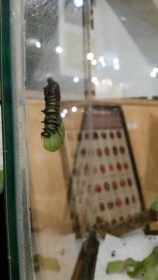
The next morning however, we got to see the process of a Monarch caterpillar pupating. It happens in the span of three to four minutes, so it is very hard to catch. The caterpillar sheds its last skin to reveal the dewey green chrysalis underneath- where it will form into a butterfly and emerge in two weeks!
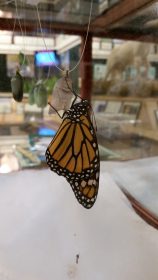
Later in the week, we got to see our first butterfly emerge from its chrysalis. Once it dried out its wings, we tested its abdomen for spores of the OE parasite. This is part of a citizen science project that the University of Georgia runs. We then made an announcement to our visitors and released the Monarch into one of our flower gardens.
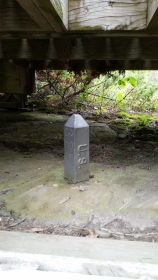
This week I was also able to visit Canada. I was visiting friends who were staying at a cabin at Lake Kabetogama. While they were fishing for Walleye, I was reading “Brain on Fire” by Susannah Cahalan. It was a very intriguing memoir about the author’s medical mystery. When my friends were done fishing, we went to Kettle Falls. Underneath a ramp was the marker for the U.S./Canada border. We had crossed into Canada numerous times on the lake, but there I was standing on Canadian soil. It didn’t look any different from the rest of the North Woods.
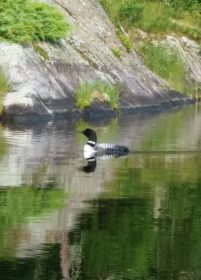
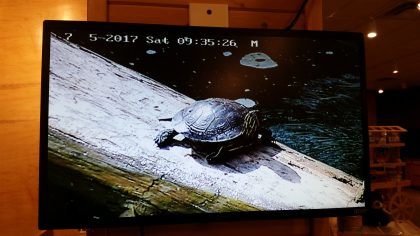
Not a lot has been happening at the bear center this week, although we did gain a new resident. About two weeks ago, a painted turtle appeared in the pond that the bears play in. It likes to swim in the pond and bask in the sun on one of the logs Lucky dragged into the pond. The bears don’t seem to mind the turtle and he has stuck around long enough that we finally decided to name him Franklin. After Franklin the turtle in children stories (whose best friend, just so happened to be a bear).
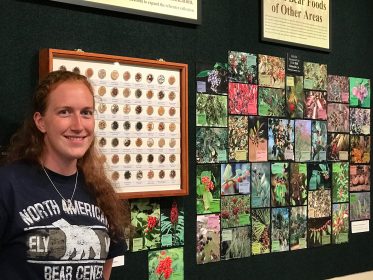
Other than that, we are still working out the kinks in the social dynamics between Holly, Lucky, and Tasha. Holly has been foraging a lot of the natural foods in the large enclosure and I caught her foraging some red raspberries along the fence. We can also tell what our bears have been eating by their scat, as gross as it sounds. Since their diet consists mainly of vegetation, it doesn’t smell as bad as one would think.
It also appears that Holly and Tasha are preparing dens for hibernation. Holly has been digging in the den she dug three years ago and Tasha has been digging underneath her cabin den in her personal enclosure. She may den in a den, beneath her den.

Kelly is a biology major from Burlington, Iowa.