
Week 1:
Welcome to Jamkhed
July 16, 2018
A Long Drive
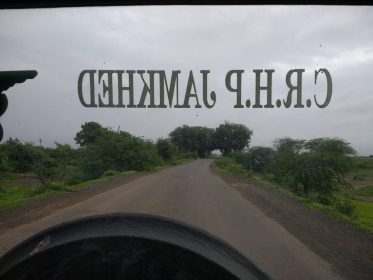
It was 2:30 in the morning when Mahadeo (the driver sent from CRHP to pick me up) and I finally got in the car to start the 8 hour drive from Mumbai International Airport to the Comprehensive Rural Health Project’s (CRHP) headquarters in Jamkhed, India. I started off strong by opening what I assumed to be the passenger door when Mahadeo said “No – drive.” I looked at him, confused, and then back at the open door; the open door with a steering wheel behind it. I looked back at him embarrassed, but he just smiled. I laughed and apologized, stuttering that I am from America where the driver sits on the other side. He was unfazed and we went on our way.
Mumbai in the middle of the night during a rainstorm looks like it could be straight out of a dystopian novel. There are massive buildings, hotels, and billboards everywhere, and lights glistening through the heavy downpour. There are also people sleeping on the raised concrete beneath underpasses and next to sinks in public restrooms. There is trash everywhere and stray dogs that maneuver through heavy traffic almost as well as the drivers do. There are businesses and homes condensed together in an almost impossibly small space, and there are people walking in the rain to their homes, their meals, their jobs. It was like driving through the clashing of two worlds: that of the rich and that of all the rest. I spent a lot of that drive thinking about my culture, the ideas that had been so ingrained in me since childhood that I was unable to escape them even though I knew logically they were incorrect and inappropriate. I reminded myself that I was here to learn and to help in any way that I could.
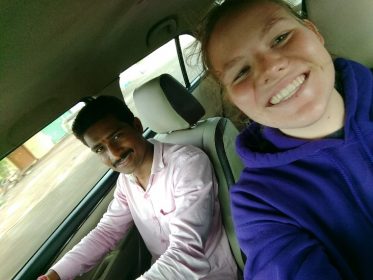
As the sky lightened and I saw more of India, the more excited I was to be in this place and to start the work that I have wanted to be a part of for so long. We drove through cities and villages and fields and even an army training camp. Mahadeo stopped for tea and although I wanted to try it I opted for a sealed bottle of water instead (don’t worry, I would have plenty of tea in the days to come). We listened to Indian music, talked about our families, and even took a picture together!
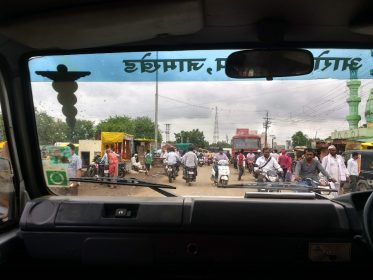
But I spent most of the time driving looking at the people and places we were speeding past, listening to the honks of trucks, cars, and motorcycles, and feeling so thoroughly grateful that I was able to spend some time in this beautiful place.
Arriving on Campus
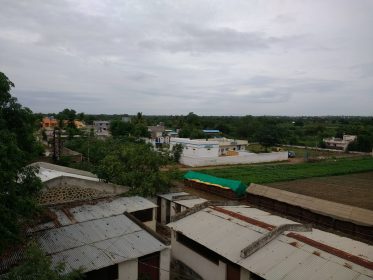
Finally pulling into the courtyard of CRHP was a whirlwind after hours of driving through lush greenery and bustling streets. Mahadeo and a woman showed me my room where I dropped off my bags before they escorted me to the dining hall (what I would come to call The Mess shortly after). There were four women and a man already sitting at the long plastic tables covered in cloth, and they introduced themselves to me as other undergraduate students from all over the United States. It was comforting to be greeted by people who I could relate to, and who had been here for at least a few days before me. I ate some pancakes before I headed back to my room to unpack.
After unpacking I went to the old training center to contact friends and family to let them know that I had made it to campus safely. I was walking around the first floor, trying to find the stairs that would take me to the second floor and the library, when I realized I had no idea what I was doing. I asked an older woman nearby where the stairs were by gesturing upstairs and to myself. She smiled and nodded, telling me something in Marathi, and took my hand. She laced her fingers between mine and led me to the front of the building and to the stairs that would take me up. Her kindness was such a small action, but it made me feel so welcomed in the community, even though I had only been there for a few minutes. She was the perfect introduction to CRHP.
What is the Comprehensive Rural Health Project?
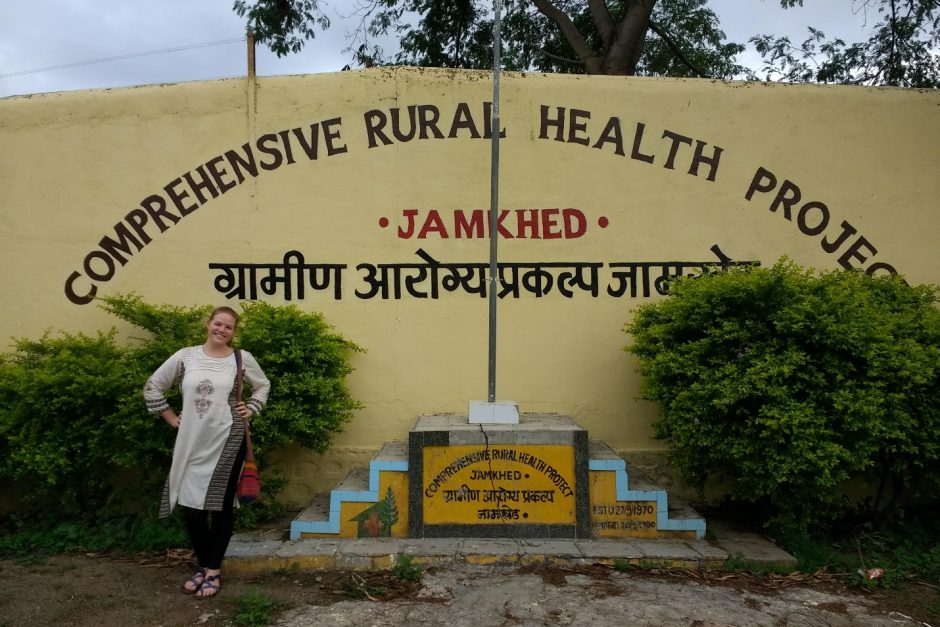
The Comprehensive Rural Health Project (CRHP) in Jamkhed, India is a nonprofit health organization that works with the rural poor and marginalized in various districts throughout India. Founded in 1970 by Drs. Raj and Mabelle Arole, CRHP has been working for and with the underprivileged and the poorest of the poor for the past 48 years. CRHP is attempting to change how health and empowerment are taught in India with a variety of programs: Women’s Self Help Groups that discuss village issues, learn about community health topics, and take part in microcredit; a Mobile Health Team that operates in many capacities including preventive and curative health services, social work, and development projects; and Adolescent Programs that cover topics like mental, physical, and sexual health, gender discrimination, self-defense, nutrition, and social issues. They work using a community based approach, known as the Jamkhed Model, to bring education, health, and empowerment to villages all over the state of Maharashtra. Jayesh, a CRHP staff member, said in one of our sessions that the community does not work for CRHP, and CRHP does not work for the community, but that the community and CRHP work together. This organization is an example of the kind of impact that can be made when nongovernmental organizations (NGOs) work to provide the resources necessary for people to empower themselves.
A Night (or Day) on the Town
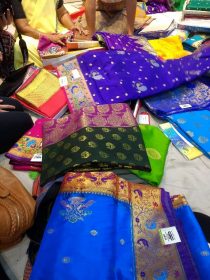
Shortly after I made it upstairs to check my phone and orient myself a bit, I was invited by the other interns/students on campus to go to town. I had a headache brought on by dehydration and exhaustion but I wanted to actively fight jet lag and so I said I would tag along. I made it downstairs and started running along with the rest of the group to catch up to Ratna, a CHRP staff member who was taking us into town that day. We rode rickshaws, bumping against the metal bars and speeding precariously past other vehicles, pedestrians, and animals before heading into a popular sari store. We climbed to the third floor, sat on mats, and were instantly showered in vibrant colors and intricate patterns. I bought my first sari at that store (pictures of which you will be able to see Week 2) and could not have been happier.
We returned to CRHP (again via rickshaw), only to turn around an hour later and go back to town. I was overwhelmed by the sounds of horns, the colorful saris that floated through the sea of people like flowers on a pond, vehicles and their proximity to everything, the smells of food and occasionally garbage, and the feeling of humidity and mud on my skin, but I was so thrilled to be a part of this giant moving puzzle.
Orienting to the Jamkhed Model
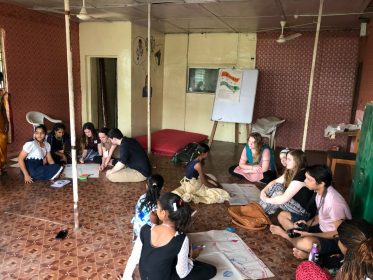
After two days of adjusting my sleep schedule, I started a three-week orientation to CRHP and their work on community based participation and sustainable development as part of a requirement for all interns and fellows. CRHP staff are the primary educators during the three weeks. In this first week we visited a project village (with CRHP programs present) and a non-project village (without CRHP programs present), and observed differences between the two. We were able to observe a Village Health Workers’ (VHW) training session, watch them treat patients in their own villages, and hear their stories about the hardships they had overcome to be the women and community members they are today. We sat in on an Adolescent Girls’ Program meeting where they talked about nutrition, menstruation, gender discrimination, practiced self-defense from one of their own members, and played games – they are kids after all.
Final Thoughts
Overall, I am happily adjusting to life at CRHP; I spend my free time reading or playing games with the other students on campus, the food is delicious, the conversation is stimulating, and I have even mastered the art of the bucket shower. I am falling in love with Jamkhed, and I cannot wait to see what Week 2 has in store.
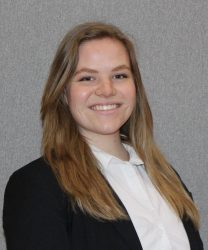
Taylor is an international relations and Spanish double major from Denver, Colorado.