
Week 3:
Travel Time
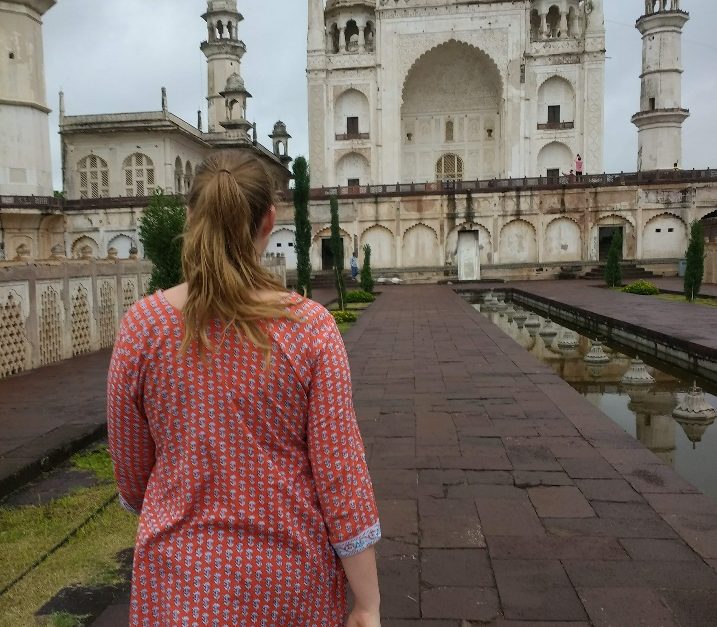
Walking down the main path to see the “Mini Taj Mahal”
August 1, 2018
“Putting the Bad in Aurangabad”
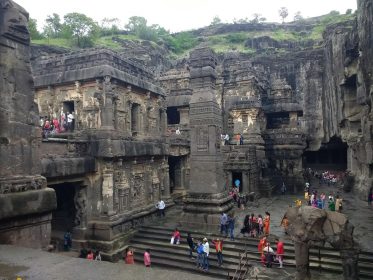
Although it happened too late to include in last week’s blog post, we finished out the second week of our orientation with an overnight trip to Aurangabad, a major city that is a four-hour drive away from Jamkhed. It was our opportunity to be tourists and see some more of the beauty of India, and boy did we. Our first day consisted of one of our vehicles breaking down within 10 minutes of the drive, then the four-hour drive to Aurangabad, followed by lunch before a couple of hours spent in the Ellora Caves. The Ellora Caves are some of the largest stone-cut caves in the world, and consist of Buddhist, Hindu, and Jain monasteries and temples. It was a humbling experience standing in the massive structures and seeing the extensive detail that was put into the statues, carvings, and paintings.
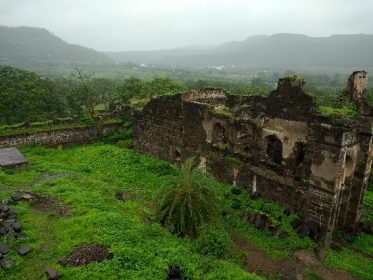
Our second day included a trip to the Bibi Ka Maqbara (or the “Mini Taj Mahal”) before touring the Daulatabad Fort, and finally visiting a small silk factory before heading back to Jamkhed. The “Mini Taj” was a lot of fun, and quite intricate and beautiful. The fort, however, was one of the most beautiful things I’ve ever seen. It has obviously degraded over time (as old buildings are expected to do) and was completely overgrown with lush grasses and moss. It was built to inflict psychological warfare rather than just physical warfare and so learning about how they protected against invaders was fascinating. We wrapped up the day by visiting a silk factory where we were shown scarves, bed covers, pillowcases, placemats, and many other beautifully embroidered cloths. It was my favorite location because it felt so peaceful; we looked at what must have been thousands of colors while cool air flowed in from outside. After the hectic environment at the fort, I welcomed this simple and quiet break from the outside world.
The Final Week… Kind Of
This past week was the last week of the orientation practicum. We spent our days learning about appropriate technology, the Adolescent Boys Program, social, cultural, and political contexts, herbal and alternative medicine, low-cost secondary care, and CRHP’s organization and administrative structure. We had the chance to visit the artificial limb center on campus where we saw how the metal is made to be stiff but molded, and we were taught the medicinal properties of a variety of local plants by Village Health Workers and Surekha. Ravi Arole, the director of CRHP, sat with us and broke down how CRHP is able to function efficiently on a small budget. Ravi explained how they are able to run a 50-bed hospital on campus with three nurses by disseminating knowledge from nurses to family members. Teaching family how to care for the patient allows the nurses more time, and the family is able to actively take care of their loved one.
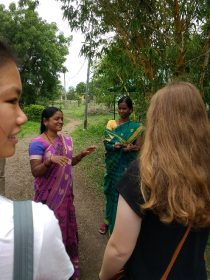
On Friday we visited the CRHP farm that is managed by a woman named Ratna. We toured the grounds, saw the livestock and fields, and then sat down beneath a green canopy to hear Ratna’s story. She told us about the obstacles she had overcome: an HIV diagnosis, the loss of her husband and son, and social ostracization. She eventually found work at the CRHP farm, but the stigma of HIV followed her wherever she went; the other employees refused to sit with her during meals, and she did not truly feel part of the community. Dr. Raj Arole heard about this and came to the farm one afternoon, shared his plate with her, and spent over an hour addressing people’s questions about HIV and how it is transmitted. Her face lit up when she talked about Dr. Raj and how he made such a huge difference in her life; by simply eating with her he was able to break down stigmas that had been passed down for generations. It was powerful listening to Ratna’s story, to see how far she has come, and the impact that CRHP has had on countless people’s lives in so many ways.
Reflection…
The CRHP orientation has taught me so much about rural India, the importance of collaboration with the community, and how to be successful within a cultural context. I have learned so much about this organization, how it functions organizationally, financially, and with the broader community, and what it has done for the people who have taken part in its programs. I have also had the chance to reflect on my own understanding of development and sustainability. I have realized that although I have understood the importance of involving the community in development schemes, my theoretical development program would stop there; I might ask what they wanted to institute or build, but after their input, I would do the planning and execution myself. I never once stopped to think about how I would build the social structures within the community so that they would have the strength as a unit to make decisions for the betterment of their village as a whole. I would not have thought to simply let them discuss their obstacles and then come to me with requests, nor would I have thought that they should be the ones implementing those solutions in their own communities with as little help from me as possible.
I have learned more than I thought possible in a few short weeks. I have learned that progress is slow and that failures are common, but that progress must be slow to be sustainable and that failures are necessary to learn and improve. More than anything I have realized the true value of people. CRHP is a successful and sustainable organization because of the people that work for and with them. The staff provides translations, educates visiting students, and trains VHWs, the Village Health Workers. The VHWs spend countless hours supporting each other and their villages, learning and improving the health of so many. The administrative staff work to spread the Jamkhed Model around the world. Jayesh said in one of our first sessions that success always lies within the community, and I have only just begun to understand how essential and accurate that statement is.
… And Progression
Now it is finally time to start my internship projects! There seem to be a plethora of possible projects that need attention, including social media, writing and designing the annual report, interviewing beneficiaries of the many CRHP programs, and taking part in focus groups in villages. I am excited to work as part of a team and to learn as much about the goings-on within an NGO as I can. Here’s to another phenomenal week!
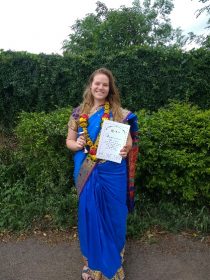
Taylor is an international relations and Spanish double major from Denver, Colorado.