
Week 8:
End of the Line
July 27, 2019
My senior year is fast approaching, and this summer internship has come to an end. To anyone who has read all my entries: thank you. You are a trooper. Or you’re using these blog posts to help you fall asleep. I have a couple of final thoughts on what I have gained from my time in Boston.
What is the point of undergraduate research?
Here is the thing about doing research as an undergraduate: you’re probably not going to cure cancer. Many undergrads who pick up a summer research experience fantasize about making breakthroughs or getting first- or second-author publications in Nature. However, these things are nearly impossible to achieve in two or three short months. It’s not a crime to have unrealistic fantasies. When I was newer to lab work, I had them too. But just because you’re not winning a Nobel Prize doesn’t mean you’re not gaining anything from a research experience.
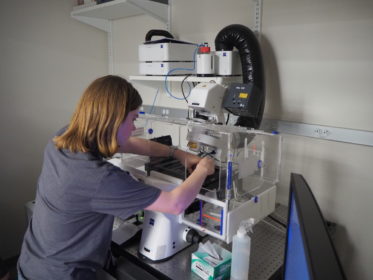
confocal microscope (Zeiss).
Before you can advance a field, you have to learn the tools of the trade. Though lab classes expose students to many of those tools (such as immunoblotting, cell culture work, and qPCR), many techniques used in research laboratories are too expensive, niche, or time-intensive to teach students. And some procedures lab classes may have exposed students to, but not to the same standard expected in research. Sure, “dissecting a mouse” is a fairly common lab for a biology class. But how many biology classes have a student dissect twenty mice in a row, harvesting several tissue samples from each? Undergrads engage in research experiences to master these tools of the trade. It’s not enough just to be able to follow a recipe for a technique. You must understand how and why the technique works, so that you can recognize and fix mistakes and interpret the results of your procedure. As an undergrad, you don’t work in a lab to be perfect or an instant expert. You’re here to learn.
Why do I care so much about cutting up mice?
Any research I contribute to doesn’t exist solely to decorate my C.V. or win awards. It exists to advance humanity’s understanding of the immune system and inform medical care. Having my work published may help me get a job or acceptance into graduate school, but that’s not why it’s published. Research is published so that other people can learn from it. Obviously, I will need graduate school, jobs, and livable wages to make a career out of research, but I’m not going into research to get rich or famous. Biomedical research is much, much bigger than I am, and it touches lives all around the world. I am grateful to Cornell College, the Cornell Fellows Program, and the Nowarski Lab for helping me be part of something so incredible.

Margaret is a biochemistry and molecular biology major from Longmont, Colorado.