
Week 1 and 2:
Raptor Conservation
June 3, 2021
This summer I decided to find an opportunity related to my major, which is Environmental Studies with a concentration on Wildlife Conservation. As I applied for internships, I came across an opportunity to be an intern at Iowa Raptor Project in Solon, Iowa. I found out about this opportunity from an alumnus who is a friend of mine, Marin Dettweiler ’19. I instantly emailed Ryan Anthony who is the director of Iowa Raptor Project. Ryan replied almost instantly, interviewed me over the phone that day, and I started the internship soon after. A summer internship at Iowa Raptor Project will help to expand my field of knowledge in environmental studies through hands-on experience that is impossible to fully obtain in a classroom setting. I have a passion for animals, and this opportunity will allow me to pursue my interest in wildlife conservation.
The Iowa Raptor Project has a mission of connecting students and the community to the conservation of birds. They conduct research on birds of prey and their natural habitats, along with providing educational opportunities to students. The research I will be involved with focuses on nesting habitats, migration routes, and wintering grounds. The goal of this research is to preserve raptor populations and habitats through education. This will create awareness, appreciation, and inspire others to protect birds of prey. This related directly to my career interests in wildlife conservation. The Project currently displays a total of 15 birds of prey found in Iowa and it is open to the public. More information about the program can be found on their blog: https://iowaraptorproject.wordpress.com/
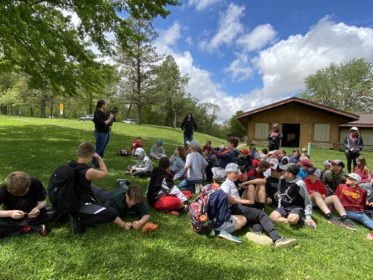
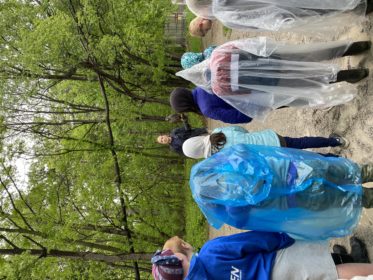
I learned a lot in the first two weeks of the internship. The first thing I learned how to do was giving food and water to the raptors. The first couple days I helped with programs for children. The first program was off site and the second program was on site. The off site program was for 5th graders and we brought three of the raptors; Wannago (Great Horned Owl), Saguaro (Harris’s Hawk), and Omaha (American Kestrel). My coworker Amanda presented the birds to the students. The second program was onsite with second and third graders. The kids were fascinated by the raptors which was fun to see.
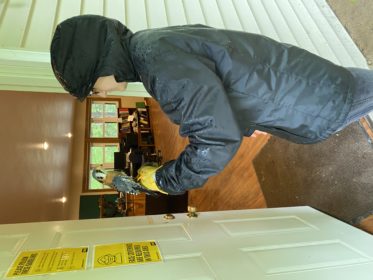
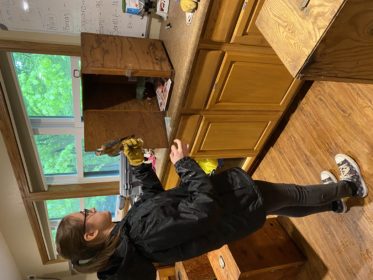
Following the programs, I was trained by Amanda to hold the raptors. I learned how to take out and handle Omaha, the American Kestrel and Little Horn, the Eastern Screech Owl. In order to do the programs, interns must learn all the steps in handling and transporting the raptors safely. There is also a written test and memorization of the signs of stress of the raptors I am being trained to handle. Interns have to pass the written test in order to be qualified to do off site programs with the raptors alone. To study for the test, we were given study guides with information about each raptor we have on site. Along with studying for the written test, I was tasked to write up study guides on all of the other raptors we have. The study guides I create are the same kind of study guides we use when studying for the exam, just for different raptors. These study guides are for the volunteers who need this information so they can properly do their jobs as volunteers.
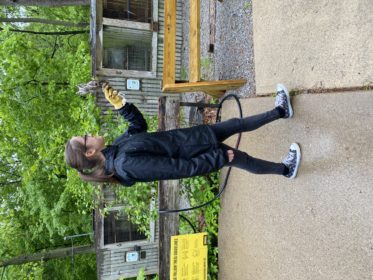
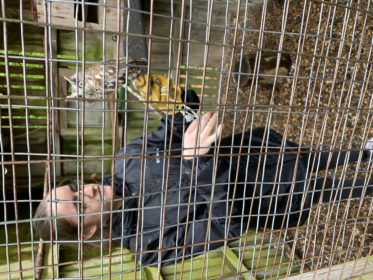
I began working with another intern, Lyndi, and we work together just about everyday now. We feed the birds when other people can’t and we drive to Solon to get bird seed for the bird blind. The bird blind is a building where people can sit and watch birds and other wildlife.
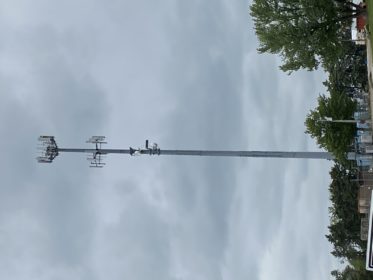
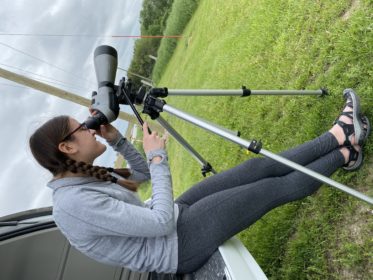
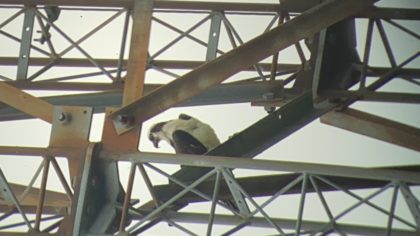
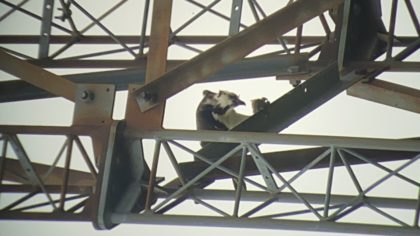
One day, Lyndi and I went to monitor osprey nests. We went to three different locations the Iowa Raptor Project has marked for osprey monitoring. At each location, there was a tower with an osprey nest on top. We used a telescope and binoculars to watch and count the ospreys we saw in or around the nests at each location and record our observations on a data sheet. Since I now know how to monitor osprey nests, I was tasked to contact some other interns about monitoring ospreys this week. I will be showing these interns where and how to monitor the ospreys. Osprey monitoring is directly related to my interest of wildlife conservation.
I am learning about holding raptors and presenting them for raptor education programs; the behavior, adaptations, training methods, and more about different kinds of raptors; engaging with the public on various fronts and learning public speaking; opportunities to connect with other wildlife professionals and go on “rotations” to learn about their fields; and coordinating activities for volunteers, providing volunteer training, and other leadership experiences.
So far, I absolutely love this internship and I am so excited to find out where it takes me!

Alina Moore is an environmental science major from Taos, New Mexico.