
Week 3:
Flying Solo
June 8, 2021
My third week at Iowa Raptor Project was very eventful. I learned a lot and I got a couple opportunities to ‘fly solo’. The week began with learning how to clean the mews. In order to do this, we started by taking each raptor out of their mew and putting them in a hood. Not all the raptors are friendly, so this allowed us to clean without worrying about the bird. We first took out any leftover scraps, owl pellets, and all the feathers. The mews are cleaning by spraying everything down with a hose, scrubbing everything, then spraying it down once again. We also raked all of the rocks to ensure the raptor mutes were not piled up. We use the feathers to give to the National Eagle Repository to disperse to Native American tribes. Native American tribes use raptor feathers such as eagle and owl feathers for religious purposes. We collect feathers in boxes that Lyndi and I sorted through and placed in individual packaging to be shipped. We use some of the feathers for educational purposes at the raptor center. Ryan taught us how to differentiate the feathers from each raptor along with where on the raptor the feather came from.
We recently got a new raptor who came from the state of Washington. He is a human-raised Peregrine Falcon, who is about a month old, and his name is Tigerhawk. Ryan showed us how to make jesses, using Tigerhawk as an example. Jesses are what allow falconers to control and handle raptors. They are very helpful when glove training raptors, which we do so we can use our raptors for educational programs. Jesses are made of kangaroo leather, which is becoming more popular making it very expensive and difficult to find.
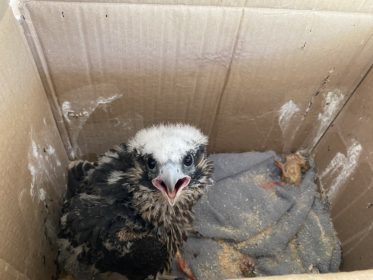
In order to make room for Tigerhawk, we moved Zorro, the Gyrfalcon to the empty mew next to one of our Bald Eagles, Spirit. In a couple weeks, Tigerhawk will be the first raptor people see when they enter the property.
I got the opportunity to hand feed Tigerhawk in front of guests, which was a great experience. I also got to hold Tigerhawk on a glove while Ryan was making his jesses. Lyndi and I held Tigerhawk while Ryan put his jesses on so we can start handling and glove training him. Hopefully, Tigerhawk will be a raptor we can use for educational programs.
I took a couple volunteer students from the University of Iowa and I showed them how to monitor osprey nests.
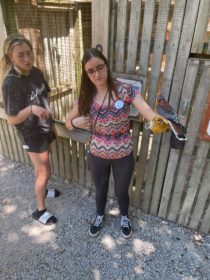
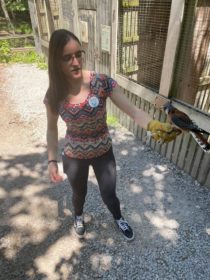
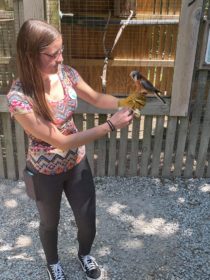
The last solo opportunity I got was practicing presenting the raptors to guests without supervision. This will help me when I have to actively participate in educational programs. Some family friends of mine came to the center and I was able to give them a tour. This included presenting Omaha the American Kestrel, and Little Horn, the Eastern Screech Owl. I was told I did a very good job presenting on my own for the first time.
Presenting Omaha
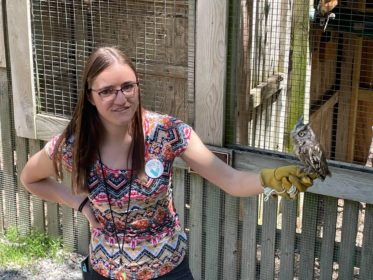
I learned a lot this week and I am so excited to get more opportunities to handle and present the raptors.
Alina Moore is an environmental science major from Taos, New Mexico.