
Week 10:
Training Tigerhawk
July 28, 2021
This week I spent a lot of time training Tigerhawk, the Peregrine Falcon.
The person who trains raptors is known as a falconer. Falconers participate in falconry, which is when people use birds of prey to hunt for them. This is similar to how people use dogs for hunting. For example, the falconer will flush out a flock of ducks, and the raptor will hunt the ducks and bring one back to the falconer. The beginning of training a raptor to be a falconers bird is ensuring the raptor is well behaved.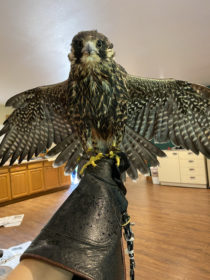
Tigerhawk is almost three months old. We are working on teaching him manners. When I say manners, one would think of being polite at the dinner table and in other situations. As far as Tigerhawk goes, the manners we are working on are his behavior. This mainly includes excessive vocalization when interacting with him. Other behaviors are biting the glove, begging for food, and footing. Footing means the raptor grabs someone with their talons. Raptors have very sharp beaks and talons, so we have to wear a glove to protect ourselves.
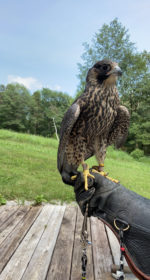
Tigerhawk was a little overweight this past week, which is why his vocalization has been excessive. To get Tigerhawk to a healthy weight, we essentially put him on a diet. This diet included only eating while being rewarded for cooperating during training. Training consisted of walking around the site with Tigerhawk on the glove and rewarding him when he was silent. I was in charge of training three days this week. On the first day, Tigerhawk did not cooperate at all due to his weight. Then the next day of training, he was vocal at first, then not vocal at all, which enabled me to reward him for such good behavior. On the third day of training, Tigerhawk was vocal most of the time, but he was still rewarded when he was quiet. Overall, training is difficult for both the raptor and the falconer. We are very excited about Tigerhawk’s progress this week and can’t wait to see his behavior continue to improve.
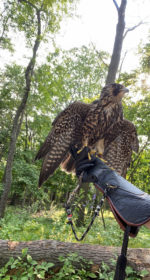
I really enjoyed learning more about falconry this week. Now I have more knowledge about the work it takes to be a falconer. I spent at least six hours holding Tigerhawk on the glove this week, which may sound like a lot, but handling the raptors is the most important part of falconry. Tigerhawk is still getting used to being on the glove, so when we handle him, we work on other office tasks so he can get used to random commotion without freaking out. When we walk around with him, we present him to guests and the wildlife camps. We have Tigerhawk because we are using him for educational purposes. In order for his purpose to be successful, working on his behavior is very important. I am fortunate to be able to work with this raptor since the day we got him. I have watched him grow into the raptor he is today, and I am excited to continue to help train him.

Alina Moore is an environmental science major from Taos, New Mexico.