
Week 11:
Self-Reflection
August 4, 2021
This week I did a lot of self-reflection.
Throughout this internship, I have been trying to figure out where this opportunity will take me in life. I have learned a lot about what my passions are and how I plan to pursue them. I initially thought I wanted to pursue a field in US Fish & Wildlife Service or US National Park Service. As amazing as working in either of those fields would be, I have found that my true passions lie elsewhere.
I have always had a passion for and connection with animals. I want to be able to work in a field where I can help people and animals. My chosen career path is to become a service and therapy dog trainer.
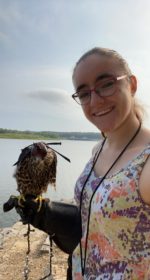
This field has become more critical since the Covid-19 pandemic began. More people started to adopt pets due to their change in lifestyle, which put them in distress. These animals are not bought just to be a pet. A lot of people buy animals for service and therapy purposes. Animals provide people with increased mental well-being. Training these animals takes immense patience and dedication. I want to help animals find their purpose to further help people. I think this is what our world needs right now, especially during a pandemic.
My internship has provided me with an opportunity to experience animal training. We are working on training our Peregrine Falcon to use for educational purposes. I have learned more about the work that goes into training an animal, and I enjoy it.
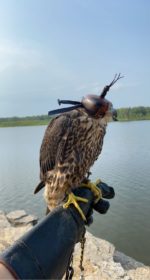
Training an animal is the same process, no matter what kind of animal it is. One might be confused about how training a bird of prey would help me with training a dog. To successfully train any animal, consistency is essential. This will provide the animal with a routine which they will learn from. Building a connection with the animal is another important part of training. The animal need to build trust in the trainer to progress. Once there is consistency, trust, patience, and dedication, the training of any animal, will be successful. The main difference between training a bird of prey and a dog is that birds of prey are wild and unpredictable. They have very sharp talons and beaks, whereas dogs have claws and teeth, which are less likely to truly harm the trainer.
I have watched the Peregrine Falcon grow from a chick into a juvenile raptor. His behavior has progressed over the time I have worked with him. We have been working on his vocalization behavior which we consider to be his manners. This is similar to when dogs bark excessively. Our goal is to get the raptor not to vocalize excessively when unnecessary, just like how a dog barks nonstop. We use food as a sense of motivation for the raptor during training, just like dogs get treats.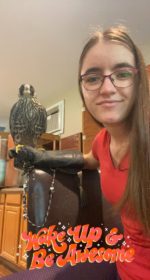
Every time the raptor stays quiet for a period of time, we reward it. This is the same as how a dog is rewarded for good behavior. Eventually, the raptor will realize that good behavior, in his case being quiet, leads to being rewarded. This will teach the raptor to not vocalize excessively when people are handling him.
Seeing the training progress with this falcon has made my interest in this field become a passion. I can’t wait to see where this passion takes me in life.

Alina Moore is an environmental science major from Taos, New Mexico.