
Week 12:
What I Learned as an Intern
August 10, 2021
I learned a lot throughout the last two and a half months as an intern at the Iowa Raptor Project. Before I started as an intern, I did not know much about birds of prey. Now I can identify and handle birds of prey, know when they are stressed, and distinguish their feathers. I am familiar with their vocalizations and other behaviors, and I know a lot about the different species. Now I would like to share some really cool facts about some of the raptors I worked with over the summer.
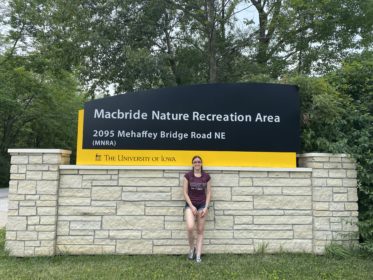
At the Iowa Raptor Project, we have 14 raptors; two American kestrels, a gyrfalcon, a peregrine falcon, a harris’s hawk, a red-tailed hawk, a turkey vulture, two bald eagles, an eastern screech owl, a barn owl, a barred owl, and two great horned owls.
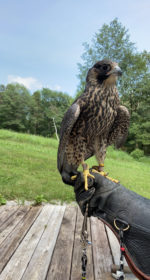
All species of raptors have their own adaptations. The falcon has a tomial tooth, which is a notch in their beak used to rip apart their prey. Falcons are the only raptors with a tomial tooth, which is how people tell them apart from other raptors. The peregrine falcon is known to be the fastest animal in the world. The speed of the peregrine falcon was clocked at 240 miles per hour by skydiving next to it.
The turkey vulture has a few adaptations that caught my attention. Turkey vultures eat roadkill, so they evolved to not have feathers on their head since they stick their whole head inside their prey. Turkey vultures defecate on their feet to stay cool, which is one reason they are so stinky. Another reason they smell bad is that they vomit a rancid fluid as a defense mechanism, similar to how a skunk uses a putrid spray to ward off predators. All of these adaptations help the turkey vulture survive in the wild.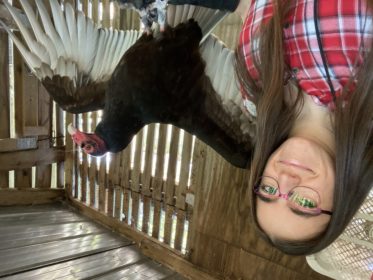
Owls are really amazing raptors, although they are not the smartest birds of prey, contrary to popular belief. Unlike other raptors, owls can turn their head almost all the way around (270 degrees). Owls have the ability to rotate their heads out of necessity. Because their eyes are so big and take up the entire eye socket, owls cannot move their eyes back and forth, so instead, they have to turn their head to see what is around them. Owls have 14 vertebrae in their necks, while humans only have seven. This allows them to turn their heads 270 degrees while humans can only turn their heads 90 degrees. The coloration of owls allows them to camouflage into trees, which is their main habitat. Some owls, such as great horns and the eastern screech owl, have feather tufts on their heads to make themselves look bigger. They also use these tufts for communication. An owl’s ears are symmetrical, other than the barn owl. The barn owl is considered to be in its own family since it is so different. Their ears are aligned differently, with one higher than the other. This adaptation allows them to pinpoint exactly where their prey is located without relying on their vision.
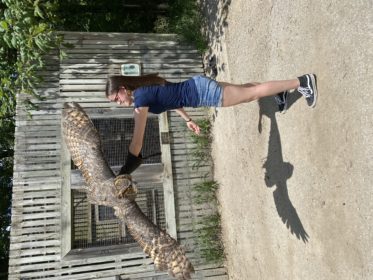
All of these adaptations help the raptors in different ways to survive in their natural habitats. Through my internship at the Iowa Raptor Project, I learned so much about raptors and falconry.
I have enjoyed all the work I have done for the Iowa Raptor Project, and I can’t wait to continue as a volunteer during my final year of college. I hope to work there after college for a couple of years as part of my career in helping animals.

Alina Moore is an environmental science major from Taos, New Mexico.