
Week 4:
The Gold Standard
July 8, 2021
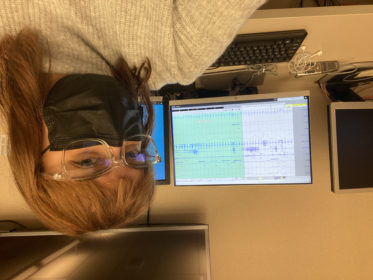
Scoring de-identified practice PSGs to prep for the Gold Standard
Week four at Mayo Clinic started off with us interns completing the remaining training file polysomnograms or PSGs and one extra Multiple System Atrophy or MSA patient training file. Our scoring master Tyler and our PI doctor St Louis reviewed these files and told us we were almost ready to take the test to affirm our scoring accuracy: the Gold Standard. We kept scoring to finish the rest of the training files throughout the week in preparation which was interspersed with journal club number three, completing the training to get approved to be on the IRB or Institutional Review Board to safely review identifiable patient data for research under Dr. St Louis’s guidance, and getting our official Mayo Clinic badges.
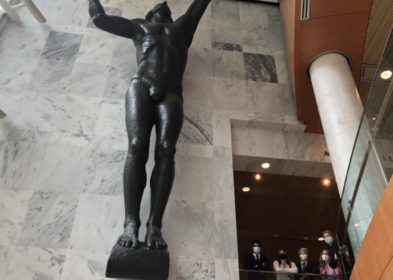
Dr. St Louis’s Minions and “Man and Freedom” by Ivan Mestrovic in the Gonda Building lobby
Journal club three concerned the review of three studies: one with clinical data and advising for COVID-19 neurological complications, one with a proposed mechanism of action of SARS-CoV-2 in the central nervous system, and one with a small sample case review of PSGs from patients who had recently had COVID-19. The last study examined the PSGs for signs of Obstructive Sleep Apnea or OSA and REM sleep without atonia or RSWA that could be used to diagnose REM Sleep Behavior Disorder or RBD. A very curious finding from the clinical advisory study was that hospitalized COVID-19 patients had a much higher likelihood of suffering an ischemic stroke than hospitalized flu patients, and the severity of a COVID-19 patient with an ischemic stroke is much greater on average, indicating more complex neurologic and immunologic effects from COVID-19 than from other upper respiratory viruses. Thrombophilia, or an imbalance of clotting proteins in the blood, is thought to be one important condition caused by COVID-19, by which these ischemic strokes tend to occur. One mechanism of action proposed by the next study posited that SARS-CoV-2 enters the central nervous system through the nose and the olfactory bulb, damaging these neurons and causing anosmia or the inability to smell, thought to affect many COVID-19 patients. They also proposed that delirium, which is another COVID-19-related condition in ICU hospitalized patients, could be caused by inflammatory immune complications of COVID-19 due to the virus infecting vascular and immune cells bringing about the infamous cytokine storm. Rather than infecting neurons directly, it seems that SARS-CoV-2 up-regulates inflammation which might be the primary cause of the encephalopathy, delirium, anosmia, and many other neurological manifestations of COVID-19. Lastly, in the final study, it was found that a small number of patients with COVID-19 who later received a PSG had a higher level of RSWA than the baseline for the general population, suggesting that RBD, too, might soon be added to the neurological complication list of the long-COVID-19.
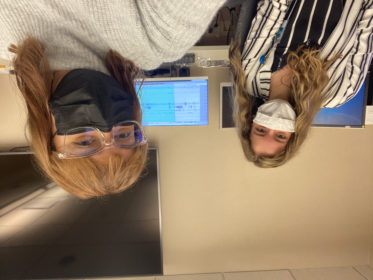
Olivia and I just before taking the Gold Standard
In the final days of the week, Olivia and I finished our last training files and took the Gold Standard, which consisted of ten mini-epochs of sleep on different de-identified patient PSGs chosen by PI Dr. St Louis. We both passed with Kappa statistic scores on all muscles between 0.7 and 1.0, indicating 70% accuracy or greater with some wiggle room for interpretation. In the end, we’re finally ready to start scoring COVID-19 patient and control patient PSGs for our summer project study, and we can also score PSGs from the NAPS Consortium, which stands for North American Prodromal Synucleinopathy, a coalition of many sleep research centers involved in RBD research from Stanford Medicine to Massachusetts General Hospital. Next week, I’m ready to begin this exciting work and utilize my new Mayo Clinic email to contact some neurologists, oncologists, and pulmonologists about shadowing.
Gwen Paule is a chemistry major from Saint Paul, Minnesota