
Week 3:
Diving Into Scoring
June 23, 2021
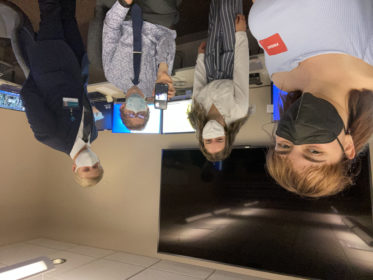
From right to left: David, Kevin, Scoring Master Tyler (virtual), Olivia, and me working on scoring training file 5
We began digging deep into the scoring curriculum training files this week. As it turns out, scoring is an even more complex art form than I had previously guessed. Even with this complexity, we ended up making it all the way through most of the training file five out of seven total. Scoring Master Tyler says we’ve progressed very quickly through the training files and we will be ready to take the Gold Standard scoring assessment soon. We’ve made it all the way from “mild” polysomnograms or PSGs belonging to mostly control patients to the “spicy” level ones which are much more complex and tend to belong to patients with Multiple System Atrophy or MSA. MSA includes some autonomic and movement abnormalities that Parkinson’s disease or PD does not, but both are characterized as synucleinopathies whose pathology lies mainly in the buildup of alpha-synuclein protein in the brain. Scoring the PSGs belonging to these patients is particularly challenging, but it has provided us with great experience and a deeper understanding of the disorder.
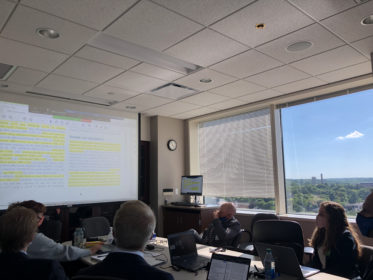
Dr. St Louis’s Minions and Dr. St Louis himself (far right) at Journal Club 2
Throughout the week we also had our periodic lectures from Dr. St Louis, our PI or principal investigator and neurologist who specializes in sleep disorders and synucleinopathies, particularly REM Sleep Behavior Disorder or RBD. We read and discussed another cross-sectional study reviewing the prevalence of abnormal characteristics like motor, vision, olfactory, autonomic, psychological, and sleep deficits as predictive markers in patients with future PD, dementia with Lewy bodies or DLB, and MSA. To me, one of the most interesting findings was that the olfactory test for hyposmia, the inability to smell strong scents linked to future or prodromal PD, is one of the most predictive tests for identifying patients with prodromal PD. This is essentially a scratch-and-sniff test, making it greatly accessible across patient communities with variable resources. Also of great intrigue, this study calculated the sample size necessary for a clinical trial testing possible neuroprotective treatments for prodromal synucleinopathies and lined up more than enough participants to fill several rounds of those very clinical trials in the future.
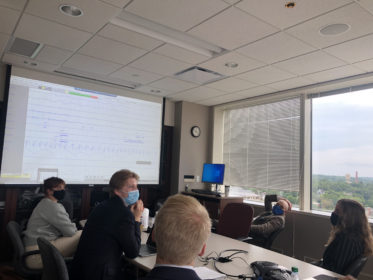
Dr. St Louis’s Minions watching him score a mild-medium PSG file named “Honey BBQ”
We also watched Dr. St Louis score some PSGs himself, which was very informative and entertaining. Scoring is a bit like fishing in a lake full of all different kinds of fish but you only want the salmon and of the salmon, you only want the salmon with the small fins, big eyes, and least amount of scales. Hearing and watching Dr. St Louis score live was very much reflective of our own internal monologue while we score. He deliberated back and forth about the frequency, amplitude, and general “juiciness” of the muscle signals to decide whether to mark them or not, how long the marking should be, “do we even dare to connect these two markings?” The reason we have to be so deliberate is that we don’t want to over-score or under-score a patient. Over-scoring could lead to a diagnosis of RBD that carries about an 80% chance of phenoconverting to PD in patients. Under-scoring could lead to missing an RBD diagnosis for a patient who deserves, with consent, to be fully informed with regards to their current and future health. It has always been tricky for Paul, Tyler, and Dr. St Louis to train many interns to score the same way, but with time we will all have group-scored enough to internalize the consistent method.

We had many more in-person trials, tribulations, and laughs this week as we have gotten to know each other more and more every day, bonding over scoring the spiciest of PSGs and eating equally spicy new Mayo Clinic subway cafe food every day. I am proud to hear from Scoring Master Tyler that we have progressed not only quickly but productively through the training files and learned so much in our three weeks here. I can’t wait to keep learning alongside my amazing fellow interns as well as start scoring some control patient PSGs and recovered COVID-19 patient PSGs to kick off the basis of our summer project data.
Gwen Paule is a chemistry major from Saint Paul, Minnesota