
Week 1:
Virtual Introduction to Mayo Clinic
June 8, 2021
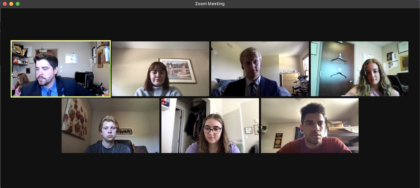
Our first-day introductions. From top left to bottom right: supervisor Paul Timm, me, David, Olivia, Kevin, Chloe, Jacob.
June 1st, 2021
My name is Gwen and I’m from Saint Paul, Minnesota. I’m a rising junior at Cornell College double majoring in Biochemistry & Molecular Biology and Spanish. I’m pre-med with the goal of conducting representative clinical research working with underserved populations such as women, BIPOC, and queer patients. Aside from my current internship with Mayo Clinic, I volunteer with Crisis Text Line as a volunteer Crisis Counselor and with the Cornell College Eating Disorder Institute as a research assistant. I am also one of two COVID-19 Data Collectors and Interpreters for Cornell’s Crisis Management Team. My goal for this summer is to continue serving my community with regards to COVID-19, mental health crises, disordered eating behavior, and in scoring data with Dr. St Louis’s lab at Mayo Clinic.
I got to Rochester this last Saturday in preparation for my internship to start on Tuesday. Wunmi, my housemate and Chemistry major from Stanford who is currently doing an internship with IBM, welcomed me warmly. We spend a lot of our downtime together since my first week at Mayo is virtual and some of her internships are as well. So far we’ve solved puzzles, cooked, and gone to the gym together in-between zoom meetings. Sharing over our virtual internships has been really valuable for me as I’m just now learning to live on my own for a bit. Wunmi helped me take some much-needed breaks between the multitude of background studies I was reading all week in preparation for the next.
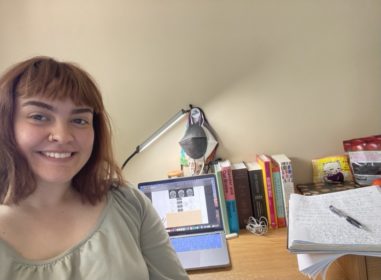
Here is my Rochester virtual setup complete with an MRI brain scan, notes, and dried cherries.
So far we’ve been learning the background of Doctor St Louis’s lab at the Mayo Clinic Center for Sleep Medicine that focuses on REM Sleep Behavior Disorder, or RBD for short. Diagnosis requires dream enactment behavior and polysomnography (PSG) confirmed REM sleep without atonia or RSWA. The largest impact that this disorder has is the estimated 75-90% of RBD patients that will progress to a synucleinopathy like Parkinson’s disease (PD), dementia with Lewy bodies (DLB), and multiple system atrophy (MSA). Dr. St Louis and his lab conduct studies on RBD with the goals of identifying early synucleinopathies in patients and unveiling the disease progression of neurodegenerative disorders while also encouraging the development of neuroprotective therapies and new treatments for these disorders. Developing my interest in neurology through learning about these disorders and their intertwined mechanisms has helped me apply and enforce knowledge gained on the block plan to developing my future career path. I’m so excited to keep learning and assist in this important research.
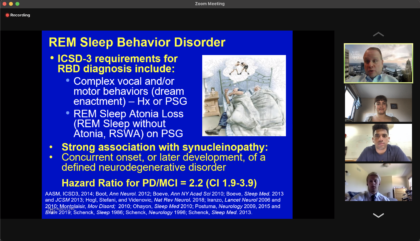
The background slide to Dr. St Louis’s lecture about RBD and RSWA. From top to bottom: Dr. St Louis, me, Jacob, and David.
The main focus of the last half of this week has been to learn the background of scoring PSGs, or sleep studies, to confirm the RSWA portion of diagnosing RBD. We learned that sleep is scored in four main stages, with REM being one of them and making up about a quarter of adult sleep. Each stage of sleep has its own characteristic dominant waveform in the PSG which, with practice, can be identified as distinct by the human eye. Scoring for PSG events like arousal, movement, apneas, and other respiratory events were introduced as tricky to identify and separate from the RBD dream enactment movement. Training my eyes for these patterns in human signal will be an enriching experience allowing me to utilize and expand data skills I’ve gained from other experiences. I can’t wait to get into the nitty-gritty of learning to score sleep studies alongside my fellow interns Chloe, David, Jacob, Kevin, and Olivia.
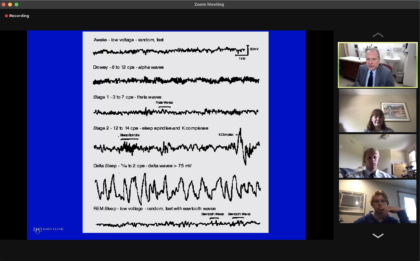
Another introductory slide, this time from the PSG background introduction, distinguishing waveforms between the stages of sleep with REM sleep at the bottom. From top to bottom: Dr. St Louis, me, David, and Kevin.
Overall, I’m most excited to move forward with getting on campus next week and working out the beginnings of our summer project which will likely be scoring PSGs of patients with recent COVID-19 infections. Adding to new research into the neurological impacts of COVID-19, we will hopefully be scoring PSG data from COVID-19-recovered patients with and without RBD to identify changes in their levels of RSWA. This research could contribute new findings at the intersection of neuroimmunology, a new area of study I’ve been interested in from the onset of the pandemic.
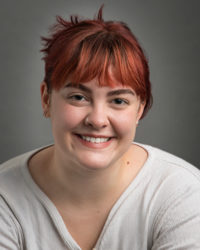
Gwen Paule is a chemistry major from Saint Paul, Minnesota