
Week 2:
Getting Started in the Gonda Building
June 15, 2021
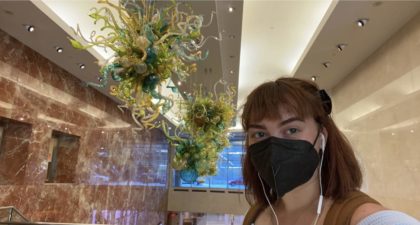
Dale Chihuly’s glass chandelier in the Gonda building lobby
This week brought many new experiences and the beginnings of great relationships with my fellow interns. By the end, most of us were fully in-person and scoring the polysomnograms, or PSGs, that we had been learning about from day one of last week. Beginning with a tour of the Gonda building for the first time, we watched doctors, nurses, researchers, and patients bustle by under the 50 foot floor-to-ceiling marble. We took the staff elevators every day up to the 17th floor to hear lectures from doctor St Louis in the PSG reading room, where the physicians read their patients’ sleep studies in the morning and we score the PSGs during the day. In our free time at home, Wunmi and I went to a cheese festival in a nearby town with some other interns from IBM.
Wunmi and I on our front lawn
Jacob, Olivia, and I were the first in-person interns. We began the week by learning more in-depth about sleep staging in the PSGs. We memorized the channels we would be referencing to score the muscle activity, or EMG, including electrooculogram or EOG, electroencephalogram or EEG, electrocardiogram or ECG, and the respiratory channels including Oxygen saturation and respiratory effort. In short, these are the eye signals, the scalp or brain signals, and the heart signals detectable from two electrodes at specific points on the skin of a patient during a sleep study. We learned the waves that characterize states of the EEG used to determine which stage of sleep the patient is in, including alpha, theta, delta, sawtooth waves, K complexes, and sleep spindles. We also learned the quantitative and qualitative methods for scoring muscle activity based on frequency and amplitude of the signal as well as human judgment.
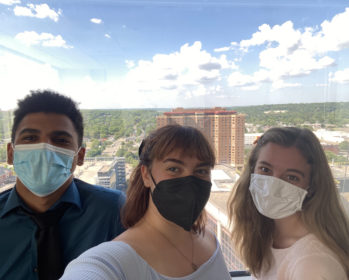
Jacob, Olivia, and I with the view of Rochester from Mayo Sleep Clinic’s conference room
Doctor St Louis held our first journal club on Tuesday where we reviewed a cross-sectional study detailing a massive array of risk factors for Parkinson’s disease or PD in controls and patients with REM sleep behavior disorder or RBD. We had a lot of discussion about the findings of the effect of antidepressants on PD and RBD, which confounded all of us. These findings seem to show that antidepressants could potentially be neurologically protective against developing PD, unveil eventual PD sooner by revealing future RBD, or increase REM sleep without atonia or RSWA without true RBD. It may be that those are variable for different patients as well. Pesticides and RBD are an area of interest for me in particular. It also seems that caffeine and smoking, which have long been thought to be neurologically protective against PD in patients, are not neurologically protective against RBD. More research is always needed.
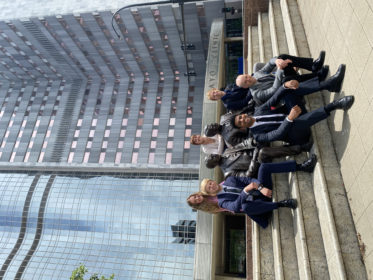
Doctor St Louis’s Minions and the Mayo Clinic Brothers Statue
From top left to bottom right: Olivia, me, David, Charles Horace Mayo, William James Mayo, Kevin, Jacob, and Tyler (our scoring master)
By the end of the week, we began scoring the practice PSGs that Tyler has laid out for us into a full-blown human sleep signal scoring curriculum. Our scoring master Tyler is a computer science major at the University of Wyoming who has worked for doctor St Louis’s lab for the past few years creating a muscle activity scoring and sleep staging training program for interns as well as doing some AI software development for automated scoring. He has helped us train our eyes on practice PSGs that range from what he has termed mild, medium, and spicy. Hypnolab, the 1990s program we’ve been using to score PSGs that has not since been updated, has given us some unique challenges that make the progression of all of our days very entertaining. I have learned to always remember to click save after every epoch of sleep.
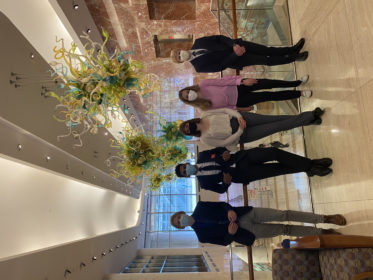
Doctor St Louis’s Minions and the Chihuly chandelier
From left to right: Kevin, Jacob, me, Olivia, and David
I find myself exhausted but content writing this blog after my first week fully in-person in which we’ve had many cathartic, in-person laughs. I’m very excited to become proficient in sleep scoring through practice and deliberation, discourse, and debate with my fellow scorers, as well as learning new methods every day from Tyler, Paul, and doctor St Louis. Sleep scoring in and of itself is proving to be a very engrossing challenge, and I can’t wait to keep bettering myself in service to this art form at the intersection of human judgment, quantitative methods, and classic scientific educated guesses.
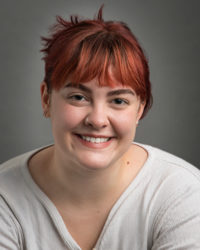
Gwen Paule is a chemistry major from Saint Paul, Minnesota