
Week 10:
Finalizing COVI-SWA Results
August 10, 2021
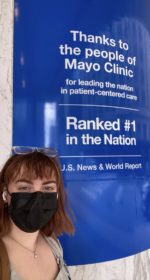
One last selfie with the hospital at the forefront of the nation’s healthcare
My last week at Mayo Clinic with my lovely co-interns, supervisors, and PI Dr. St Louis went by breathtakingly quickly. By the end, I felt like there wasn’t enough time to complete all I had set out to do with our COVI-SWA study, even though in past summers, the cognitive neurophysiology lab hasn’t been able to include interns in the analysis or writing of the paper as we were lucky to experience. We ran analyses on our scoring of the polysomnograms (PSGs) using R software to code Wilcoxon Rank Sum Tests to determine the p-values for our given factors (age, sex, beta-blocker usage, hospitalization due to COVID-19, periodic limb movements) plotted with the y-axis being COVID-19 v. control patients and the x-axis being the patients’ Chin Bilateral Any Density REM sleep without atonia (RSWA). The purpose of these box plots was to determine and demonstrate whether or not our findings of elevated COVID-19 patient RSWA averages in density and percentile metrics were confounded by these factors: to prove that these factors did not influence our data. The p-values from the Wilcoxon Rank Sum Tests demonstrate what percentage our findings were due to random chance, with the accepted values being below 0.05 or 5%. We continued checking and re-checking the tables that will go into the study for Excel user errors which can be quite common with such a massive amount of data.
Lastly, we continued co-writing the abstract and the introduction sections of our study along with scoring master Tyler Steele and PI Dr. St Louis. I was very fortunate in having another opportunity to shadow Dr. St Louis in the clinic again, where we met with many narcolepsy patients whose disorder is diagnosed by the presence of excessive daytime sleepiness, cataplexy, vivid hallucinations, and sleep paralysis. Most of them found that the treatment for their condition, which is almost exclusively stimulants, was not very effective at combatting all of their symptoms or requiring a higher dose to function well throughout the workday. Neurology does not yet have an FDA-approved treatment for narcolepsy that targets the root cause of the disorder: the loss of the neuropeptide orexin that regulates the sleep/wake cycle through GABAergic, cholinergic, and monoaminergic neural networks. One patient even had narcolepsy and epilepsy, which was an almost unheard-of combination. Dr. St Louis took the time to hear his patients out with full attentiveness and compassion as always and provided his much-needed optimism in the face of a very devastating condition.
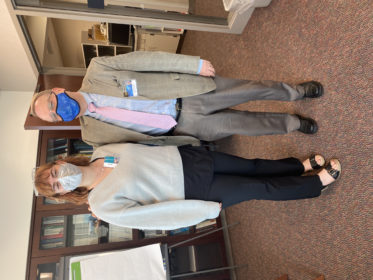
PI Dr. St Louis and one of his minions
I also had the opportunity to shadow Dr. Mara Piltin this week, a general surgeon specializing in the surgical treatment of benign breast disease, breast cancer, and melanoma. I watched her, and her resident perform several surgeries, including one bilateral breast lumpectomy with a right/left axillary sentinel lymph node biopsy and possible dissection with both breasts containing Ductile Carcinoma in Situ (DCIS) and the left breast also containing Invasive Ductile Carcinoma (IDC). DCIS is often very manageable with surgery and is non-metastatic. IDC is a quite aggressive cancer that metastasizes rapidly using the sentinel lymph node that it drains into in the axilla. Dr. Piltin had radioactive tracers injected into cancer before the procedure, using a neoprobe to exactly locate it and its sentinel lymph node to remove all of it during surgery. I followed the removed malignancies to pathology to watch them be inspected for negative margins, ensuring that Dr. Piltin had gotten all of it out. Dr. Piltin’s sense of humor, charisma, and teamwork with her colleagues was refreshing and infectious. She made the OR an enjoyable environment where excellent care was always being delivered as well.
Lastly, I shadowed Dr. Bernardo Mendes, a vascular surgeon, his fellow Dr. Matthew Breitte, and his resident Dr. Peter Anderson. The experience of watching two Endovascular Abdominal Aortic Aneurysm Repairs (EVARs) was indescribable. With one patient, I could even see the aneurysm through the skin on his stomach, beating in time with his heart. We all had to wear up to 10 lb. leads to stay safe from the ionizing radiation used to be able to see the wire being threaded through the aorta and the graft slipping over that wire to be inflated at the site of the aneurysm to repair it (hopefully by eventual deflation) by restricting blood flow to the appropriate shape of the artery. Dr. Mendes was extremely cautious, a great teacher, humorous, and fought for the very best outcome for all of his patients regardless of any expense on his part.
By the end of the week, I could barely process how many amazing things I had witnessed at Mayo Clinic these past two months alongside the dedicated professionals I had the blessing to learn from and hope to one day emulate. After running more analyses on COVI-SWA data and finalizing my version of the abstract, I rode the bus home and just smiled for the whole ride. Then cried a little bit after realizing I wouldn’t be able to see Mayo again for a while. I am so grateful for this fellowship, the amazing mentors I have met along the way, and my fantastic fellow interns. I can’t wait to keep writing and thinking about these experiences for many years to come.
Gwen Paule is a chemistry major from Saint Paul, Minnesota