
Week 7:
Scoring the Rest of COVI-SWA and more Shadowing
July 21, 2021
The initial intern COVI-SWA scoring came to an end this week, albeit with some technical errors to be fixed in several studies next week. Some of these technical errors involved impedance such as faulty electrode placement, bleed from other leads, or unknown rhythmic non-biologic signal usually around 60 Hz. Deciding how to exclude these artifacts from our data has been challenging on the scoring level, some files more than others, but it is great practice in learning to trust and refine my judgment. What has really stood out to me from learning to score has been simultaneously learning a balance of humility and pride in my abilities. Learning that I can’t always be right, along with the fact that I can’t always be wrong with respect to scoring, has been a valuable lesson, especially when it comes in the form of an objective data collection method. Throughout my day of scoring, this balance has brought with it a sense of excitement because there is truly always more to learn each and every day. That is one of my biggest motivations to hopefully one day work in healthcare.
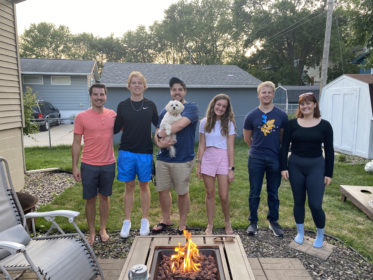
Dr. St Louis’s Minions and supervisor Paul Timm plus Millie (puppy)
Mid-week, we held a journal club focusing on an article about the glymphatic system in the brain, which is responsible for the clearance of extracellular metabolites and waste products such as beta-amyloid proteins that lead to synucleinopathies like Parkinson’s disease, dementia with Lewy bodies, and multiple system atrophy. Understanding the glymphatic system physiology is only now becoming clear, as scientists initially did not recognize a traditional lymphatic system in the brain and have just begun to investigate the non-traditional CSF-based clearance system that exists. It turns out that the interstitial space in the brain widens during sleep, allowing for clearance of extracellular debris like beta-amyloid, and this may be the chief reason why we need to sleep in the first place. This reasoning behind the need for sleep is illuminating in research like ours. It could explain sleep patterns throughout life, especially when accompanied by synucleinopathy, which presents in patients who are older and, on average, sleepless. The most striking finding from this journal is that older mice have less glympathic interstitial space volume, which means less flow of CSF and less metabolite clearance.
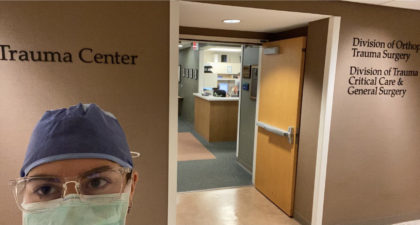
Outside the Trauma Center at Mayo Clinic St. Marys Campus
I had the amazing opportunity to shadow Dr. Erica Loomis (MD) this week, a trauma and critical care general surgeon, also with the Trauma Center at Mayo Clinic St. Marys Campus, along with Dr. Rivera, who I had the pleasure of shadowing last week. Dr. Loomis researches how to optimizing fluid management of trauma patients and is a surgical professor in the general surgery residency program at Mayo Clinic Alix School of Medicine like Dr. Rivera. Under her guise, we watched residents perform two laparoscopic cholecystectomies and one laparoscopic hernia repair with mesh, umbilical, and possible conversion to open. Observing laparoscopic surgeries has shown me just what the surgeon sees, which is usually impossible with the number of hands needed to support surgeons in the OR. Seeing exactly what the lead surgeon sees was an amazing experience, one which I was much less squeamish about than I had thought I would be. It gave me a first-hand view of talented residents manipulating these tools and solving physical problems immediately as they unravel. Dr. Loomis gave me great insight into what her time as a surgeon has looked like from a work-life balance perspective and pushed me to listen to my own gut when making career decisions, not the words of others. I look forward to hopefully shadowing Dr. Loomis again, as well as a few more surgeons, if I am able before I wrap up at Mayo Clinic.
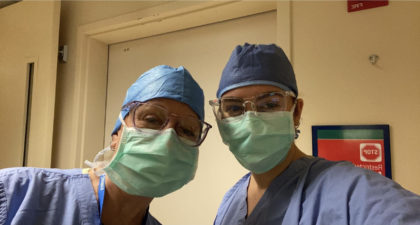
Dr. Loomis and I
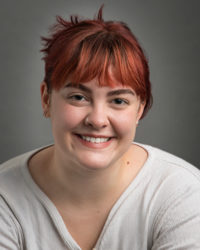
Gwen Paule is a chemistry major from Saint Paul, Minnesota
PreviousWeek 6: Shadowing Surgeons and Scoring COVI-SWA
NextWeek 8: Finalizing COVI-SWA Preliminary Data