
Week 2:
Training File…
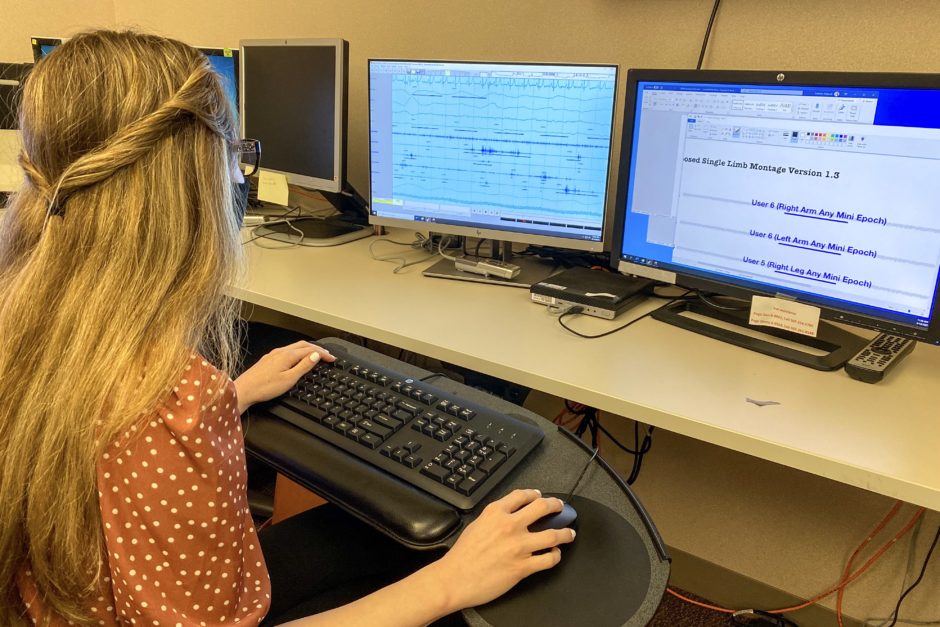
Scoring one of the hardest files took 1.5 days!
June 18, 2022
This past week flew by! Similarly to coursework on the Block Plan, everyone was working incredibly hard to finish all of the RSWA training files by the end of the week. I had so much fun learning from my mistakes to become a better scorer. In fact, we all did. All of the hard work paid off, and on Friday, everyone passed the Gold Standard!
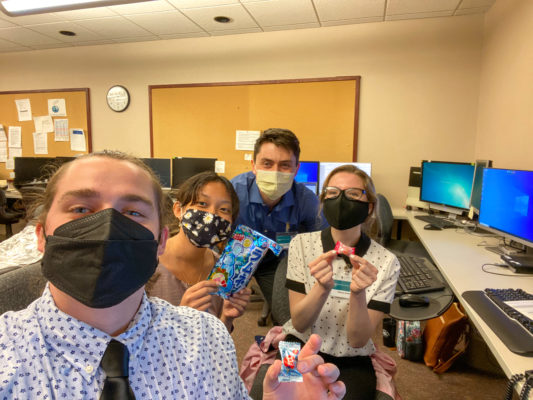
In lecture this week, Dr. St. Louis shared further details on what the Sleep Center cares for. One of the major conditions seen by the Sleep Center is sleep apnea (where breathing can stop during sleep). Dr. St. Louis went over treatment options for various sleep diseases, too. For sleep apnea, he shared that a CPAP (continuous positive airway pressure) remains the number one most reliable treatment method! Other treatments can include dental devices, similar to a removable retainer, that would push the lower jaw forward to promote an open airway during sleep.
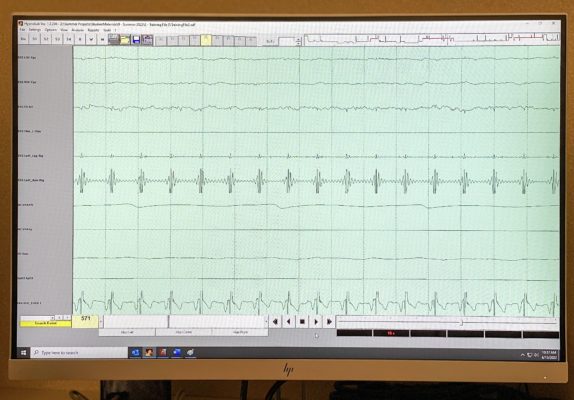
During another meeting, Dr. St. Louis showed us a large black book known as the Atlas of RSWA and Scoring. We went over multiple pages in the book looking more in depth at the contents of a polysomnogram. Of everything we studied, I found the stages of sleep to be the most interesting. N1 (non-rapid-eye movement, stage 1) sleep is the very first part of sleep. It is usually very light sleep where someone could be awoken by the slightest environment change. Small and quick Alpha waves are usually seen in this stage. As you fall deeper into sleep, you reach N2. This stage allows the body’s core temperature to fall a few degrees, autonomic functions begin to slow down, and your muscles become relaxed. Unlike the other stages, N2 sleep is characteristically identified by K-complexes and sleep spindles. After N2 sleep comes… N3 sleep! The N3 stage can be considered deep sleep. Delta waves, which are larger and slower, are active. REM sleep is the fourth stage of sleep. As relevant for the project being conducted this summer, atonia is supposed to occur during REM sleep. For some individuals with sleep disorders like sleep apnea or narcolepsy, RSWA occurs.
To score RSWA, I am looking for phasic, tonic, or phasic on tonic wave bursts on the chin, arms, or leg channels within a polysomnogram. This can be a very tedious process as I want to score as accurately as humanly possible.
In addition to sharing only a microscopic amount of the knowledge I learned this week, I’d like to share a little more on the polysomnographic training files. The files are from actual patients who have had a sleep study done, and there were 5 training files of varying difficulty. Completing the files was very much both an individual and team effort. While each file needed to be completed by each person, we all helped one another. It became like clockwork as we progressed through the files. All that goes to say that taking the Gold Standard test in silence was very out of the ordinary for us!
In other exciting news, we had our first journal club this week! The group (which consisted of the interns, Dr. St. Louis, and a handful of research assistants) read a very insightful article discussing the biomarkers for RSWA.
Dr. St. Louis also shared a patient with us. We were able to watch video footage of the overnight sleep study and watch the polysomnogram together in real time. The experience was very intriguing and cool. It was also really neat to have a reference for some of the things we have only seen in literature so far!
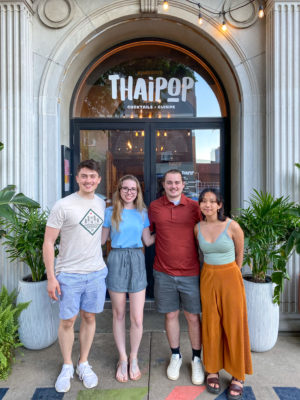
As I find a home here at Mayo, I am starting to see the many things that Rochester and Cornell have in common. I can tell that anyone would go above and beyond to help someone. Not surprisingly, this inkling was proved true at ‘Thursdays Downtown’ – an event held every Thursday afternoon. My fellow interns and I had found a great spot to have lunch when all of the sudden we heard someone calling for a doctor or nurse. Everyone in the vicinity who was qualified dropped what they were doing and sprung into action. Bystanders, including us, were prepared to help, too. This coming week I will be taking that motto with me. A lot of firsts and new information will be provided as we start the project and embark on shadowing. I think it will be helpful to have the reminder that even if I get stuck, someone will be there for me!
Makayla is a behavioral neuroscience major from Newton, Iowa.