
Week 3:
Climbing Uphill
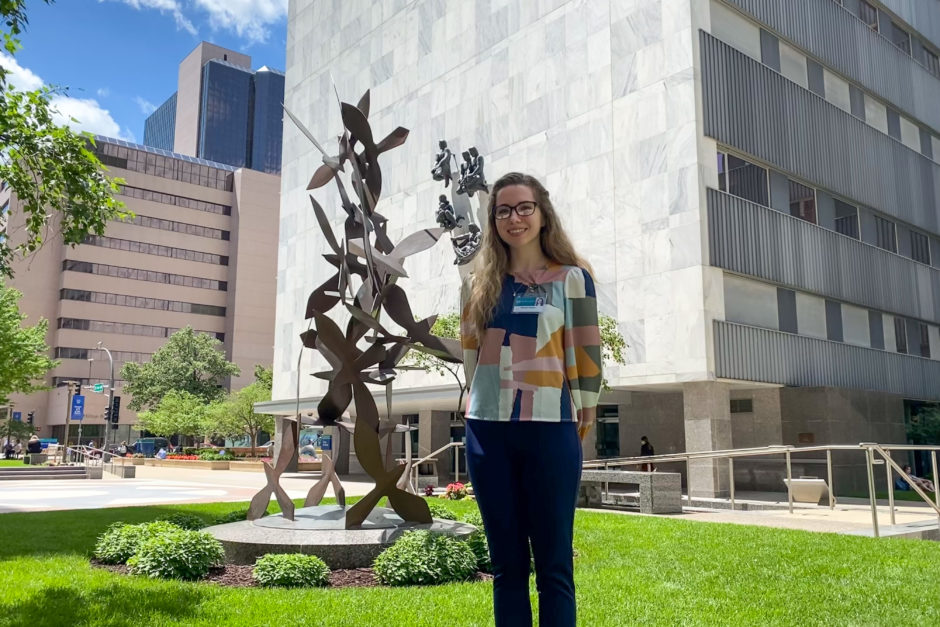
While eating outside on Wednesday, the interns and I enjoyed the Carillon Music performance
June 25, 2022
Week 3 flew by! I had so many amazing experiences this week that it would be hard to share all of them. One of the most exciting things I did was shadow for the first time. Dr. Erik St. Louis was happy to bring me aboard for his morning clinic. Before seeing any patients, Dr. St. Louis went over their charts so those of us in the room could understand the history and diagnosis of each patient. I was impressed by the thoughtful questions Dr. St. Louis was asking his patients. I’m glad I was able to meld into the comfortable and safe environment Dr. St. Louis provides them. They seemed very happy to share their experiences with me. While I can’t share too much detail about my shadowing experiences, it is safe to say that all of the patients I met with had unique stories. Since most of their diagnoses were similar, it was interesting to see how each individual had their needs met by unique treatment tailored to them by Dr. St. Louis!
The interns began this summer’s project on narcolepsy this week! Dr. St. Louis gave a lecture that covered narcolepsy in depth, and shed more light on the project. Hypocretin is a neuropeptide that helps promote wakefulness. In people with narcolepsy, there can be a lack of hypocretin causing increased drowsiness and/or sleepiness. Sudden muscle tone loss can occur, too, if a strong emotion like anger or excitement is shown. This can cause someone with narcolepsy to collapse – called cataplexy. People of all ages can be affected by either narcolepsy type 1 (narcolepsy with cataplexy) or narcolepsy type 2 (narcolepsy without cataplexy). Other components of narcolepsy that can occur include hallucinations and sleep paralysis. Dr. St. Louis shared that there are tests that can be done to check if someone has narcolepsy. One test checks for the DQB1*06:02 gene in cerebral spinal fluid (CSF) via a spinal tap. Another test is a multiple sleep latency test (MSLT). In this test, an individual would take 5 naps over the course of a day with a 2 hour time span separating each nap. Sleep technicians would be looking for REM sleep within the first 15 minutes or so of each nap. The quick onset of REM sleep is a great lead on a narcolepsy diagnosis because REM sleep typically occurs within the second half of sleep and uncommonly in short naps (less than an hour and a half)!
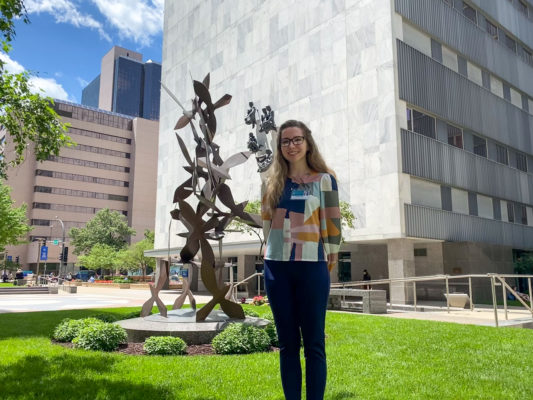
There was a pleasant surprise at lunch this week. When looking for a shaded spot to sit, my fellow interns and I heard a carillon (care-uh-lawn) music performance. This is a weekly event that occurs every day at 4:45pm, and Wednesdays and Fridays at 12:00pm! Lucky for us, lunch is everyday at 12:00pm. After some investigation, I found out that there are 52 carillon bells that have been played by official Mayo Carillonneurs! I’m glad we ate our lunch with the bells playing all around us! For more information on these beautiful bells (and livestreamed performances) I highly recommend checking out the Mayo History website!
As we began our narcolepsy project this week, I became even more skilled at scoring files in the 2006 software Hypnolab. One of the most interesting things to happen while scoring patient files this week was noticing some files were in French! Dr. St. Louis has a few contacts in France that provided some patients for this study. The origin of the files is important to note because in France, 50 Hz is the frequency of the current used in electronic devices, while 60 Hz is the frequency used in the United States. The frequencies can have an affect on the signals within the devices used on the patient to record their sleep waves!
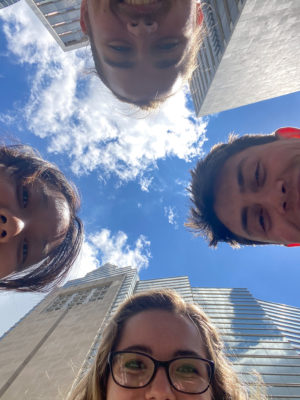
Since we all started to work individually, it was a perfect opportunity for project coordinator Paul Timm to do some 1:1 teaching with each of us. Paul took the patient file I was working on and walked me through the entire sleep study. I appreciated this 1:1 moment because it allowed me to ask questions I didn’t know that I had! Paul made sure each of us got quality time to learn everything he had to share.
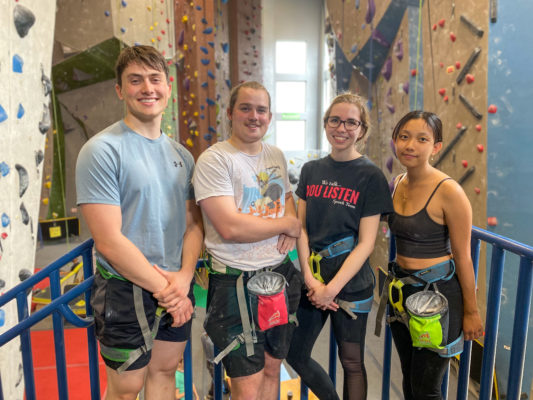
To end off the week, the interns went rock climbing. This was quite metaphorical as earlier in the week Paul had mentioned the Dunning-Kruger Effect. This is a graphic that explains confidence levels – Mount Stupid being the most confident with the least competence, the Valley of Despair being the least confident with slightly more competence, the Slope of Enlightenment increasing in both confidence and competence, and finally the Plateau of Sustainability. Paul made sure everyone knew we were on our way up the Slope of Enlightenment, climbing higher and higher every day. Each of us worked diligently this past week, and I think that was reflected well in our rock climbing adventure!
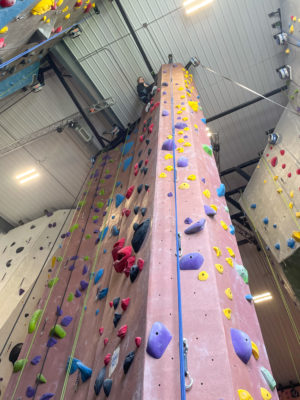
This coming week, I am excited to reach out to other departments for shadowing opportunities. I’m hoping to shadow a doctor in the psychology department! I’m also looking forward to a short week! Everyone will have Friday off to allow for the 4th of July celebrations. I think above all else, I’m looking forward to keep trekking up the Slope of Enlightenment and getting better every day!

Makayla is a behavioral neuroscience major from Newton, Iowa.