
Week 4:
“Sleep Is More than Brainwashing”
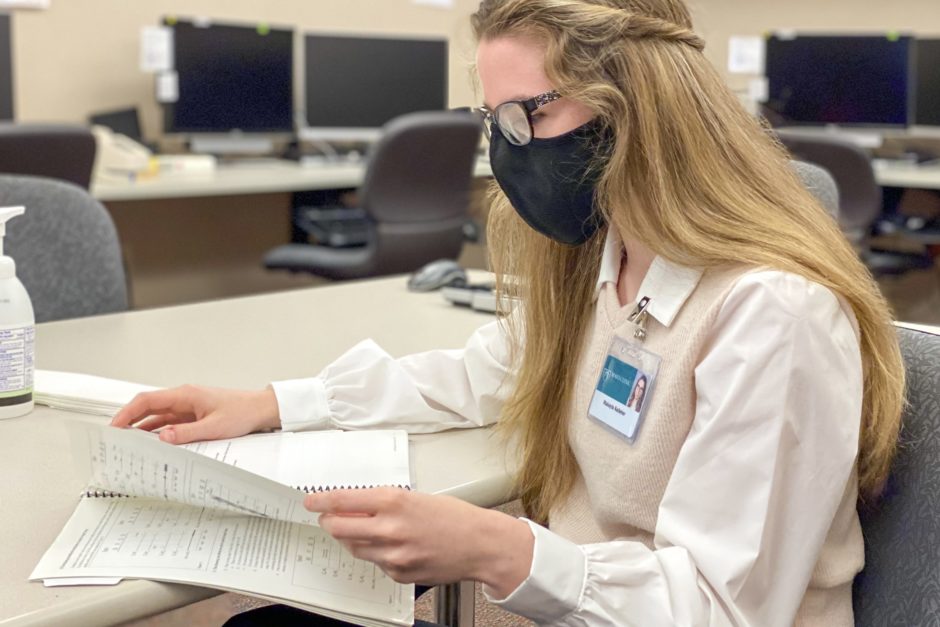
The AASM Manual for the Scoring of Sleep and Associated Events offers in-depth descriptions of various sleep rules, terminology, and technical notes!
July 2, 2022
As I mentioned last week, this week would be the continuation of the climb up the Slope of Enlightenment. This week was very much an uphill climb! The interns continued analyzing patient files for the HCT (narcolepsy) project. Everyone fell right into a routine that became extremely efficient. We eventually started dividing and conquering – Carter worked with Olivia to organize and assess project information, Dalin scored the remaining files we had, and Nolan and I started writing the manuscript! My organization skills came in handy as I created an outline with prompts for the paper. Because I took the extra time to build scaffolding for the paper, Nolan and I were able to focus heavily on the introduction and background sections. While this is only the first draft, I can say with confidence that the end result will be amazing! I look forward to writing more of the manuscript in the coming weeks and getting feedback from the neurology department to help our writing improve.
This past week, everyone started finding patients and controls for our second project on Charles Bonnet Syndrome. I’ll be able to provide a more in-depth description of what this phenomenon is in the coming weeks. Simply put, Charles Bonnet Syndrome is hallucinations after vision loss. I’ve found it curious that a handful of patients I have come across have auditory hallucinations – a variation of Charles Bonnet.
One of the most exciting things about starting a second project is being able to be a part of everything from the very start. By this, I mean that our first project was already laid out (for the most part) before the interns arrived. Because of this, we didn’t get to see or be apart of much of the beginning stages of coming up with the project, finding subjects, and all of the other fun things that come with conducting research. Since the second project is beginning in the middle of the summer while we’re all on location, we are getting the opportunity to see first hand many of the elements that go along with starting a study. I’ve been very interested in the multitude of lists that are created and information that is gathered to help narrow down patients who qualify to be in the study.
By the end of the summer, I’ll have another outline ready for a second manuscript! I’m proud to be in this hard-working group of interns. Without the ambitious attitudes we all have, we wouldn’t be at the point that we are, let alone starting on a second project!
In other news, we had our second journal club gathering this past week. I was super interested in the topic we were going over: the glymphatic system. We read three articles, one of which showcased a study done with mice. One study suggested that, in a mouse, an awake brain had less interstitial space (essentially, the area between cells in the brain) than an asleep brain. This discovery showcases that when asleep, there is a better opportunity for certain brain functions like cleaning!
The main article we read suggested something interesting that I hadn’t thought too much about before: we know a lot of what we do about sleep from sleep deprivation. As one would expect, sleep deprivation has significant adverse effects on the brain. Some of these can include poorer cognitive functions and a weakened memory. Dr. St. Louis suggested that while sleep deprivation may not be fatal in humans, there would be a point where the lack of sleep would end in unsolicited sleep onset – perhaps the body protecting itself from the detriments of the deprivation. We learned that the locus coeruleus is important for norepinephrine activation. This activation is key in wakefulness! The study suggesting this was done in mice who were given noradrenaline inhibitors in both the alpha and beta receptors. The researchers found that the inhibition allowed for waves that were very similar to sleep waves. Dr. St. Louis mentioned that showing this in humans is difficult, but there is research being conducted to further this analysis of sleep!
One point that I found particularly interesting from the main article suggested that if the aquaporin channels (primarily offer the transportation of water across cell membranes) of glial cells in the brain are blocked, the entire glymphatic system could shut down and stop functioning. If the glymphatic system in the brain is not functioning properly, an excess of toxins can build up in the brain. I’ve already touched on what the excess of toxins can mean for the brain in other blog posts, and Dr. St. Louis suggested this article adds to the importance of sleep in combating neurogenerative diseases.
While brain cleaning was the primary topic for journal club this week, there are many more functions of sleep that we’re just getting into. I’m excited for the other articles we will be reading this summer. I can’t wait to uncover more of what sleep has in store since, as Dr. St. Louis would say, “sleep is more than brainwashing!”
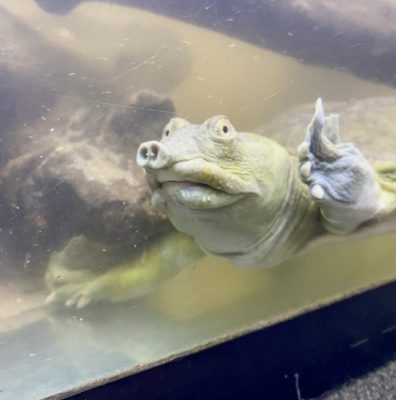
My activity for the week was visiting the reptile zoo! I had a lot of fun learning about all of the reptiles and amphibians the zoo had, particularly the Malayan softshell turtle shown above.
In the coming week, I am looking forward to my next shadowing opportunity with Dr. St. Louis. It will be a full day adventure to a hospital in La Crosse, Wisconsin! I’m also excited to keeping working on the manuscript for our first project and seeing how far we can get before the end of the week!
Makayla is a behavioral neuroscience major from Newton, Iowa.