
Week 7:
The Little Details
July 23, 2022
If I had to describe a cute little theme for this week, paying attention to the little details would probably be what I chose. We did a lot of the same things I have talked about before (scoring and charting) but in slightly different ways that allowed me to gain a broader experience in this fellowship.
The hypocretin project seems to be heading toward a negative finding. After the addition of some more patient PSGs, we had more narcolepsy type 1 patients for the low and high groups. It was a small change, but it was something we needed to try to see if there was any statistical significance of the new angle that Dr. St. Louis decided to take on the hypocretin project. I ran statistics through BlueSky to analyze our numbers, and they do not seem to be significant. Dr. St. Louis believes that we can get a negative finding published from this, but it is more on the backburner to the Charles Bonnet syndrome project.
For the Charles Bonnet project, we had to focus on controls this week. These are patients with PSGs that are similar age and sex to the CBS patients, but do not have RSWA-affecting factors like REM-sleep behavior disorder, dementia, or Parkinson’s. Fortunately, the lab has a cache of pre-scored files of various ages and sexes that we can use for a majority of the CBS subjects.
However, about half of the patients with CBS are also on antidepressants. Antidepressants can affect RSWA, so we needed to control for that variable to yield accurate results. To do this, we needed to find patients with PSGs in Mayo’s systems that were on a similar antidepressant type, without any of the previously mentioned factors, as well as age and sex matching them.
This process was tedious, but actually pretty fun. Our student supervisor Olivia looked through Mayo’s database with the filters above. These filters do not account for if they were on antidepressants at the time of the PSG, however, nor if they have RSWA-affecting conditions. After the search was completed, we looked from lists of patients sometimes 300 strong to find someone on similar antidepressants to the CBS partner. There were times when it seemed like a person was a perfect control, but they were not yet on antidepressants at the time of the PSG, or had been diagnosed with Parkinson’s, making it a long process, but an interesting one. It also involves looking at all the little details that are needed to make a good control. Patient charting is one of my favorite tasks; I love reading about different medicines and conditions, as well as seeing the process of care through reading the chart notes.
By the end of the day on Friday, we had a majority of these completed. We needed to unarchive these PSGs from Mayo’s system, though the four of us interns did not have proper clearance to do this, so hopefully Olivia has them unarchived to score on Monday.
Another cool part of the week was watching Dr. St. Louis and two of the research assistants demonstrate the use of a gait analysis tool. This can be used to help diagnose neurodegenerative disease like Parkinson’s and consists of force sensors that slide in a shoe like an insert and connected to an iPhone to record the data. The patient would then perform a series of moment tasks, including a long walk, as well as going from sitting to standing to walking, and back to sitting. Though this was not inherently relevant to our project, it was cool to see a diagnostic test for some of the conditions that we have read about in patient charts.
I was a little bit unlucky in shadowing this week. I originally was scheduled to shadow the doctor I watched perform the mitral valve replacement in the clinic, but due to complications in another surgery, it got canceled last-minute. In a way, I got a new experience of shadowing: when things don’t work out. I am rescheduled to shadow him on Tuesday, so fingers crossed it all works out this time!
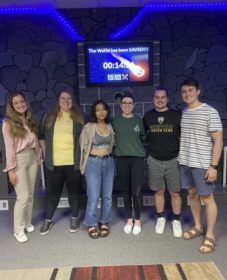
We finished up the end of the week with some fun at an escape room. All five of the interns and one of the research assistants went to an escape room under the premise of finding artifacts to prevent an asteroid from hitting earth. We managed to solve it by looking at the little details (and with some hints), just in time.
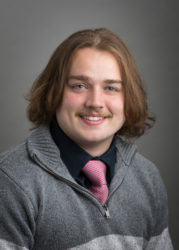
Nolan is a biochemistry and molecular biology major from Omaha, Nebraska.