
Week 6:
Adjusting to the Unexpected
July 16, 2022
If I had to sum up this week in a few words, I would say it revolved around adjustment. The hypocretin project has been put in a temporary standstill for now, and the focus is now on the Charles Bonnet project, which is attempting to identify a link between Charles Bonnet Syndrome (CBS) and RSWA.
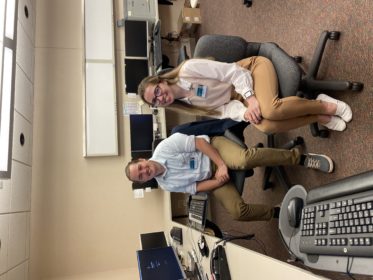
We began scoring and patient charting for this project in previous weeks, but this week took the bulk of patient charting and scoring. Patient charting was difficult, as CBS is often not concretely diagnosed, and can be lumped in with other conditions. Patient charting took longer than with the hypocretin project, as Dr. St. Louis added things to include in our charting, to eliminate any confounding variables that could affect our stats. While it got repetitive, it was cool to see more of the patients’ records from the study, as the work is usually split between interns and not everyone can see all the patients. My favorite part of this process was seeing the different types of hallucinations patients had, ranging from old western scenes to leprechauns.
A principal difficulty we had when charting was finding viable polysomnogram (PSG)/CBS diagnosis dates. Searching in Epic can sometimes be a needle in a haystack. We needed to find patients with either a PSG after CBS diagnosis, or very close to it. If the PSG was too far before, the patient may not have CBS brain neuroanatomy or neurochemistry, so it would be an inaccurate PSG for their condition diagnosis.
Another big part of the week of adjustment was with scoring. As with the hypocretin project, scoring is the critical part of differentiating levels of RSWA, so we had to do that with all patients that we were examining.
Though we work well to score quickly together, problems do come up. These are typically in the form of bad leads which cause not-scorable muscle segments. We had to adjust these files or just ignore certain muscles like the arm muscle used to score RSWA because the majority of the PSGs had bad muscle activity on that channel.
The next step is to hopefully get controls for the scored CBS files (matching age, sex, and antidepressant use) from a pre-scored archive the lab has. This would allow us to begin running statistical analyses without spending the time to score the files. We have been moving so well through scoring and charting that Dr. St. Louis even brought up the possibility of a third project this summer.
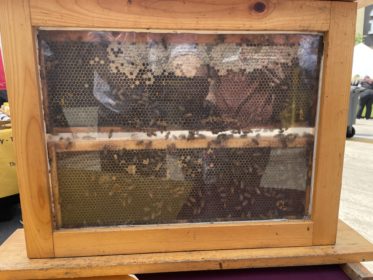
The interns in the lab again experienced Thursdays Downtown in Rochester. We walked further this time, finding new food stalls to try next week, as well as some cool artisan crafts, including a beehive, olive wood cookware, and some boba tea. This is always a great break from computer work, as well as a chance to get to know the local area from the business stalls set up along the street.
There was not a whole lot of uniqueness to this week, a lot of repetitive but important work. I am hoping to get more shadowing set up next week to continue expanding my horizons!
Nolan is a biochemistry and molecular biology major from Omaha, Nebraska.