
Week 2:
Cast Nets and Community
June 5, 2023
After an exciting first week settling in and meeting the community I’ll be working with this summer, my second week was filled with learning new skills, meeting new people, and working on a variety of projects. My fellow interns and I began preparations for our shrimp trials, while learning new techniques for data collection and species identification. Our week concluded with a wonderful time bonding at a beach party hosted by people from the Lab.
This week, all the interns working on juvenile penaeid shrimp arrived. Two new interns, Rya from LSU and Devin from the University of Connecticut joined our team. We met with our supervisors of the shrimp project to discuss a schedule for the upcoming weeks. We have a lot to do in the next few weeks in order to capitalize on the shrimps spawning times. This week we were primarily focused on catching all the brown shrimp we need for our experiments. Matt, our lead supervisor, had ordered us to collect at least 300 juvenile penaeid brown shrimp by the end of the week. Our next steps are to set up the shrimps’ indoor habitat for our experiment, and PIT tag them so we can track their growth and survival.
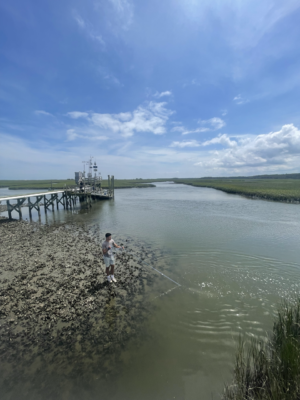
Our team learned many new skills in the process. Early in the week we were taught how to use cast nets to catch small fish and shrimp. This is our primary way of collecting the shrimp for our experiments. The process includes tossing a circular net ranging from 5-10 feet in circumference into a shallow lake or river and pulling the line up once the net settles to bottom. While it’s a bit of a strain on the arm, it’s totally worth it for a good catch.
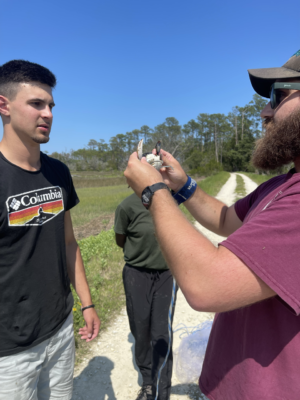
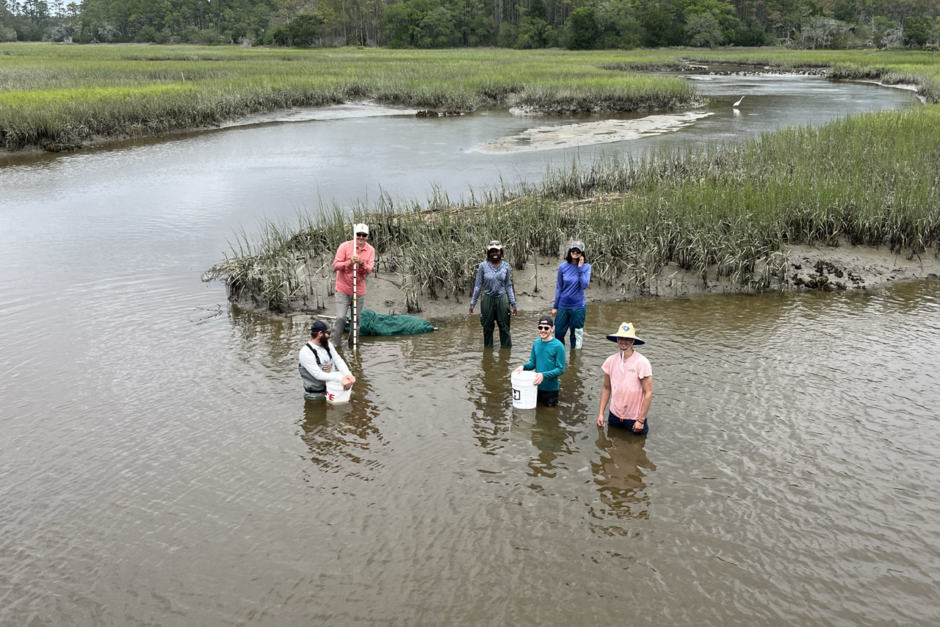
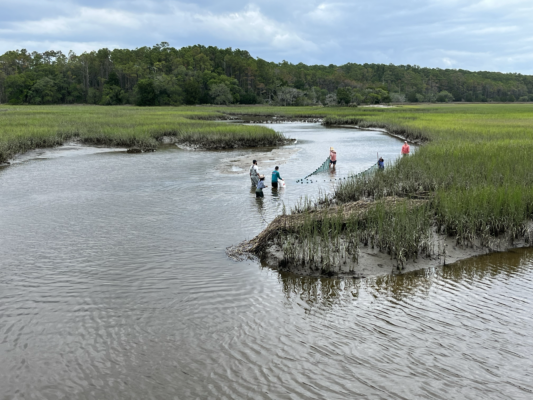
Later in the week, we helped with the monthly seine collection. This collection happens every month and gives insight on the types of species that can be found year round. As well as insight on species abundance and size. Seine collection is taking a long net with two wooden poles attached on each end, and walking it through a stream or river. This process collects all the organisms in the way of the net. We put the catch into a bucket and take it back to the lab for sorting. We also learned how to identify the different species we caught. This was by far the hardest since there are a lot of smaller fish that look similar to each other.
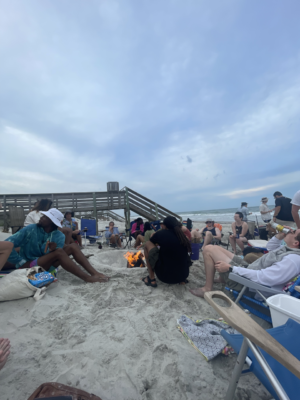
One of the best parts about working at the Baruch Marine Institute is the community events. Every weekend, people at the lab organize some type of gathering, usually at a beach, to bond and connect with fellow colleagues. Last week’s cookout had to be moved indoors due to weather, but this weekend was perfect beach weather. It was a nice sunny day, and the breeze off the ocean felt amazing. There was a lot going on, and I tried to get in on all the action. I played volleyball with everyone, tried boogie boarding for the first time, and enjoyed a campfire with new friends. It’s incredible how diverse our community is. Many people come from all over the United States, and it’s exciting to learn about them and their experiences.
Nikita is an environmental science and sustainability major from Naperville, Illinois.