
Week 3:
Crab Pots and Otoliths
June 11, 2023
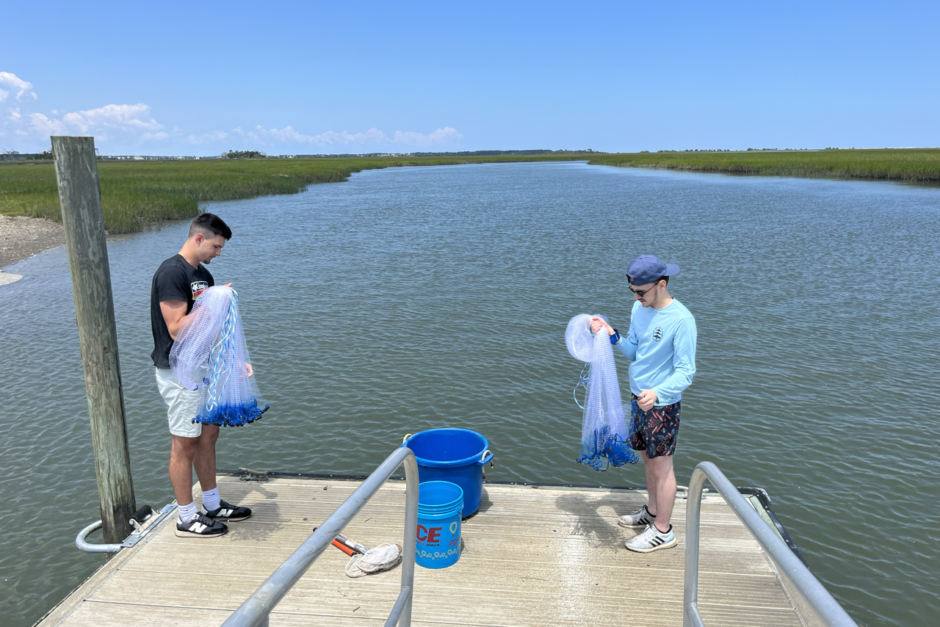
One of the best parts about working at the Baruch Marine Lab is the opportunity to work on a variety of projects. Our shrimp experiment is currently on standby as we wait for white shrimp to become more abundant in the estuary. This provides a perfect chance to learn more about the different research projects going on around the lab. This week we got the opportunity to learn about crab identification and participate in fish dissection. We also continued to prepare our shrimp enclosures for our experiment later in the month. The week concluded with a delicious family dinner with all the interns in dorms.
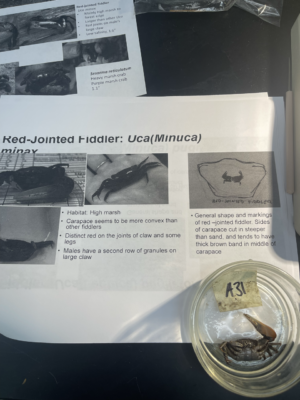
Throughout the week we helped Robert, one of our advisors, with his crab experiments. We spent a full day collecting all the crab traps scattered across the estuary, and took them back to the lab to preserve for later identification. Later in the week, Robert showed us how to identify the different species of crabs under a microscope. This was my first time learning how to identify different animal species. However, it was quite similar to the rock identification I learned in my Sedimentary and Stratigraphy class at Cornell. It’s interesting learning about the different features crabs have. My favorite part was identifying the fiddler crabs because you can instantly tell whether you have a male or female. The males have a distinctly large claw, while the females have two smaller claws. We learned that the large claws on the males are extremely important to their survival and ability to mate.
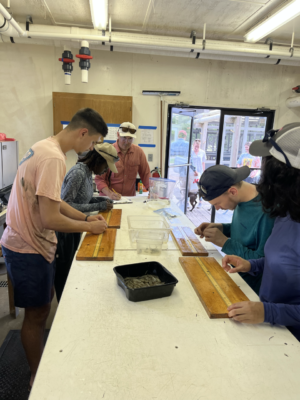
In addition to helping with crab identification, we helped Liam, another one of our advisors, with ichthyological analysis. This process includes taking previous seine collections and cutting open the fish to collect its guts and otoliths for later analysis. The gut contents are important because it provides details on fish predation and trophic cascade. The otoliths are the fish’s eardrums, and we collect them because they allow us to age the fish. The whole process was a bit unsettling; however it was still interesting to learn about the importance and techniques of ichthyological analysis.
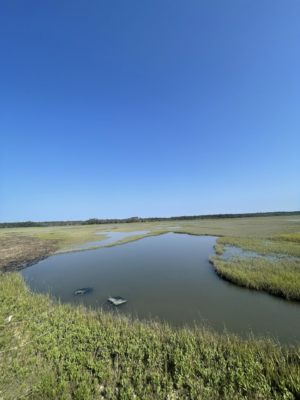
We also continued working on preparations for our shrimp experiments this week. We had to add some attachments to the shrimp enclosures we were using. Additionally, we took samples of the bodies of water we want the outdoor experiment to take place in. We took measurements of dissolved oxygen concentrations, temperature, and salinity to ensure that the shrimp can survive the whole trial.
The week concluded with a delicious dinner and a night out on the town. Devan, another intern working on the shrimp project, cooked fresh fish tacos for everyone in the dorms. Later that night, all the interns and some of our advisors joined in for live music in Pawleys Island. It was a great week overall. I love that there’s a good work-life balance here. All the interns are very friendly and always up for an adventure.

Nikita is an environmental science and sustainability major from Naperville, Illinois.