
Week 6:
Carver College of Medicine
June 30, 2014
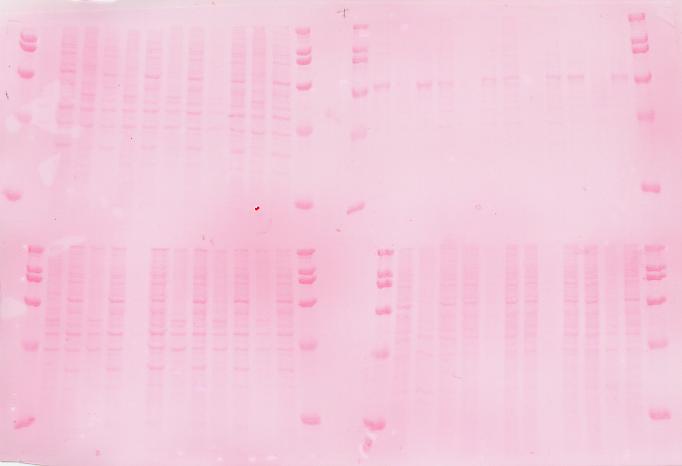
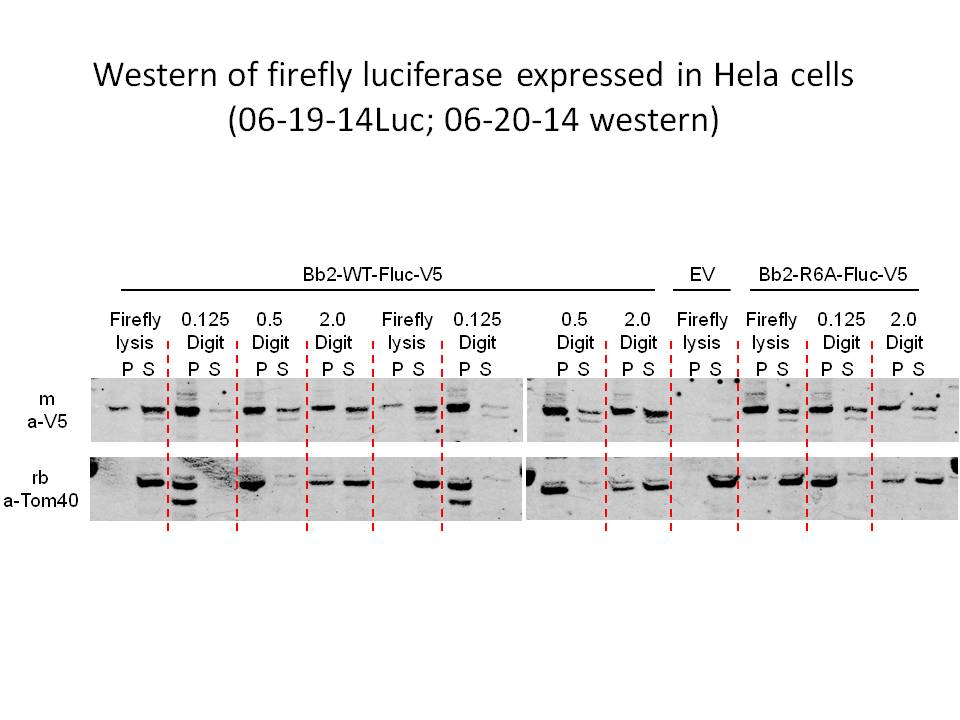
This week was all about Western blot. I ran the samples from the luciferase assays in the past two weeks. Certain samples needed to be sonicated to break up the DNA strands so that they were no longer too viscous to run on the gel. Then I heated the samples at 95 °C for three minutes to denature the proteins so that SDS in the later-added buffer would fully coat the proteins. This was done to make sure that the proteins would run according to their different sizes rather than charges. After a quick spin, I loaded 12.5 µL of each sample into the wells and let the gel run. Then I transferred the proteins on the gel to the nitrocellulose membrane. The transfer buffer used contained 10% of methanol and 1% of 1.0 M CAPS (pH = 11.5) in water. After allowing the transfer process to go overnight, I used Ponceau S, a red dye, to stain the membrane so that all proteins could be visualized by eye. I scanned this stained membrane before washing Ponceau S off the membrane. Then I added the buffer that contained 2% BSA and 0.05% sodium azide in TTBS (Tris-buffered saline + Tween 20) to block all the potential binding spots of the antibodies on the membrane, so the antibodies that I would add in the next step would only bind to the proteins on the membrane. After rocking on the rocker for thirty minutes, I cut the membrane in two halves according to two different probes, which I would expose to two different antibodies. First, I exposed the membranes to the primary antibodies (which targeted the probes) and rocked them on the rocker overnight at 4 °C. Then I washed the leftover primary antibodies off and exposed the membranes to the secondary antibodies (which targeted the primary antibodies). It was important to mention that the probes, which were sequences on the luciferases recognizable by the primary antibodies, were the V5-tag and TOM40. The primary antibodies were the anti-V5 antibody from mouse and anti-TOM40 from rabbit. The secondary antibodies were goat anti-mouse and goat anti-rabbit. Finally, I used Odyssey infrared scanner to scan the membrane and the result was shown below.
Major: Chemistry. Hometown:Centuria, Wisconsin.