
Week 3:
And Genetic Manipulation is Half the Battle!

As someone who grew up in Colorado and goes to school in Iowa, all this water is still a novelty to me.
June 15, 2019
Life in the Lab
One of my most pressing concerns was to renew my access to the labyrinthine halls where we keep our mouse colony. Fortunately, that soon happened. Work in the mouse house is never in short supply. I wean pups from their parents. I genotype — that is, I test mice to see which genes they have inherited from their parents. (For the curious, here is an example protocol.) When breeding mutant mice, knowing what genes end up in their offspring is essential. Perhaps most importantly, I mark the mouse cages to keep track of where each mouse comes from and what (if any) mutant genes they have. Since our lab has approximately one thousand mice, all this is no minor feat.
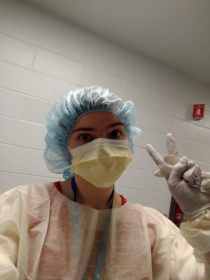
Of course, there is more work to be done than putting mice in cages. I acted as a second set of hands for the lab manager during one of his experiments with K. pneumoniae-infected mice. (Read my Biology Corner for this week to learn about why we do this!) He handled half of the tissue processing, I did the rest, and we finished twice as fast. Getting colony maintenance and this big experiment out of the way this week was important. You see, our lab will be attending two big events in the next two weeks. I look forward to telling you about them.

Margaret’s Biology Corner
Last week, we talked about how we can breed mutant mice that don’t express specific genes. We say that these mice are “knockout” (or “KO”) for that gene. In our lab, we usually want mice that are KO for chemical messengers called cytokines. Overall, we want to understand how cytokines affect various diseases. By comparing KO and non-mutant mice, we can discover how a cytokine’s absence affects a mouse. But making mutant mice is only step one. You see, it is not sufficient to compare a healthy KO mouse to a healthy mutant mouse. We want to understand the role of these cytokines in disease. To do that, we need to get our mice sick.
How do we get a sick mouse? If infectious diseases interest you, the solution is simple. You infect the mouse with the pathogen. For example, if you want to study salmonellosis (the formal name for Salmonella infection), you can treat your mice with Salmonella bacteria. We treat our mice with Klebsiella pneumoniae. This bacterium is normally content to live a peaceful life in your gut, but it can cause major problems if it spreads to other parts of the body. As its name suggests, one possible such problem is pneumonia. Another is sepsis, which is what interests our lab. We use a needle to inject K. pneumoniae into the body cavity of the mice (this is an intraperitoneal injection), which causes the mice to become sick.
Getting a mouse sick with your disease of interest is not always so straightforward. What about cancer? Or allergies? Or autoimmune diseases, such as multiple sclerosis, arthritis, or inflammatory bowel diseases? We don’t even fully know what causes those conditions, let alone can replicate them perfectly in a mouse. I cannot speak much to how cancer or allergies are studied in mice, as I don’t work with those models, but our lab studies autoimmunity. Specifically, we are interested in a form of inflammatory bowel disease called ulcerative colitis (UC). And what we — and many other labs — do to give mice UC is cheat. Next week, I’ll pull back the curtain on how autoimmune researchers cheat to investigate diseases we don’t completely understand.

Margaret is a biochemistry and molecular biology major from Longmont, Colorado.