Jon & Jean Reynolds Fellow in Conservation Medicine
Saint Louis Zoo |
St. Louis, Missouri
Shares: 0
Comments: 0
June 1, 2022
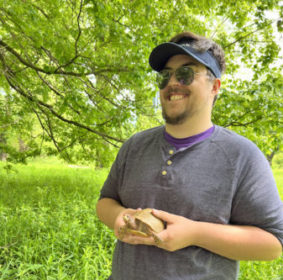
Holding a new box turtle in Forest Park
This was a wild week from start to finish!
On Monday we looked for a new turtle to tag in Forest Park. A French film crew was interviewing Dr. Deem, the director of the Institute for Conservation Medicine. They were filming for a documentary about the next pandemic, and were very interested in seeing the box turtle project. While it may seem strange to create a documentary about the next pandemic featuring a box turtle study in St. Louis, a closer look reveals the importance and relevance of our work to the bigger picture. Animal, human, and environmental health are all deeply connected. Although the box turtles in our study are unlikely to transmit an infectious disease to humans, understanding how they are doing, how disease is transmitted through their population, and what threats they face can help us to learn more about the health of both the environment and humans. Conservation Medicine allows us to look deeper at these connections while working to protect the health of all three branches of One Health. So, by studying animals that are seemingly not connected to human health, we can actually work to get a better understanding of human health.
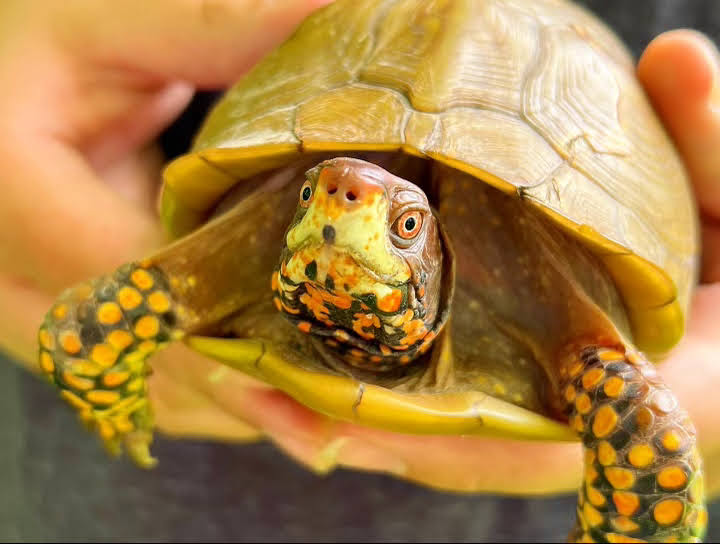
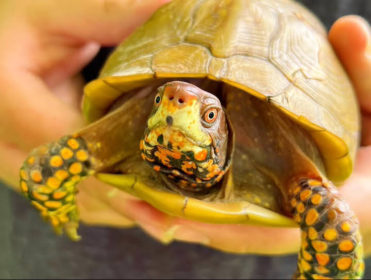
A closer look at the new three-toed box turtle we came across in Forest Park
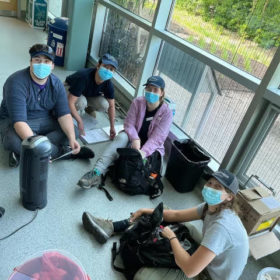
After briefly becoming an actor on Monday, it was back to tracking turtles. We were very successful this week and found the majority of our tagged turtles along with lots of new ones. Each time we encounter a new turtle, we give it a full physical exam and take measurements of its size and weight. We also determine if we have met a turtle before using a unique notch ID on the turtle’s marginal scutes. While tracking turtles, I also found tracks! The other interns and I also worked on preparing supplies for microbiome sampling (more on that next week). Along with preparing our standard field bags, we also worked on labeling 192 test tubes, sorting swabs, and preparing anything else we need for sampling. Later in the week, we also had the chance to tour the zoo’s Endangered Species Research Center and Veterinary Hospital. It was amazing to see the facilities used for the medical care of the zoo’s collection as well as all the research departments and projects the zoo is involved in!
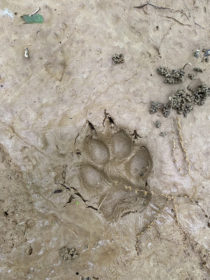
Coyote Track at WildCare ParkBri, Carly, Erin, and I prepare field bags for next week
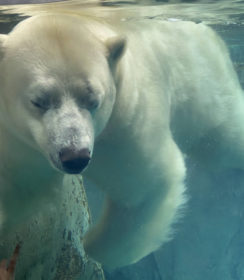
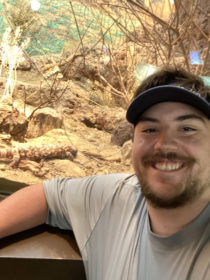
On Friday after prepping for next week I headed to a free concert held at the zoo called Jungle Boogie. The ICM had a table presenting on their work with crocodiles in Cuba. The band was amazing, and I was also able to continue to explore the zoo with the other interns! One of the first places we visited was the Charles H. Hoessle Herpetarium, home to a variety of reptiles and amphibians (including three-toed box turtles). We also visited one of my absolute favorite places in the zoo, the McDonnell Polar Bear Point, home to Kali the polar bear (aka the best polar bear ever).
Kali the polar bear, one of my personal favorites in the zooMe and a Gila monster, a venomous lizard native to the American southwest.