
Week 4:
A Star is Born
June 11, 2022
All species that are part of an ecosystem are important to its overall health and balance. Perhaps the most intriguing part of an ecosystem are the animals at the top of the food chain. Animals like lions, tigers, wolves, and bears are among the most charismatic animals that people care about. However, the importance of these top predator species are poorly understood, and in most cases have been extirpated in urban and suburban environments.
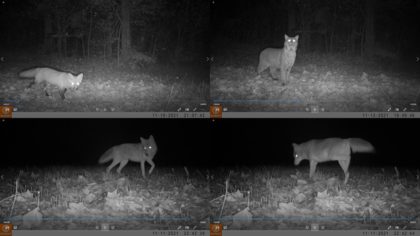
While there hasn’t been a population of wolves or mountain lions in Missouri since the early 1900s and the state’s population of black bears remains small, other predators that make up part of the ecosystem are just as important. The Carnivore Conservation Initiative is a collaborative project between the Saint Louis Zoo, Washington University in St. Louis, and the Endangered Wolf Center and is working to better understand top predators that call Missouri home. The initiative is examining the ecological and health related questions about Missouri’s carnivores both at WildCare Park and at Tyson Research Center. Among the species being examined are coyotes, red foxes, grey foxes, and bobcats. All of these animals are primarily active at night and are wary of people, so one of the best ways to study them is using remote camera traps. Camera traps allow for a better understanding of the animals’ habits and are placed along areas heavily used by wildlife. These are often the path of least resistance. Some of the best places to place camera traps are along open trails and roads. Another great place is along gaps in fences that can be used to move from one area to another.
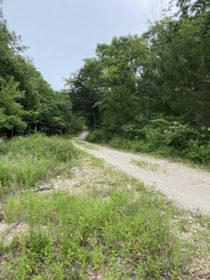
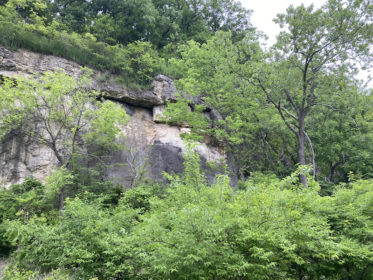
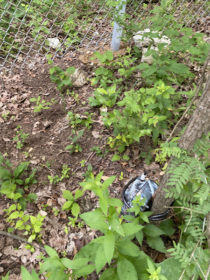
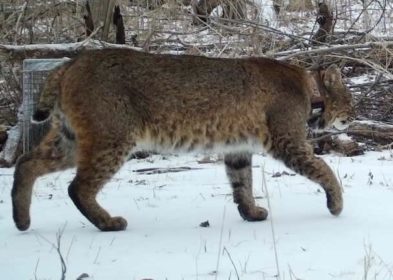
On Monday of this week, I had the chance to help track two radio-collared bobcats that were collared at Tyson Research Center. The bobcats are tracked using radio telemetry similar to the turtles. However, the transmitters for the bobcats are different from the turtles as they record the animal’s location about every ten minutes. Rather than manually recording the bobcats’ location like the turtles, the data is stored in the collars and can be downloaded remotely. In order to do this, you need to get close enough to the bobcats to download the data. That is easier said than done, as bobcats can cover incredibly large territories (and move further and faster than the turtles). In order to cover the additional ground, a radio receiver is placed on the roof of a truck. It then involves a lot of driving around listening to static while hoping to pick up a signal. When a signal is received, a hand antennae is used to better determine the direction of the signal. We picked up the radio signal for one of the bobcats, a male known as Timmy. We were able to download the data from his collar that could help shed light on preferred habitats, home range, and paths animals use to cross busy roadways such as I-44.
A week of field work at ICM is never complete without tracking a couple box turtles. After tracking turtles at all three research locations throughout the week, on Friday we set out to find a new turtle in Forest Park for a very important reason. The objectives of the box turtle project are to better understand their biology, home range, and compare survivorship and disease between the two locations. However, perhaps the most important part of the project is education and outreach. The zoo’s education department works with the Institute for Conservation Medicine to bring people on turtle treks into Forest Park. These turtle treks allow people to learn more about an animal that lives right in their backyard and the challenges that they face.
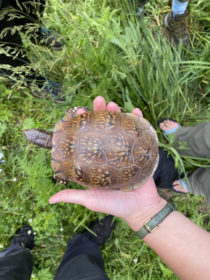
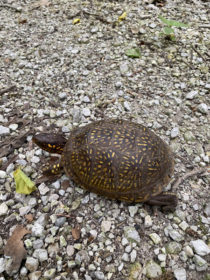
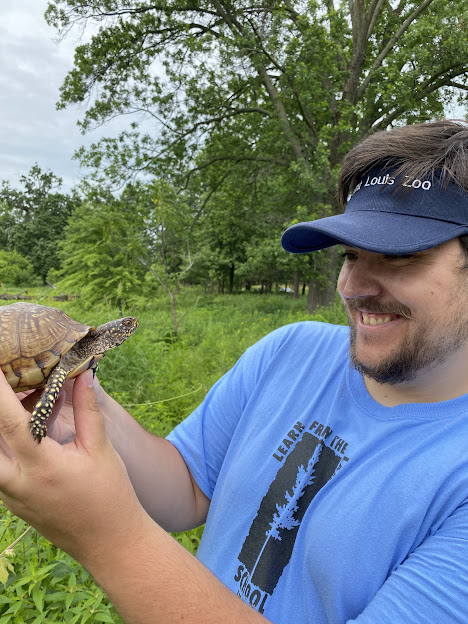
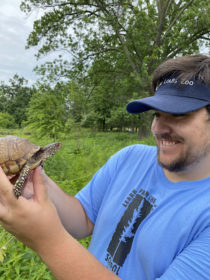
It was almost lunchtime, and we were about to head back to the ICM office when Carly, one of the other interns, spotted a three-toed box turtle near the edge of the sidewalk. We completed a full workup of the turtle, who was determined to be a female we had not met before. Her outgoing personality and the presence of pyramiding on her shell (caused by malnutrition as she was growing) make it likely that she was someone’s pet that they had released in the park. We notched her shell with a unique pattern so that we would know her when we met her again and attached a tracker onto the shell. We decided to name her Stella after intern Bri’s daughter. With her tag fitted, a new star was born, and Stella was ready to get to work as an ambassador of her species.
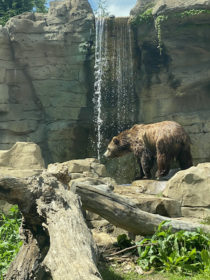
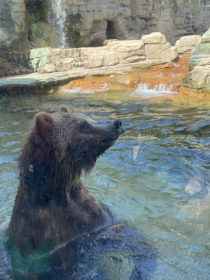
Along with tracking animals, I again spent some time walking around the zoo. My favorite pictures this week were of the zoo’s grizzly bears, Huckleberry and Finely. The bears are siblings originally from Montana. Unfortunately the bears learned to associate people with food and had to be removed from the wild. Their story is an excellent learning opportunity in the importance of keeping wildlife wild. Simple actions like taking trash and birdfeeders in at night and not leaving out dog food can help bears and other wildlife stay out of trouble. Even if you don’t have bears in your backyard you can always take steps to be mindful of wildlife and help them thrive.

Nate is a biochemistry and molecular biology major from Colorado Springs, Colorado.