
Week 4:
Voice and Translation
February 3, 2016
It seems very strange to realize that I now have only this week and one more left of my internship/fellowship here at the Labor Center. I have been fortunate enough to learn more than I ever could have anticipated about not only Spanish, but also something of labor history, the real people behind immigration stories, and even a better awareness of the interview and documentation process of history.
Over the past week, I have been focused on finishing transcription and beginning translation of my first interview. Once this is completed, I will move on to a second interview to get as far as possible before my time here ends. Fortunately, I have finally found a process which works for me; transcription can be painstakingly slow and monotonous if not handled appropriately.
Early on, I tried to catch every word on the first go through, replaying the same five-second clip maybe ten or more times at different speeds to make sure I could identify the word. This granted a feeling of satisfaction at the completeness of the line of phrase, but it also meant that hours could pass with what felt like almost no progress. I was warned going in that for transcription of an English interview, 10-14 hours for every one hour of audio is fairly common, but until I really dived into the work that seemed incredible to me.
Now, I know better. Between slowing down the speed so that I stand a chance of typing along with the words, then speeding it up so the words actually sound like words rather than over-elongated syllables, then replaying for accuracy…well, I scarcely need to say I have an incredible amount of respect for those in all fields who do this kind of work on a daily basis for a living.
I eventually wised up and recognized that I was only frustrating myself with my old method. For me at least, it is far better to slow the speed, type as much as I can as fast as possible, mark the times with brackets when I get behind the audio or can’t understand a word, and then go back through all of it later to fill in the gaps. This way, I am not bored or frustrated and can more readily maintain focus. Pages fly by much faster now and there is measurable progress.
On the translation side of things, I have not quite worked out all the quandaries I anticipated last week and have the dubious pleasure of having encountered even more. The process is much like I have been through in class translations before; first, do a word-by-word translation, carefully checking for false cognates and potential alternate meanings, then go back and smooth out the edges for coherency’s sake. It is not terribly complex, but the actual process of smoothing out the edges is a difficult one as it is in our “edges” that we have voice.
Put another way, when we speak we have a tendency to shift tenses, sometimes use them incorrectly, change our mind halfway through a sentence what we are saying so that subject and very no longer agree (or in the case of Spanish, maybe the beginning of the sentence references multiple nouns, but by the time the adjective is listed and would be plural, the mind has shifted to thinking of just one of those and so is now singular), or borrow from other slang, dialects, accents, or outright languages. If all those edges are smoothed, the end result is easy to read and understand and maintains the same meanings as the original, but the voice is from someone else entirely, if indeed it does not come across as overly formal or mechanical.
So, aside from technical issues such as emphasis and so on, I have to determine how important it is to maintain voice and how important it is to provide coherency. In Spanish it might be easy to follow the flow of conversation despite changes in tense, concordance, and word choice, but the English can look very choppy and has a tendency to leave an impression of someone less educated or simply scatter-brained. On the other hand, it isn’t much better to take the Spanish speech of someone with the equivalent of a Southern rural accent and try and convert that to “proper” English grammar. I’m still working to find a balance which does justice to both sides of the equation, but in the meantime I am simply going through to compose a “literal” translation (and don’t get me started on what the word “literal” really means; it is a bane to translators everywhere).
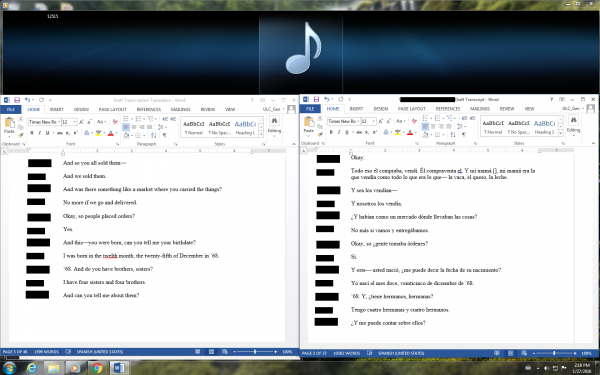
In a related issue, I have been having a blast encountering Spanglish for the first real time (and I am actually serious when I say that). While the particular interview I have been working with features almost entirely Spanish, word choices such as the verb “lunchar” rather than “almorzar,” borrowing English vocabulary such as “break” and “turkey plant” rather than saying, “descanso” or “planta de pavos” or something similar, and mixing interjections between those in Spanish and English makes for a very interesting listening and reading experience.
While I am thankful for the base of traditional Spanish I learned and am still learning, the more Spanglish I encounter the more I wish it was discussed and perhaps even studied to a degree in classes; it is more or less a language in and of itself, and one that is very prevalent in the States. Of course, it would be difficult as even within a region the way Spanglish is used varies greatly (person-to-person, if I’m to be completely honest), far less when considering the difference between Miami Spanglish versus Brownsville Spanglish versus San Franciscan Spanglish; each is heavily influenced by the different Spanish-speaking countries feeding into the language as well as local English variances.
At one point, I found myself considering the impact that the large Guatemalan Spanish population had on the local Spanish in Postville; “my” interviewee is from Mexico, but she was one of very few Spanish speakers from Mexico at least for the first several years, meaning when she spoke to those around her she was hearing mostly Guatemalan Spanish, which in turn was being influenced by Midwestern English. In a day and age when people are traveling more than ever, I would venture to say all languages are changing faster than we realize and in ways we can scarcely imagine.
On that note, I think I will wrap things up; I started by mentioning all the different subject areas I have been fortunate enough to encounter and learn something of during this internship, and now I have linguistics to add to the list.
With any luck, by next week I will have completely finished the first interview and have spontaneously developed the inner wisdom to flawlessly translate it with style (though I’m not going to count on that; it seems more likely I will wake up in the middle of the night worrying over whether I should have used this word or that word). I should have also begun the second interview, which should go a great deal faster now that I have a system developed and was actually present to hear the interview when it was first recorded.
Elizabeth Flick is an English and creative writing major from Paris, Texas.