
Week 5:
Ending and beginning anew
February 11, 2016
With five weeks gone, I have finally finished the first interview. Well, at least mostly finished. I still intend to go back and review everything, as it feels rough and choppy in places (of the transcription and the translation). Furthermore, I would challenge anyone to declare a translation with any degree of creativity ever complete.
Stylistically, I think I played it a bit safe in the end. I generally translated word for word first, then read it through and changed syntax where needed, before finally reading it to determine if it just “sounded weird” in the English, at which points I would reword it. Otherwise, I left the words as true to the original as possible. When colloquialisms were found, I used English versions of them as much as possible and where not, I defaulted to the intended meaning, even if a bit less colorful.
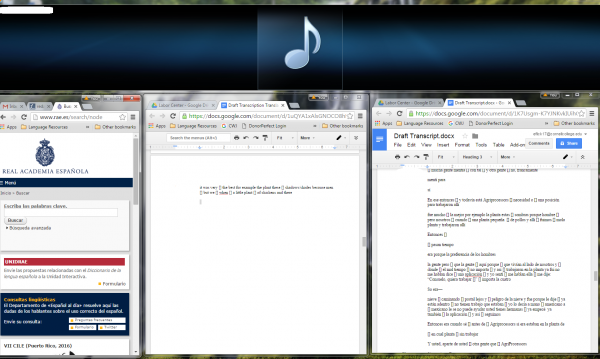
I’ve also managed to find a number of good websites which cater to Latin American Spanish and different vocabularies, colloquialisms, and so which are specific to given countries; they’ve been immensely helpful in identifying “non-correct” or at least nonstandard Spanish which is not necessarily readily available through more academic dictionary sites. Interestingly, many of these appear to be fairly new websites which are still adding new words and phrases, often by site visitors. One day when I have time I think it could be fascinating to track down how the perception of non-Castilian (non-Spain Spanish or classroom Spanish) has changed over time; at first glance I would guess that many countries have probably been developing a greater sense of pride in their differences recently, but that could just be my own speculation.
So, at this point I am mostly refining what I have and moving on to the next interview. There is a time index to be made, after which I will begin on the interview transcription itself. It is unlikely I will finish, of course, but I’ve actually spoken to Jen Sherer, the director here, and John McKerley, the lead historian/interviewer on the project, about continuing to work with ILHOP after the end of my fellowship. The experience I am gaining is invaluable, and while the work can be monotonous it is mostly just time-consuming. Should this actually be the case, I will be able to continue with this second interview and help with any future interviews that may come up as well.
I fell like this week’s post is far too short, but there really is not much new to say. For now, I am simply continuing previous work and preparing to begin new work; it should be interesting to see just how far I manage to get before the end of next week.
Elizabeth Flick is an English and creative writing major from Paris, Texas.